Advertisiment

Showing posts with label Wales. Show all posts

GWTTA: Aberaeron

ADSENSE HERE

I first came up with the Great Welsh Tea Towel Adventure a few years ago. The idea was pretty simple: using the map on a touristy dish cloth (aka "tea towel"), I would visit some 66 different villages, towns and cities in Wales, as well as Snowdonia National Park.

The reason for this was twofold:

Firstly, it's an excuse to ride my motorcycle. Wales is a tiny country and just about any location within its borders can be reached and returned to from any other location within the space of a day. Wales has a number of exceptionally good roads for riding and if –– like me –– you live here, the proximity of everything to everything else means you can pretend you're on a fancy, exotic road trip without having to fork out for hotels.

The tea towel
The second reason was that I had developed a deep, unabiding hatred of Wales, and I found this to be somewhat detrimental to my overall wellbeing. I had come to Cardiff in 2006 full of incredulous belief I was moving to my spiritual home, that this would be my place of acceptance, my milltir sgwâr of belonging. But it turns out I was wrong.

In particular, I was wrong about the ever-dwindling community of speakers of Wales' native language. They are isolationist, exclusionary, and welcoming only in the sense that a really good B&B is welcoming. You may feel very cosy and happy and special in a B&B but there is always a clear you-and-them relationship. No matter how long you stay, how frequently you return, you will never be welcomed into the B&B owner's family; you will never become one of them; the B&B will never be your home.

That lesson was learned via a series of personal disasters that created in me a deep, festering bitterness toward Wales and everything in it. Which, as I say, was problematic. First and foremost because I was angry all the time. All I needed do to enrage myself was open my eyes and look at my surroundings. Was I in Wales? Yes? Cue rage. 

That was a silly way to be. Especially in light of the fact I had no solid plans to leave. Convenience and circumstance keep me here: free health care, the fact my wife and I own our home, the fact my wife (an Englishwoman) generally likes Wales, the fact her best friend lives roughly 45 seconds away, and other little things. I want to leave at some point, and have made my wife promise on numerous occasions that she will not bury me in Wales should I meet an untimely end, but leaving right now creates a stack of financial and personal burdens that, ostensibly, may not be worth shouldering for the simple joy of being able to skedaddle.

It took me a long time to come to terms with the Not Going To Leave Soon reality of my situation (I still haven't completely accepted it) but I realized that if I was going to survive here without developing stomach ulcers, I was going to have to find a way to accept Wales for what it is, rather than what it isn't.

The daffodil is the national symbol of Wales.

And what Wales is, generally, is a pretty-but-wet place populated by mostly nice people who will never show you true love. Which means that, of all the places you could end up, it's not actually that bad. I implemented the Great Welsh Tea Towel Adventure as a means of reminding myself of that.

But, as I say, that was a few years ago. The idea ran out of steam after a handful of trips and I soon found myself using my motorcycle more as a means of escaping Wales rather than improving my opinion of it. I was working a full-time job and I didn't want to waste those rare moments when good weather intersects with a weekend trying to change my opinion about a place.

Then, late last year, circumstance pushed me into the life of a freelance journalist. With my schedule now more flexible, I decided it would be a good idea to restart the GWTTA project. After all, the financial instability inherent in freelancing roots me even more firmly in Wales; no new home loans for me. And in restarting the project, I decided to go about things in a more systematic way: choosing to visit places alphabetically.

So, Aberaeron –– a small town on Wales' west coast –– was placed at the top of the list. Where it stayed for the next three months, thanks to one of the facets of Wales that causes me the most displeasure: weather. For three months not one day passed in which rain was not forecast for Aberaeron. Sometimes it was an all-day light rain, sometimes it was a heavy rain with gales, sometimes it was drizzle with freezing fog, but always there was rain.

Finally, just a day or so before my 40th birthday, my phone's weather app showed an open window. So, I threw my camera in my pocket, hopped on the bike, and pushed northwest.


Aberaeron is some 95 miles from Penarth via the "slower," more interesting route that I chose. Google Maps would have had me get there by a long stretch of motorway, running from Cardiff to Carmarthen on the M4, then trundling up the A485 and A487. But it's generally my experience that you can get somewhere in Wales more quickly if you avoid main routes, i.e., the routes suggested by mapping programs and GPS devices.

Partially this is because you'll be avoiding the route that everyone else is taking and partially this is because main routes tend to be the ones littered with speed cameras. I can too quickly start to sound like a libertarian wingnut in expressing the frustration and concern I feel toward speed cameras, but suffice to say I think they're a terrible idea.

Fortunately, Big Brother's reach isn't as vast in Wales' interior as other parts of Britain. And the fact that local authorities have abandoned actual policing in favor of stationary yellow boxes on main routes means that the odds of your getting in trouble for riding 110 mph on a 60-mph road are shockingly low.

My route took me first across an eastern section of Brecon Beacons National Park, where sheep served as the only witness to my Suzuki's high-rpm snarling. Twisting routes like the A4069, A4059 and A4067 provide scenic riding that –– in certain sections –– is on par with roads I've encountered in Italy. Sight lines are good across the moorlands, meaning you can see all the way through curves, and road quality is generally better than you'd expect for tarmac so exposed to the elements. Sheep poop and gravel are omnipresent, and overnight ice can sometimes linger into the afternoon, but sane riders can still enjoy spirited biking.


Further east, I hopped onto the A482, which winds its way through slightly more forested terrain all the way to Aberaeron. Technically the speed limit on large sections of this road is a bafflingly slow 50 mph, but, as I say, there is no enforcement. I made good time.

I don't know why my tea towel draws particular attention to Aberaeron. As far as I can tell it isn't noteworthy. It doesn't get a single mention in John Davies' A History of Wales, which, at 718 pages, contains exceedingly more information about Wales than anyone ever need know. 

More than 800 years ago, Aberaeron was home to a fortress known as Castell Cadwgan, named after one of the myriad squabbling warrior kings that fought over Wales until Edward I succeeded in conquering the region in 1283. 

There are no signs of the fortress now, and it was all but gone to the sea when the town was set up as a shipping port in the 1800s. For a very short while it supported the shipbuilding industry but by the start of the first World War it had generally turned its hand to the task of attracting tourists.

To that end it is a lovely place to visit on a sunny day. Aberaeron is located in the Welsh county of Ceredigion but it feels more Pembrokeshire to me. The latter county has been known since Tudor times as "Little England Beyond Wales" thanks to the fact it was the area of Wales most successfully held by the Normans in the 12th century, and roughly 1,000 years later it possesses a certain Englishness.

How you interpret that depends on your view of Englishness. To me it is good. Aberaeron is colorful and it has a handful of little shops, boutique restaurants and charming pubs. It is immediately likeable; it is the sort of place one might choose to take his parents were they to travel several thousand miles from another country. 
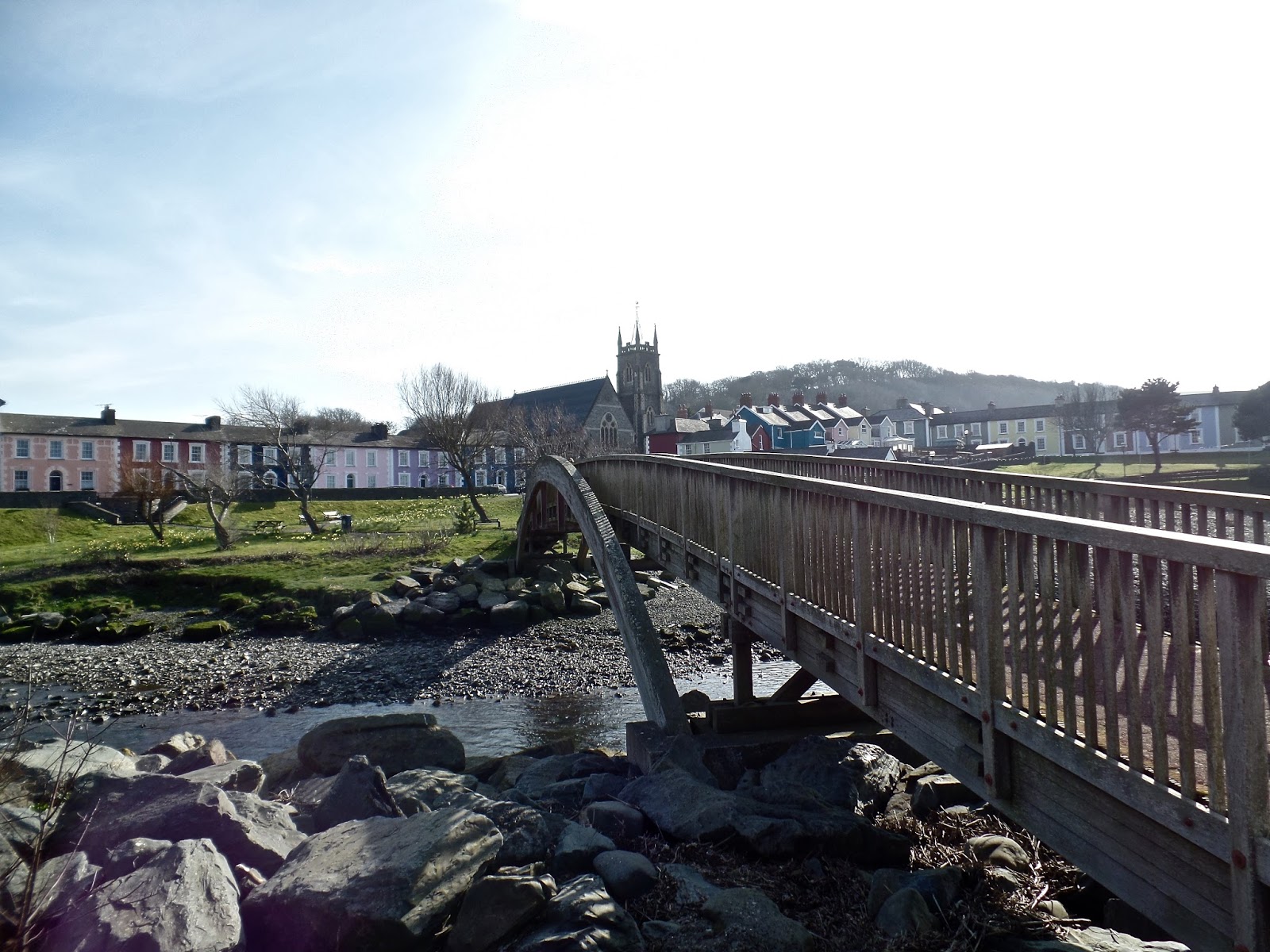

In contrast to its perceived Englishness, according to the ever-reliable Wikipedia, some 70 percent of the town's inhabitants speak Welsh. I suspect some fuzzy math there, however, because in walking around I didn't hear a single Welsh word being spoken.

Not that I cared, really. The sun was shining and it was warm enough for me to take my jacket off. I bought an ice cream and sat on a park bench overlooking the harbor and sent a text to my wife expressing my delight in having a freelancer's schedule. Far better to be doing this on a Tuesday afternoon than sitting in an office.

Aberaeron is home to the annual Cardigan Bay Seafood Festival in July, which might be worth returning for, but on a random weekday in March it was unsurprisingly quiet. Pretty, charming, but still not terribly noteworthy.

Once I had finished my ice cream I walked around town. Maybe I will come back with Jenn in the summer, I told myself. Aberaeron would be a nice place to spend the day –– eat some ice cream, go swimming in the sea. I guess it depends on how many other people have the same idea; the smallness of the town suggests it wouldn't be very enjoyable when crowded. And really, there are similar places –– in Pembrokeshire, for example –– that are easier to get to.

Either way, I suppose it was a good way to restart the GWTTA project. After walking around a little more and finding not much to pique my interest, I bundled up in my gear and sped home to Penarth. Next on the list: Aberdaron.


ADSENSE HERE

Riding Motorcycles In Britain

ADSENSE HERE

(Originally published on Motorcycle.com)

Forget the Frogs, the UK is best for motorcycling

Not too long ago Tod Rafferty wrote a piece for Motorcycle.com in which he intimated that France is the best country for motorcyclists. As a resident of the country that is France’s oldest and closest enemy, I feel I am duty-bound to inform you that, with all due respect to Tod, his assertion is codswallop.

Yes, codswallop. Tommyrot. Poppycock. Flapdoodle. I’m sorry to use such strong language. But if you’re anywhere east of the Atlantic Ocean, it’s Her Majesty’s United Kingdom of Great Britain and Northern Ireland you want to be visiting. Britain is home to civilised riding. That's civilised with a 'S,' thank you.

I’m from America, but have lived in the UK –– in Wales, specifically –– for roughly a decade. I often pine for Minnesota thunderstorms and Texas cooking, but one thing that keeps me from going back home is knowing how much I’ll miss motorcycling here.

Germany (or possibly the United States) may be able to claim to have made the first motorcycle, but the UK is the country that made motorcycling. Triumph, Norton, Vincent, Brough Superior, and dozens of other great names. The rockers (and mods), the ton-up boys, the Isle of Man TT heroes, and adventurers like Ted Simon, Elspeth Beard, and, of course, Ewan McGregor and Charlie Boorman. Eric Gardner, the man who invented the crash helmet. Geoff Duke, the first man to wear a one-piece leather racing suit. Café racers and streetfighters. It all started here. 


Motorcycling runs in British blood. It is a part of the people’s history, a part of their present, and, as roads grow ever more congested, very much a part of their future. Just last month, MO reported sales of commuter-sized bikes are at an all-time high in the UK. That’s not surprising. I’ve driven in Houston, Los Angeles, Boston and Manhattan, and I assure you: no American has seen traffic congestion of the sort experienced in London or Manchester. Motorcycles are allowed to filter (a.k.a., lane split) in the UK, which means they are generally the best way to ensure you’ll show up on time.

Additionally, a motorcycle-friendly culture means toll roads are often free or discounted. In most cities, motorcyclists are allowed to use bus lanes. Parking lots and parking garages usually have allocated free spaces for motorcycles, and many offer locks and helmet storage.

Police enforcement of speed limits is rare, and on the occasion officers do post themselves roadside they take a relaxed view, disinclined to stop anyone going less than 30 mph over the limit. By and large, though, authorities leave speed enforcement to our machine overlords. Around cities, radar cameras are the scourge of British motorways (a.k.a. “freeways”), but the good news is: those cameras are almost all forward-facing. A motorcycle has no forward plate.

Meanwhile, the good ol’ British punk spirit means many cameras will be damaged –– lenses smashed or spraypainted –– by locals who hate them more than you. Especially in parts of Scotland and Wales where nationalists see rules as a form of English oppression.

Outside of urban areas, roads are generally free flowing. Off the beaten path, Britain’s narrow B roads and country lanes make it seem as if it was built for motorcyclists. In truth, it was built for horses and carts by Roman soldiers; it’s simply that no one since has put in effort to widen the roads. In my wife’s native Devon, roads leading to her father’s house are so narrow that hedgerows scrape both sides of a car.


It’s a situation that plays to a motorcycle’s size, allowing you to explore nooks and crannies that are effectively inaccessible to cars. Well, assuming your motorcycle is set up with good suspension. There’s a reason the BMW R1200GS (including the GSA) is the best-selling big bike in Britain. Followed closely by the Yamaha FJ-09 (known as the MT-09 Tracer over here). The country’s best-selling Suzuki (V-Strom 1000) and Triumph (Tiger 800) are also adventure-styled.

That’s not to say all the roads are awful. Routes known as “A roads” are generally in good condition and offer plenty of opportunity for engaging and spirited riding. FYI, “spirited” is British motorcycling code for “in excess of the speed limit.” Especially in Scotland in Wales.

One of the real advantages of British geography is the fact this place is so small. Run top to bottom (John o’ Groats to Land’s End) in less than a day and you’ll still need to ride a quarter of the way back to earn an Iron Butt badge. So, everything is close. Long, boring, tire-squaring rides on the interstate aren’t necessary for great riding.

Okay, it’s true what they say about the weather. It rains. If you’re one of those people who refuses to ride in the wet, you should probably stay in Arizona. The good news is that, except in winter, it doesn’t tend to rain very heavily or for very long. Besides, wearing waterproof gear isn’t uncomfortable because temperatures rarely exceed 75º F. Every few years we’ll get a day in July that hits 90º F and they treat it with the same sense of alarm and confusion as Houstonians do snow: cancelling school, closing offices, panic-buying things from grocery stores, etc.

In the case of Britons, though, the thing they’re buying is booze. This speaks to an aspect of Britain that helps one overcome the wet weather, an aspect that makes this such a great country to ride in: British people. Quirky, irreverent, foul-mouthed and quick-witted, they are a people who know how to have fun. British motorcyclists in particular.


Moto-journalism legend John Burns has written a few times about the feeling of asking oneself: “Why doesn’t somebody take this thing away from me?” The feeling that we motorcyclists are somehow pulling off a great trick on the universe, that we’re getting away with something: “Whee! Somebody’s slapped some wheels on this metal box of explosions and I’m going to sit on it! Ha-ha!”

That spirit is strong in British riders. They are mischievous and silly, and happy in their silliness. We Americans often feel need to make what we do seem more important than it is; we don’t just go on a group ride, we Ride in Support of America’s Warrior Heroes. You don’t tend to see that sort of thing here. Britons possess a sense of adventure that they don’t seek to justify or rationalize. After all, it was a Brit, George Mallory, who said he wanted to climb Mount Everest simply “because it’s there.”

I can give you plenty of reasons to come to Britain. Americans are generally well-liked. Everyone speaks English (though, the Welsh appreciate when you use the greeting: “S’mae”). Drivers are better than those found in California, Italy or Spain. You can’t drop a bike without hitting some historical something or other. The food is far better than some would lead you to believe, especially if you like pork. And the quality of the ale will help you not care either way.

But the real reason, of course, is simply that it’s here. It’s odd and it’s beautiful, but most importantly –– and they’ve fought wars to prove this –– it’s better than France.
ADSENSE HERE

Scooter Bob and I go to Aberystwyth

ADSENSE HERE
Recently I've had the privilege of hosting Scooter Bob, who you can read about here. We went on two little adventures together before he carried on with his world travelling. Here's the first of those:


Hey, Chris, I've been thinking...

Yeah, Scooter Bob? What about?

Well, you know, I don't want to sound ungrateful... I mean, I appreciate your letting me stay at your place for so long and keeping the fridge stocked in beer and everything... but, well, since I'm a wooden scooter I don't really drink beer. Or anything else for that matter. And I'm not really a homebody, either. I'm a travelling sort, Chris, and I'd really like to do something.

Like what, SB?

Like go somewhere. We're here in Wales, aren't there any interesting places to go?

Sure. Loads. Arguably, Wales is home to the best motorcycling roads south of Hadrian's Wall.

OK, that sounds like my sort of thing. Let's explore some of those roads!

Good idea, SB. We'll head up to Aberystwyth, about 100 miles north and west of Cardiff. Hop on the back of my V-Strom. The road to Aberystwyth takes us first through the post-industrial towns that line the Welsh Valleys. Coal, steel and all other sorts of useful things used to pour from these valleys. To a certain extent, it could be said that the Industrial Revolution started here. Certainly it could be claimed that the labour movement got its start in Wales. Legend says that the reason socialists choose to be represented by the color red comes from a blood-soaked flag that was waved during a workers' riot in Merthyr Tydfil many centuries ago.

Wow. Interesting! Why aren't we stopping to take any pictures?

Because it's depressing. There are many warm-hearted people in the Valleys, but I honestly can't understand why they stay here. I'd rather be dead than wake up every morning to find myself "living" in some of these Valleys towns.

That's pretty extreme. Ooh, where are we now?


This is Brecon Beacons National Park, one of Wales' three national parks. Not too long ago it was awarded Dark Sky status, which means it's a place to try to escape the light pollution that blights so much of the UK. Even out of the park, though, Mid and West Wales offer good stargazing. My wife and I were up here for my birthday back in March. The temperature fell below freezing but I stayed out, staring into the night sky, until I couldn't feel my toes.

The roads that curve and roll over these hills are pretty fun.

They are. Well, they are when the sun is shining, at least. Unfortunately, that doesn't happen nearly enough.

I have roots in Vancouver. Don't talk to me about rain! So tell me about Aber... uhm... What was it called?

Aberystwyth. The name means "Mouth of the River Ystwyth." Its claim to fame is that it was a popular seaside town during the Victorian age. When the weather's good it'll still draw a decent number of day visitors. As you'll see when we get there. But in modern times it has also transformed itself into being the cultural capital of the Welsh language. The bulk of Welsh-language artists and writers and such went to university here. To the extent that it's sort of a cliché.

Didn't you get a degree in Welsh, Chris?

I did. Two of them –– a bachelors and a masters. But I went to Cardiff University. I figured a big city and a big university would offer more chances to fit in. I was wrong. I didn't know at the time how much of Welsh culture is centered in Aberystwyth. I often wonder how things could have gone for me. Anyway, look, here we are. The town lets motorcycles park for free, right on the promenade.


Ha! Wow! This is so cool. There are some pretty nice bikes here. 

Yeah, it's definitely THE thing. Riders from all over the place like to make a trip here, then they'll make their way back to wherever they started by following the roads that hug the coast. It's a pretty nice way to spend a Saturday. Or you can just lounge around and talk to people about their bikes; all the riders are friendly. And because many are Welsh they will never run out of things to say.

What are all these different flags along the promenade?

Well, those are the flags of various nations that are seeking independence or, at least, some form of greater recognition from their governments. There's Brittany's flag, the Catalan flag...

The Quebec flag...

Yup. There's a fair amount of separatist sentiment here. As I say, Aberystwyth is the capital of Welsh culture and a lot of people within that culture are, or at least purport to be, in favour of leaving the United Kingdom. Further along the seafront you'll see a mural dedicated to Owain Glyndwr, who rebelled against the English crown in the 1400s. 

And what does this say?


"I ble gei di dy gludo pan fo'r haul yn suddo?" The fact that it rhymes should clue you into the fact it's a verse from a poem –– I don't know which one –– and as such, translating it is somewhat tricky because of the issue of interpretation. Roughly, I'd say it means: "Whence shall you be carried when the sun sets?"

What does that mean?

No clue. It's poetry, SB. You can interpret it to mean whatever you want it to. Welsh-language culture is stupid for poetry. They even have their own wholly unique form of it, known as cynghanedd, which manages to turn poetry into some kind of mathematical equation. I can't stand it. 


You certainly have a lot of negative things to say about Wales.

Yeah, I guess I'm pretty jaded. A lot of bad things have happened since I moved here and I guess I can't really let go of how angry and hurt I am about them.

Bad things. Like meeting your wife, Jenn?

No. That was a good thing, obviously.


Oh, so you must mean something bad like getting your motorcycle license?

Well, no, but...

Or maybe it's the free healthcare that upsets you about Wales? Or those incredible roads we took to get here? Or those dark skies you mentioned? Or this seafront? Or those mountains I can see in the distance?

OK. I get your point, SB. Want to hit the road? We can take a different route back to Cardiff.


I hate to go. It's so pretty here. The sea looks so nice. I'll bet it would have been a lot of fun to attend university here.

Maybe. Maybe. It's pretty isolated from the rest of the world; that might get lonely. But, see these houses along the seafront? A lot of that is student accommodation. Imagine being a student with that view.

Wow.

Indeed. OK, let's get rolling. If there's enough time we can stop for chocolates at a place I know in Llandeilo.

Sounds good. Hey, what's that by the roadside?


Ah, this is the "Cofiwch Dryweryn" wall. In Welsh that means "Remember Tryweryn." It's something of a rallying cry for the separatist movement. Tryweryn was a little village that the government cleared in the 1960s, then flooded the surrounding valley to create a reservoir for water to serve Liverpool. Needless to say, flooding a Welsh village to provide water for English people fuelled the separatist fire. The wall itself has earned its own kind of iconic status. Activists make sure it's repainted regularly.

You live in a place with so much beauty and unique history, Chris. You're very lucky. You really need to remember that, rather than holding onto whatever negative experiences might have happened here. 

I'm trying, Scooter Bob. I'm trying. Now hold on tight, this next section of road is pretty curvy...
ADSENSE HERE

GWTTA: Porthcawl

ADSENSE HERE

It's 9 a.m. and I am riding down the main road of Porthcawl on a sunny, crisp winter morning. Already, there are people walking the promenade. Outside the beachfront cafe, old ladies in decades-old winter jackets hawkishly stake out places to sit while their husbands stand in queue for milky tea and dry cakes. And in this I find myself strangely reminded of another town, some 6,000 miles away: Julian, California.

Not because Porthcawl and Julian are in any way alike. Julian is nestled in the Laguna Mountains of Southern California, whereas Porthcawl sits on the southern Welsh coast. Julian maintains a classic Americana small town feel, with a number of wooden buildings dating back to the 1860s. Porthcawl is worn and piecemeal, its architecture reflecting decades of failed attempts to make it into something more than it will ever be.

The similarity comes simply in the fact that, in both cases, just about every person from the surrounding area insists you should go there. And when you get there you are suddenly confronted with the inherent flaw in crowdsourcing for advice. Because, see, if just about every person you meet tells you that you should visit this or that town, the odds are extremely high they've told other people the same thing.

Julian and Porthcawl are sold to newcomers and visitors alike as quaint and charming. And conceivably they could be were it not for the fact that everyone and their uncle –– and their uncle's uncle –– has come in search of that quaintness and charm. So, your main impression is instead of a place so overcrowded that every fibre in your being aches to get away from it. Its beauty is all but lost to the fact you are trying not to get run over by confused drivers as they dart for parking spaces. You are trying not to run over their children as they leap from cars into the road. You are trying not to kill their grandparents, who have apparently reached the age where they no longer know how to cross a road.

Pictures you take of the town will include all of these people, no matter how hard you try to frame them out of shot. If you stand still long enough, these people will literally walk into you. Because the bustle is all just a little too much for them, as well, and they've lost basic spatial awareness. 

Porthcawl seafront. The businesses on this end were shut, so it was less busy.

I have of late been trying to follow the riding advice of Gary France: "I like to ride my favourite roads very early in the morning, while others wanting to ride it are still in bed."

I suppose 9 a.m. isn't "very early", but in the dead of winter it feels early enough. The sun has only been up for an hour at this point, and I have spent that last hour meandering my way across the Vale of Glamorgan from my own seaside town, Penarth, which is about 25 miles east along the coast.

The VOG is a damned lovely place to ride if you time it right. The A48 stretches the width of its 129 square miles, but even that is relatively relaxed thanks to the fact it runs parallel to the presumed-to-be-faster M4. Almost all other routes in the borough are B road and country lane, most of it relatively well-maintained and affording the sort of broad sightlines on corners that I prefer.

Its close proximity to the major urban centres of South Wales means you can encounter a fair few impatient and inattentive drivers during commuting times. But on a winter Sunday morning all is calm. The fields are so heavily covered in frost it looks like snow. Here and there, patches of black ice glisten in the unusually bright sun.

I have arrived at Porthcawl via an indirect and gentle route. After all, slow = warm. With my heated grips cranked to 100 percent I am able to keep feeling in my hands.

The approach to the Porthcawl seafront is an unspectacular series of roundabouts and poorly labelled roads that leave you feeling as though you've accidentally turned yourself in a full circle, but I keep following signs to the beach and eventually know I'm on the right track when I pass the sign famously warning drivers to keep an eye out for individuals riding giant ducks.

Caution: People riding ducks

That the seafront is crowded causes me to suffer a classic Chris moment of crippling indecision. Assuming the streets and pavements would be empty at this time of day, I had planned to ride my bike onto the promenade and take artsy photos. Or, well, as artsy as one can achieve with a Nexus 4 (Jenn has promised to get me a real camera for my birthday). But with the pedestrian walkway buzzing, and the winter chill forcing an aggressive determination into people's gait, it seems quite possible that riding my bike onto the pavement now would result in my knocking someone down or, at the very least, getting a stern talking to.

Especially if I park up anywhere near the beachside cafe. The people sat outside it wear a look of belligerence that suggests they could not be moved even with artillery fire. I am reminded of an observation my friend, Chris Phin, once made of efforts by residents of Edinburgh to mimic a hip, Southern Europe lifestyle despite the realities of the Scottish climate: "They're all sitting at these outdoor cafes, turning blue, with a look on their faces that's like: 'I will sip this fucking latte and smoke these fucking designer cigarettes if it fucking kills me.'"

The cafes in Porthcawl are not hip, nor their clientèle, but the spirit is the same. They are trying to imagine themselves as being somewhere else. Like almost all British seaside towns, Porthcawl has at least two abandoned hotels and a crumbling concert venue advertising a DJ Spoony gig from about 5 years ago. 

It is the cycle of British seaside towns that the country will get two good summers in a row, so some have-a-go investor will set up a cheaper, half-assed version of a thing he saw while on holiday in Spain, telling himself: "This'll really pack 'em in." Then the reality of British non-summer will return for several seasons; the business will decay, flounder and shut. The cycle repeats every 7-10 years.

It's hard to tell where Porthcawl is in its cycle. Enough people come from the nearby area to keep the cafes busy on sunny days, but no one stays overnight. Well, usually, no one does.

The town's main claim to fame is that it is home to an annual Elvis Festival, which sees literally thousands of Elvis impersonators and tribute acts pour into the town for a few days each September. I've found no particularly good explanation as to why this happens: why it got started, why an Elvis Festival takes place in Porthcawl. If you ask locals, it's clear they've given it no thought: "I don't know, to be honest. He had some sort of Welsh connection, didn't he? A grandmother or an aunt, like."

This hardly seems like a viable reason to me, but then, local newspapers regularly report anything and everything about Australian pop star Kylie Minogue because her mother was from Maesteg.

Like almost every place along the South Wales coast that isn't a cliff, Porthcawl once served as a coal port during the Industrial Revolution. There are thankfully little signs of that today. Indeed, there is little sign of anything that would employ a person outside of the day-tourist trade. To that end, the bulk of Porthcawl's residents are retirees or commuters.

Just to the north (or west, depending on how you think about it) of the town's main seafront area lies Rest Bay, which is apparently renown among local surfers. I know this because there are always surfers there, regardless of conditions -- which are frequently atrocious. I suspect surfing in Wales is something akin to religious self-flagellation: the serenity of it comes through pain.

Looking over Rest Bay. I had to crop several people out of this photo.

I park my bike overlooking the beach. On a rare warm and sunny summer day, it would be crowded with literally thousands of people. Today, just a few hearty souls wander the coastline, throwing balls to their dogs or kicking at stones. In the water, a handful of fully wet-suited learning surfers try and fail to stay upright against the cutting winter winds.

From here I can see clearly across the Bristol Channel to the Exmoor coast of Somerset and Devon. Each time I'm afforded a view like this I am reminded of a story Jenn told me once of her mother, from the days when Jenn was attending Cardiff University. When her parents would drive up from Devon to visit, her mother would phone as soon as the road afforded them a view of the coast.

"I can see you," she'd say. "I can see Wales."

With U.S. shores so impossibly out of view, I have partially adopted Jenn's home county as my own. From here I can see Devon and I feel vaguely homesick. In a content sort of way. In Wales, they call this feeling "hiraeth."

I am still wearing my helmet because it helps keep my head warm, but it is only after I stomp some 150 metres across a field to a public restroom and stand there at the urinal do I realise how odd I must look. Coming out of the toilet I pull off the helmet and, out of habit, my gloves. By the time I get back to my bike, my fingers and ears are stinging with cold.

I fire up the bike, turn the heated grips to 100 percent and slip my gloves over them for heat. Then I crouch down to hide from the wind and and place my bare hands on the crankcase. Honda efficiency and winter cold mean it is only warm.

The bike, I see from this close vantage point, is filthy. Salt and sand and manure from the road is caked on the bike's exhaust pipes. I decide that I need to get home and spend my afternoon cleaning off the crap picked up in the morning's ride. But first I will spend another hour or two drifting through the VOG's lanes.

I loop back through the seafront area as I leave Porthcawl. I stop at a crosswalk to allow an a middle-aged woman to cross the road. When she is directly in front of me, she pushes back her windblown hair and says: "Lovely day for it."

Then I am off and moving away from the place that everyone will tell you to go to.

Winter muck


____________

This visit to Porthcawl was part of the Great Welsh Tea Towel Adventure, my attempt to fall in love with Wales again through visiting some 66 places listed on a tea-towel-based map.

ADSENSE HERE

GWTTA: Kidwelly (Cydweli)

ADSENSE HERE

Before I came to Kidwelly the only thing I knew about it was that it's the home town of Ray Gravell. The fact this is not mentioned on Kidwelly's Wikipedia page is a travesty.

It's quite possible you've never heard of Ray Gravell, but suffice to say he was one of the Welshiest Welshman that ever Welshed. A hard-hitting rugby player who was part of the Llanelli RFC side that beat New Zealand on the Day the Pubs Ran Dry (a) –– 31 October 1972 –– he was also a nationalistic Welsh speaker who served as sword bearer for the Gorsedd y Beirdd.

Oh hell yeah, we're going down the rabbit hole on this trip, y'all.

In Wales, there is a pseudo-religious group of Welsh-language sycophants known as the Gorsedd y Beirdd. There's not a particularly good translation for the word "gorsedd" so let's just use "posse." Meanwhile, "beirdd" is equally difficult to translate –– especially in this context. But basically it is the plural of "bardd" or "bard" in English, which is a word English speakers use to describe writer types (most famously William Shakespeare) and a New York college that Steely Dan hated so much they wrote a song about it.

So, anyway, this Welsh Bard's Posse was dreamed up in the 1700s by a guy who was whacked out on opium, but now people take it really seriously. If I'm not mistaken, my two university degrees in Welsh mean that I am, by default, a member of the Gorsedd y Beirdd. But I have never bothered to get dressed up in green tablecloth and chant with the rest of them. 

Ray Gravell did, though he was given white robes because his ability to run straight into people at speed made him more important than me. He was so important they gave him the super-mega special job of carrying around the Cleddyf Mawr. Literally translated as "The Big Sword," the Cleddyf Mawr is a 7-foot sword that its keeper holds over his head during the opening of the Gorsedd's biggest annual event: Eisteddfod.

So, yeah, that's what Gravell did. He also got drunk on television, commented on rugby matches, sold cars, and cried any time someone played "Yma o Hyd." He died in 2007 but Welsh separatists still wear T-shirts with his face on them.

Viewing Kidwelly from a window in Kidwelly Castle
Meanwhile, his car business thrives to this day, and if a person in Wales drives a Renault purchased at Gravells (replete with Gravells bumper sticker in rear window) it is effectively the same as flying a 70-foot banner banner that says: "I AM WELSH AND I AM REALLY, REALLY PROUD OF IT."

And he was from Kidwelly. He mentioned this fact at any and every opportunity. Like Kathie Lee needs Regis, like Kanye needs Jesus –– that's how our Grav felt toward Kidwelly. That the town fails to capitalise on that deep love is, as I say, a travesty.

According to the (n)ever-reliable Google Maps, Kidwelly is just 1 hour and 23 minutes from Penarth, but I chose to get here avoiding the motorway. Such a move was, admittedly, questionable. Not only did it more than double my journey time it also resulted in my having to roll slowly through a slough of undesirable Welsh valleys towns. Places with names that sound like Victorian diseases: Pyle, Margam, Baglan, Skewen.

Oh, aye, poor Tommy were working the coal pits only a fortnight afore he come down with the Margam –– he were dead within two days after that.

South Wales is the land of the bedsheet birthday wishes. At roundabouts and strapped precariously to railway bridges you'll see grandma's unwanted linen adorned with proclamation of landmark birthdays ("HAPPY 30TH GEMMA!"). This sort of thing is exemplary of how uncouth people of the South Wales Valleys can sometimes be. They think it's a good idea to make signs out of bedsheets. They think that a person would want to be celebrated in such a way; no doubt they hope to be celebrated in the same way themselves.

And because this is Wales, it is more often than not the case that these goodwill messages are illegible, the rain having caused paint to run.

Kidwelly lies on the River Gwendraeth, which stretches quickly into the Bristol Channel.
Eventually, though, I made my way past the grime and stench of these towns to the incongruence of Swansea's streets and thereafter into the best part of Wales: the west.

West Wales is the most attractive part of the country and its residents are, in my opinion, generally the most likeable. I admire the ridiculous Texan-like pride they have in their region; I enjoy the broad, growling way in which they speak Welsh; and I love their sense of humour that is at once self-effacing and unafraid. But, oh, are they annoying drivers.

In West Wales there seems to be just one speed: 40 mph. The people there drive too fast through towns and too slow through the country. Fortunately, with a little bit of throttle wind up, the Honda could easily launch past when gaps made themselves available. Then I was free to enjoy sweeping curved roads with good sight lines and decent surface –– until closing in on yet another crawling Renault.

Kidwelly itself is like a lot of West Wales towns in the sense that you imagine it would be lovely to live there but if you really imagine actually living there you realise you're happy that you don't. Especially if you roll into town on a Sunday in the winter; there is nothing to do. Nothing. Not a thing. These places live for the summer and its tourists.

I'm not entirely sure what the place lived for before tourists started showing up. Tin, probably. That's the story of huge swathes of Wales: the industrial revolution saw the ore and natural resources of Wales building up the rest of the world. Then the rest of the world decided it was cheaper to get their raw materials from places that didn't have labour unions, and the whole country fell into decline.

Kidwelly Castle
Before the industrial revolution, the town served as a strategically important location for numerous folks. The Normans established a castle in 1106. About 200 years later, Edward I ("Longshanks" for those of you who've watched Braveheart) fortified said castle amid his successful efforts to crush Welsh resistance. Another few centuries after that, it played a role in Owain Glyndwr's failed revolution.

I visited the castle and had the place pretty much to myself. It's in good condition, considering it is more than twice the age of my home country, and has lots of mysterious, narrow stairwells to wander through.

Many years ago, I watched an S4C documentary about Ray Gravell in which he stood atop of one of the castle's towers and started weeping because he loved Wales so much. Climbing up to that very same vantage point and looking out, I could understand how one might get emotional.

Just below your feet lie the town's higgledy-piggledy medieval lanes, then a handful of more modern houses that blight the eye, and beyond them a broad river delta that spills into the bits of the Bristol Channel as it becomes the Celtic Sea. On the whole, the view is almost cinematic.

The wind here is seemingly always fresh and clean. I gulped in deep breaths of the stuff, as if somehow able to store it in my lungs to enjoy back in Cardiff.

"Well done, God," I said aloud. "Excellent work."

I stood at the top of that tower until I started to chill and it occurred to me the sun was soon going to set. All the roads surrounding Kidwelly are hard to navigate in the dark if you're unfamiliar with them (b). I hummed a verse of "Yma o Hyd" in honour of Grav and scrambled my way back down to my bike.

I fired up the Honda and cranked my heated grips to 100 percent, then shoved my gloves over them to gather warmth as I did up my jacket, fussed endlessly with the two scarves I wear, and strapped on my helmet.

I sent a text to Jenn to let her know I was on my way, pointed the bike to the nearest motorway and flew home.
Narrow road leading to Kidwelly Castle
____________________

(a) For those of you playing along at home, this was a huge moment in Wales' cultural history –– on par with Martin Luther King's "I Have a Dream" speech, or the Berlin Wall being torn down. Rugby has long been incredibly important here, and the Wales national rugby team hasn't beaten New Zealand since 1953. The fact that a regional team managed to do it turned those players into demi-gods.

(b) Well, actually all the roads in Wales are hard to navigate at all times of day –– but outside of the cities they are even more baffling at night.
ADSENSE HERE

GWTTA: Monmouth (Trefynwy)

ADSENSE HERE

Let's call the visit to Monmouth a learning experience. 

I learned, for instance, that I should probably do a little research on the places I visit as part of the Great Welsh Tea Towel Adventure before going to them (a). Otherwise I'll arrive at said place with no idea of what might be there.

Additionally, I learned I should not attempt to explore a place when I haven't eaten. Being hungry makes me incomparably stupid and indecisive. Which, of course, isn't a good thing to be when you don't know what you're doing.

These two issues came to a head when I had the experience of also learning that the Waitrose in Monmouth doesn't have a cafe.

For those of you playing along at home, Waitrose is chain of high-end grocery stores in the United Kingdom. Often they have cafes. Or so I thought.

Monnow Bridge
I had ridden through Monmouth once or twice in the past and noted the existence of aforementioned Waitrose, so my plan had been to arrive, eat at aforementioned cafe and thereafter take a leisurely stroll through aforementioned town to see what I could see. But, as I said afore, the Monmouth Waitrose is sans cafe.

Because I had not arrived with a back-up plan, because I was feeling a little flustered from my ride here, and because I was being made stupid by hunger, I was not able to respond to this minor setback and simply choose somewhere else to eat. There are literally dozens of cafes, pubs and restaurants in Monmouth but in the face of them I became so indecisive that all I was able to do was walk around getting more and more upset at my inability to decide where to eat.

"Oh moan, that place looks a little too pricey. Woe is me, eating in this place might leave me too full for dinner tonight. Sorrow, with all my motorcycle gear I'd draw too much attention in there. Fie, this place looks so nice I'll want to spend the rest of the day in here. Distress, If I go in there I'll want a pint, too, but I have to ride home..."

In the end, I just chose to not eat. This in itself was a learning experience. From it I learned that if I spend all day riding around in the cold, having eaten nothing but two pieces of toast in the morning, I will end up getting a fever blister the next day and feeling awful for the next two weeks.

Monmouth Castle
All in all, I would say my visit to Monmouth was something of a bust. I was flustered and hungry and I failed to deal with it properly.

I was feeling flustered partially because my visit to Monmouth came on the same day I had visited Caerleon –– the two towns only being a few miles apart –– and that hadn't gone terribly well. But also because it was on the ride to Monmouth I learned I shouldn't rely solely on my sat-nav (known as a GPS in America-land) to get to a place. I mean, yeesh, everyone knows that. But especially my sat-nav.

Mine is a hand-me-down Tom-Tom given to me for free because its previous owner was convinced she couldn't trust it. I learned on my Monmouth adventure that I can't really trust it either. Especially not its battery, When I stopped in the middle of nowhere to click on the device, its battery was dead. I have since found that some sort of fault in the sat-nav (probably as a result of its being in my bag that time I got soaked en route to Exeter) causes it to take more than 48 hours to charge fully.

I'm going to need to come up with a solution to my sat-nav issue as I go forward with the Great Welsh Tea Towel Adventure. Navigation can be damned tricky in Land of Song. Physical maps are hard to use on a motorcycle anyway, of course, but also it can be extra difficult to find maps that even bother to include the small country lanes that are requisite to getting places in Wales.

Getting lost en route to Monmouth.
Meanwhile, outside of Cardiff and Swansea, phone signal is weak at best and sometimes non-existent, so navigating via Google Maps is ill-advised (not to mention it saps battery that will be needed to phone for help if your bike breaks down). But, for that matter, sat-navs, too, struggle to keep tabs as you wind through narrow valleys. My friend, Sian, was born and raised in Wales but lives now in London. She told me she often gets lost when she returns home. In trying to give me directions to the town where her wedding was held she said: "Head west and follow your heart."

Which is more or less what I did when getting from Caerleon to Monmouth (though, I was headed north and east).

There is a pretty straight-forward 70-mph route I could have taken, but that would have been boring. I wanted instead to make my way through the undulating country lanes that lie between the two towns. With my sat-nav dead, I studied an overview map of the area on my phone, memorised the names of a few towns I would pass, and set out –– planning to use road signs as a guide.

The phrase "road sign" is a misleading one when it comes to finding your way in the Welsh countryside. There are, indeed, signs by the road but often they were not designed for motorists. In these country lanes the signs can be upward of 200 years old, intended for the eyes of people moving at a far slower pace.

Random shop in Monmouth
If you've ever read PG Wodehouse novels, he frequently references the challenges of driving in the 1920s, literally having to stop and get out of the car to read a road sign. These are the sort of signs that were guiding me to Monmouth. And the route they prescribed was one that saw me bumping down lanes so narrow I could stretch out both my arms and touch the hedges on either side.

These lanes were pockmarked, crumbling, and caked with mud, livestock manure and, in some darker corners, algae. It is in situations like this that I am thankful I do not own an expensive motorcycle. As I rode along, I found myself remembering the claims made by the Michelin guys when they wined and dined me a few months ago. Pilot Road 4 tires have improved grip on every surface but snow, they said.

But "improved" doesn't necessarily mean "good." Not when tackling the literal and metaphorical crap found on a Welsh lane. I had several bum-clenching moments of having the rear tire kick out on me as I crept down the lanes. Fortunately, I encountered almost no other traffic on these roads (everyone else being smart enough to avoid them, I suppose) and was able to move at a snail's pace.

Eventually, I was rewarded for my efforts. I stopped on the rise of a hill, alone in the green, tranquil quiet of the countryside. I shut off my bike and was overwhelmed by the silence, the peacefulness. It felt otherworldly. Normally you just don't find this sort of thing in Britain. Everyone is so aggressive, so impatient and so crowded around each other on this little archipelago that when it all finally stops, when you can take a breath and actually hear the sound of fresh air filling your lungs, the experience kicks you in the stomach.

This was intensified by the views I had of the mountains to the north of me. I sat there for several minutes, listening to my breathing, the birds and faraway sheep. I didn't really think it at the time but it occurs to me now that this is the point of the Great Welsh Tea Towel Adventure; this sort of thing is why I moved to Wales.

Statue of Charles Rolls upstaging statue of Henry V
Eventually, I fired up the bike again and bounced my way down to Monmouth. It is a nice town, far more English in its quaintness than most Welsh towns and villages. That makes sense, as it is quite close to the English border.

Thanks to a statue in the town centre, I learned it is also the birthplace of one of the most iconic Englishmen ever: Henry V. You know, the fella of, "Cry God for Harry, England and Saint George," fame. You can't get more English than that, lads. Especially considering the fact that before becoming king, Henry V cut his warring teeth by defeating and humiliating one of Wales' greatest cultural heroes: Owain Glyndwr.

Far more recently, Monmouth was home to equally iconic Englishman Charles Rolls, of Rolls-Royce fame, and in present day it is home to a whole lot of people who don't speak a word of Welsh. In part because of all of these things, the town is often dismissed by hardcore Welshies. And this speaks to something else that I sense will become a theme throughout the Great Welsh Tea Towel Adventure: often, the things I like most about Wales are, in fact, quite English in nature.

I didn't bother to ponder this at the time, however. I was hungry. After a quick visit to the crumbling remains of Monmouth Castle (built by the English to help them invade Wales) and a stroll through the town's older streets I headed back to my bike and sped home to dinner. It had been a positive learning experience, even if I was still pretty ignorant about Monmouth.

___________________

(a) If you've got any insider knowledge about the places I'm planning to visit, please clue me in.
ADSENSE HERE

GWTTA: Caerleon (Caerllion)

ADSENSE HERE

This is the second stop on the Great Welsh Tea Towel Adventure. Remember that this whole thing is a work in progress, so if you happen to know anything about the towns, villages and cities I'm planning to visit, don't wait until after the fact to tell me what I should have done -- give me your suggestions on what to see, what to do, where to eat, when to visit, etc. Thanks!
__________


Caerleon –– according to the tourism officials at Caerleon –– was once one of the most important places in Britain. It was home to a large Roman fortress and thereafter the setting for a number of Arthurian legends.

Yeah. Bet you didn't know King Arthur was Welsh, did you? He was. He gets mentioned a lot in the Mabinogi, a collection of folk tales that has somewhat biblical status in Wales. And even before then he was being linked with Caerleon. Some versions of his tale say he came from there and others claim simply that he held court there.

Somehow, however, Caerleon's prestigious beginnings didn't translate well beyond the Middle Ages. These days it is little more than a quaint suburb of Newport where visitors may find themselves somewhat challenged to find anything worth taking a picture of.

That said, it is somewhat exemplary of Wales. There is was a castle. There are Roman ruins. And the people of the town don't really seem to give a damn about either. That is such a Welsh thing. You have history falling out of your ears and you just don't give a fuck. These days all that's left of the castle is a crumbling bit of tower next to a pub, and the Roman ruins are crowded by rugby pitches and a school.

There is also evidence that Caerleon may be the home of the Mari Llwyd tradition, which is the most Welsh thing ever. It involves singing a bunch of boring songs and waving about a horse's skull for reasons no one understands until you either get bored or people bribe you to go away.

Huge chunks of Welsh folk tradition, song, dance, food and storytelling were obliterated forever by the unrelenting no-funness of puritanism and thereafter Methodism in Wales (a). The Mari Llwyd is one of the very, very few things to have survived long enough for us to even know it existed. But, of course, no one in Caeleon cares.

Remains of Roman amphitheatre

I used to teach Welsh at the school that overlooks the Roman ruins. That is, I taught night classes there. Getting students to show up was a challenge. Eventually, my class was reduced to just two regular attendees. Often no one would show up for classes at all. In a trick I learned from reading Mihangel Morgan novels (b), I took to marking absent students as present so the council wouldn't cancel my class and put me out of a job.

I didn't have a car or motorbike in those days, and getting to Caerleon was always an unreasonably arduous process due to the infrequency of buses. So, I'll admit that Caerleon instils in me a kind of sadness, a "Is this all there is?"-ness. This place was the end of the dream for me. I had come to Wales, worked incredibly hard to learn the language and culture, and all it had earned me was a small-time teaching gig in a town where the Welshness had withered away before I was even born. Sometimes, when I'd find myself again with a studentless classroom and an hour's wait for the next bus, I would walk out to the remains of the Roman barracks, sit on the walls and cry because I hated my life so much.

This speaks to something I mentioned when I first came up with the idea for this tea-towel-driven adventure: I carry a great big heaping lot of bitterness and animosity toward Wales. Several of the worst years of my life have been spent in this country. I want to overcome that, but there will be times during this adventure when it will all come flooding back and I'll just want to scream and set things on fire. That's kind of how I felt upon visiting Caerleon again.

Which is a really unfair amount of weight to put on the shoulders of an otherwise quaint British suburban town. In and of itself, there is nothing too terribly offensive about Caerleon. Nor too terribly exciting. 

From a motorcycling standpoint, you can cover the town in under three minutes. That's assuming you want to see it twice. There is a single one-way road that runs in a circle around/through the town taking you on a speedy tour past Roman remains and a handful of interesting looking pubs.

If you ignore the soul-destroyingly uninteresting 1970s semi-detached homes on Caerleon's outskirts, it is a town set within an attractive valley of the River Usk. Thanks in part to the fact Caerleon's train station closed in the 1960s and buses are so rare, it seems most of the undesirable elements of Newport don't make it this far upriver. 

If you've got good weather and sturdy legs, you can use Caerleon as the starting point for the 25-mile Usk Valley Walk, which will eventually land you in the very charming and very much worth visiting (even though it's not on my tea towel map) town of Abergavenny. Jenn and I have walked various sections of the route and I've always come away from the experience feeling inspired.

So my point is, Caerleon is a very nice spot indeed. As long as you're not me. 

Before heading here, I had thought I might stop and have lunch at one of the pubs that overlook the River Usk, the day being just barely warm enough for me to sit outside. But when I got to Caerleon I managed only to take a picture of the old Roman amphitheatre before a deep feeling of needing to be elsewhere kicked up inside me. I rode two or three loops around the town before deciding there was nothing worth taking a picture of, then sped away.

Caerleon town centre


____________________

(a) One of the things that makes Wales harder to love than its Celtic cousins of Ireland and Scotland is that it lacks the sort of songs, dances, foods and traditions those places have. Protestantism spent a very long time stifling creativity in Wales, to the point that well into the late 1800s it was considered sinful to read or write a work of fiction, because fiction is inherently a lie, and to lie is a sin.

(b) In one of Morgan's novels -- either Dirgel Ddyn or Y Ddynes Ddirgel, I can't remember which -- the main character is a Welsh teacher who creates a false student for the sake of having the bare number of students to hold a class.
ADSENSE HERE
 

Advertisiment