Advertisiment

Showing posts with label United Kingdom. Show all posts

This will probably end in tears

ADSENSE HERE

Last week, Jason Fogelson published an article on RideApart about the infamous Iron Butt Association, the worldwide motorcycle "club" where membership is earned by riding a stupidly long distance in a short period of time.

Jason finished his article by stating: "I'd love to be counted among the world's toughest riders. Wouldn't you?"

Yes, I would. And coincidentally, just before I read that article I had signed up to take part in an event that will see me tackling my first-ever Iron Butt ride. If I pull it off, I'll get to claim membership in the Iron Butt Association and, presumably, get a spiffy patch that I can have sewn into an Aerostich Roadcrafter or some such thing.

If I don't pull it off, though, that'll be OK because this will be an Iron Butt attempt with a difference. Unlike most attempts this won't be a lonely affair. I'll be on the road with more than 200 other riders, all helping to raise money for British military personnel as part of the Royal British Legion Riders' 1000 ride.

The Royal British Legion is an organization that helps provide support to current and former military personnel, as well as their families. It's an incredibly active organization and one of its most famous fundraising initiatives is the Poppy Appeal. Folks from the UK will know what that is, but if you're unfamiliar with British culture it's an integral part of life here.

Almost all performers on Strictly Come Dancing incorporate a poppy into their costume in November.

The initiative reaches its peak in the month leading up to Remembrance Sunday (the Sunday closest to Armistice Day). In those weeks, paper representations of poppies are sold in every shop, train station, and main street in the country. And just about everyone pins one to his or her lapel. Turn on the television during that time of year and poppies are omnipresent, worn by everyone from politicians and newscasters to reality show contestants.

Although most visible in the autumn, the Poppy Appeal raises money year round. And it's in support of that initiative that the RBLR 1000 ride has taken place each June since 2009. When I first heard about the event I knew I wanted to take part, if not simply because it's partly organized by the Royal British Legion Riders Branch, a group of motorcyclists — the vast majority of them veterans — helping to support the work of the Legion. And those dudes are awesome.

One of my favorite motorcycling experiences happened when I was amid a throng of Branch riders. Like a lot of people in riding organizations, many Branch riders wear leather cuts bedecked with patches that, if you didn't know better, might make them look somewhat nefarious. I was riding amid a pack of about 10 of these guys when we pulled up at a stoplight and one of them decided to crank up the stereo on the Indian Chieftain he was piloting.


It took approximately half a second before the entire group was dancing along to Taytay's sick beat. Within another half second we had managed to coordinate our moves, a few of the particularly celebratory riders dismounting their bikes and beckoning to people to get out of their cars and join us.


So, yeah, this June I'll be riding with those guys.

As well as members of the UK's Iron Butt Association, who are equally nuts.

Earning an Iron Butt badge in the UK isn't easy—if not simply because the country is less than 1,000 miles from top to bottom. And there are close to 70 million people crammed into it at any given time. Which means you can't just point yourself down a lonely highway and click on cruise control. There are no lonely highways; you have to navigate congested roads through heavily populated cities.

And more often than not you have to do it in the face of British weather. It never gets hot in Blighty and the odds of your riding 1,000 miles without hitting rain are extremely low. Nonetheless, I'm looking forward to it. Which is to say that ever since I sent in my entry fee I've been jittery with fear.

I worry I've made a terrible mistake and this whole thing will only end in tears. Or, perhaps snores. I mean, 1,000 miles in 24 hours; I'm the sort of fella who likes his sleep. Still, I feel I'm capable of accomplishing the feat. In part because of a marathon ride I managed last year on a Victory Vision, speeding 685 miles from Milan, Italy, to Rotterdam, Netherlands, in just shy of 15 hours.

The weather on that ride was horrendous — nonstop rain for about 6 hours — but apart from wet boots and gloves I came out of it OK. Admittedly, the Vision is a more comfortable bike than my own Suzuki V-Strom 1000, equipped with heated seats, cruise control and a radio to help fight boredom. 

So, perhaps one of the main things I'll be doing between now and June 11th is working to increase my Strom's levels of comfort. The seat is famously large, but maybe I should do that sheepskin thing. Anyone know if that actually works? Any other tips you want to throw at me, feel free.


I think my main fear in all this is that I'll hit the physical wall in the middle of nowhere. That I'll be riding along in Scotland at 2 a.m. and suddenly realize, "Nope. No more of this. Gotta sleep," and end up trying to grab some shuteye in a rest area that turns out to be a popular spot for dogging.

(If you don't know what dogging is, look it up. Do not look it up if you are at work. Hint: it has nothing to do with dogs.)

As I say, though, it's OK if I don't finish because either way I'll be raising money for a good cause. I've had the pleasure of meeting a number of veterans and current military men and women in my 10 years of living in the UK, and I'm always struck by how friendly and good humored they are. Perhaps, too, I feel a fondness for them because the UK has been such a staunch ally of the United States for more than a century.

And this is the part where I transition into an awkward pitch for donations. As part of my participation in the RBLR 1000, I'm being asked to raise at least £50 (US $70) for the Poppy Appeal. My plan is to simply contribute that amount myself, but I have set up a GoFundMe page to collect additional funds.

Yeah, I know. GoFundMe. It's the site used by Gixxer brahs when they crash wearing no gear and need money to pay medical bills. But, of the crowdfunding sites I'm aware of, it's also the one with the lowest fees. And I want the most money possible going to the Poppy Appeal. Additionally, the site allows donations in different currencies. 

So, if you're reading this in the United States, or Australia or Spain, you can still help out. That is, if you want to. If you don't want to, that's OK. I'm hoping though that the reach of the interwebs can be used to help out some very cool people. All of the money collected will go to the Poppy Appeal. To donate, visit: www.gofundme.com/ironbuttchris


(Originally published on RideApart)
ADSENSE HERE

GWTTA: Aberaeron

ADSENSE HERE

I first came up with the Great Welsh Tea Towel Adventure a few years ago. The idea was pretty simple: using the map on a touristy dish cloth (aka "tea towel"), I would visit some 66 different villages, towns and cities in Wales, as well as Snowdonia National Park.

The reason for this was twofold:

Firstly, it's an excuse to ride my motorcycle. Wales is a tiny country and just about any location within its borders can be reached and returned to from any other location within the space of a day. Wales has a number of exceptionally good roads for riding and if –– like me –– you live here, the proximity of everything to everything else means you can pretend you're on a fancy, exotic road trip without having to fork out for hotels.

The tea towel
The second reason was that I had developed a deep, unabiding hatred of Wales, and I found this to be somewhat detrimental to my overall wellbeing. I had come to Cardiff in 2006 full of incredulous belief I was moving to my spiritual home, that this would be my place of acceptance, my milltir sgwâr of belonging. But it turns out I was wrong.

In particular, I was wrong about the ever-dwindling community of speakers of Wales' native language. They are isolationist, exclusionary, and welcoming only in the sense that a really good B&B is welcoming. You may feel very cosy and happy and special in a B&B but there is always a clear you-and-them relationship. No matter how long you stay, how frequently you return, you will never be welcomed into the B&B owner's family; you will never become one of them; the B&B will never be your home.

That lesson was learned via a series of personal disasters that created in me a deep, festering bitterness toward Wales and everything in it. Which, as I say, was problematic. First and foremost because I was angry all the time. All I needed do to enrage myself was open my eyes and look at my surroundings. Was I in Wales? Yes? Cue rage. 

That was a silly way to be. Especially in light of the fact I had no solid plans to leave. Convenience and circumstance keep me here: free health care, the fact my wife and I own our home, the fact my wife (an Englishwoman) generally likes Wales, the fact her best friend lives roughly 45 seconds away, and other little things. I want to leave at some point, and have made my wife promise on numerous occasions that she will not bury me in Wales should I meet an untimely end, but leaving right now creates a stack of financial and personal burdens that, ostensibly, may not be worth shouldering for the simple joy of being able to skedaddle.

It took me a long time to come to terms with the Not Going To Leave Soon reality of my situation (I still haven't completely accepted it) but I realized that if I was going to survive here without developing stomach ulcers, I was going to have to find a way to accept Wales for what it is, rather than what it isn't.

The daffodil is the national symbol of Wales.

And what Wales is, generally, is a pretty-but-wet place populated by mostly nice people who will never show you true love. Which means that, of all the places you could end up, it's not actually that bad. I implemented the Great Welsh Tea Towel Adventure as a means of reminding myself of that.

But, as I say, that was a few years ago. The idea ran out of steam after a handful of trips and I soon found myself using my motorcycle more as a means of escaping Wales rather than improving my opinion of it. I was working a full-time job and I didn't want to waste those rare moments when good weather intersects with a weekend trying to change my opinion about a place.

Then, late last year, circumstance pushed me into the life of a freelance journalist. With my schedule now more flexible, I decided it would be a good idea to restart the GWTTA project. After all, the financial instability inherent in freelancing roots me even more firmly in Wales; no new home loans for me. And in restarting the project, I decided to go about things in a more systematic way: choosing to visit places alphabetically.

So, Aberaeron –– a small town on Wales' west coast –– was placed at the top of the list. Where it stayed for the next three months, thanks to one of the facets of Wales that causes me the most displeasure: weather. For three months not one day passed in which rain was not forecast for Aberaeron. Sometimes it was an all-day light rain, sometimes it was a heavy rain with gales, sometimes it was drizzle with freezing fog, but always there was rain.

Finally, just a day or so before my 40th birthday, my phone's weather app showed an open window. So, I threw my camera in my pocket, hopped on the bike, and pushed northwest.


Aberaeron is some 95 miles from Penarth via the "slower," more interesting route that I chose. Google Maps would have had me get there by a long stretch of motorway, running from Cardiff to Carmarthen on the M4, then trundling up the A485 and A487. But it's generally my experience that you can get somewhere in Wales more quickly if you avoid main routes, i.e., the routes suggested by mapping programs and GPS devices.

Partially this is because you'll be avoiding the route that everyone else is taking and partially this is because main routes tend to be the ones littered with speed cameras. I can too quickly start to sound like a libertarian wingnut in expressing the frustration and concern I feel toward speed cameras, but suffice to say I think they're a terrible idea.

Fortunately, Big Brother's reach isn't as vast in Wales' interior as other parts of Britain. And the fact that local authorities have abandoned actual policing in favor of stationary yellow boxes on main routes means that the odds of your getting in trouble for riding 110 mph on a 60-mph road are shockingly low.

My route took me first across an eastern section of Brecon Beacons National Park, where sheep served as the only witness to my Suzuki's high-rpm snarling. Twisting routes like the A4069, A4059 and A4067 provide scenic riding that –– in certain sections –– is on par with roads I've encountered in Italy. Sight lines are good across the moorlands, meaning you can see all the way through curves, and road quality is generally better than you'd expect for tarmac so exposed to the elements. Sheep poop and gravel are omnipresent, and overnight ice can sometimes linger into the afternoon, but sane riders can still enjoy spirited biking.


Further east, I hopped onto the A482, which winds its way through slightly more forested terrain all the way to Aberaeron. Technically the speed limit on large sections of this road is a bafflingly slow 50 mph, but, as I say, there is no enforcement. I made good time.

I don't know why my tea towel draws particular attention to Aberaeron. As far as I can tell it isn't noteworthy. It doesn't get a single mention in John Davies' A History of Wales, which, at 718 pages, contains exceedingly more information about Wales than anyone ever need know. 

More than 800 years ago, Aberaeron was home to a fortress known as Castell Cadwgan, named after one of the myriad squabbling warrior kings that fought over Wales until Edward I succeeded in conquering the region in 1283. 

There are no signs of the fortress now, and it was all but gone to the sea when the town was set up as a shipping port in the 1800s. For a very short while it supported the shipbuilding industry but by the start of the first World War it had generally turned its hand to the task of attracting tourists.

To that end it is a lovely place to visit on a sunny day. Aberaeron is located in the Welsh county of Ceredigion but it feels more Pembrokeshire to me. The latter county has been known since Tudor times as "Little England Beyond Wales" thanks to the fact it was the area of Wales most successfully held by the Normans in the 12th century, and roughly 1,000 years later it possesses a certain Englishness.

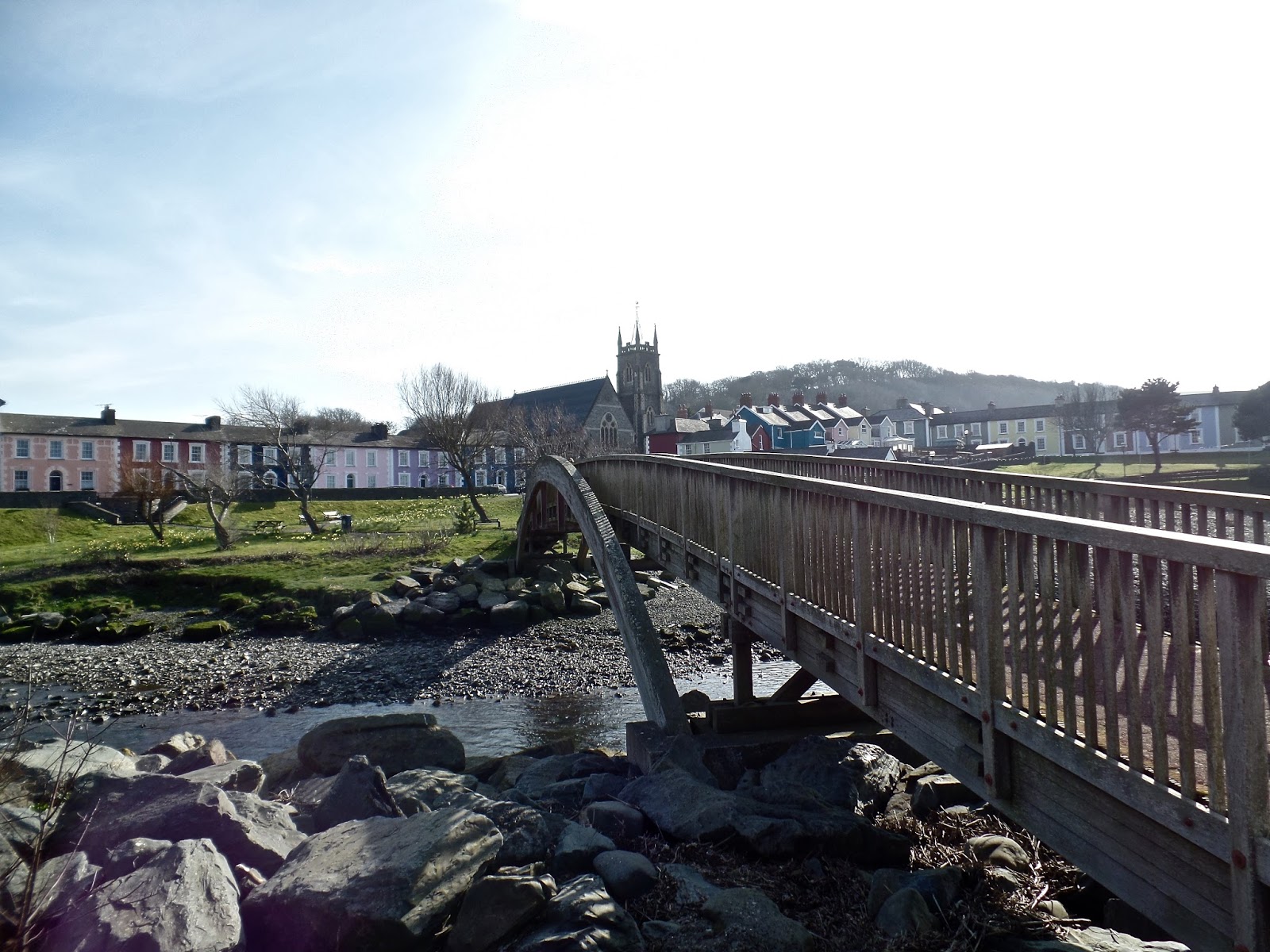
How you interpret that depends on your view of Englishness. To me it is good. Aberaeron is colorful and it has a handful of little shops, boutique restaurants and charming pubs. It is immediately likeable; it is the sort of place one might choose to take his parents were they to travel several thousand miles from another country. 


In contrast to its perceived Englishness, according to the ever-reliable Wikipedia, some 70 percent of the town's inhabitants speak Welsh. I suspect some fuzzy math there, however, because in walking around I didn't hear a single Welsh word being spoken.

Not that I cared, really. The sun was shining and it was warm enough for me to take my jacket off. I bought an ice cream and sat on a park bench overlooking the harbor and sent a text to my wife expressing my delight in having a freelancer's schedule. Far better to be doing this on a Tuesday afternoon than sitting in an office.

Aberaeron is home to the annual Cardigan Bay Seafood Festival in July, which might be worth returning for, but on a random weekday in March it was unsurprisingly quiet. Pretty, charming, but still not terribly noteworthy.

Once I had finished my ice cream I walked around town. Maybe I will come back with Jenn in the summer, I told myself. Aberaeron would be a nice place to spend the day –– eat some ice cream, go swimming in the sea. I guess it depends on how many other people have the same idea; the smallness of the town suggests it wouldn't be very enjoyable when crowded. And really, there are similar places –– in Pembrokeshire, for example –– that are easier to get to.

Either way, I suppose it was a good way to restart the GWTTA project. After walking around a little more and finding not much to pique my interest, I bundled up in my gear and sped home to Penarth. Next on the list: Aberdaron.


ADSENSE HERE

British riders are better

ADSENSE HERE
(Originally published on RideApart)

Fire up the hater machine: There's no way things are going to be civilized after a headline like that. 

But if you haven't gone straight to the comments section to break your fingers typing a load of stereotype-driven vitriol (Bad teeth! Socialism! Rain! Russell Brand!), if you are actually still reading this, I'll explain why I think Britons are better motorcyclists than their American counterparts. And why I think Americans could stand to learn a few things from the Mother Country.

I hope you understand it hurts me to say that. I've developed a fondness for the UK over my years here, but not so much that I don't hate to admit anything British is in any way "better."

Food? No.
Music? No.
Weather? Definitely no.
Healthcare? More accessible, but no.
Police? Friendlier and considerably less shooty, but probably no.

When it comes to riding a motorcycle, however, I can't deny it: The people here do it better.

I'm speaking in general tones, of course. If you happen to be a championship racer or some such thing I'll wager your skills surpass those of some bloke named Nigel who's pootling about on his Triumph. Though, I'd also wager that if you pit Nigel against the average American motorcyclist, he'll come out the better rider.


On the surface, if you compare the two countries, there's not much reason for this to be true. In both places, motorcyclists make up about the same small percentage of road users (roughly 2 percent). Both countries have a rich motorcycling history stretching back more than a century. Both countries have fostered motorcycle cultures that have influenced all other parts of the world.

It's true that Britain has more curvy roads per mile. The straightest road in Britain is 12 miles long and there's really only one like it. Whereas the straightest road in the United States is apparently 123 miles long and roads of its kind are so common you probably don't even notice. Obviously, being required to navigate more curves more frequently may help Britons sharpen their skills. But surely that can't be it entirely.

The weather might have something to do with it. We get a lot of rain in Blighty—a lot of gale force winds, too—so if you're going to ride more than five days a year you have to learn how to handle a bike in unpleasant conditions. Laura Llovet's recent RideApart article about riding in the rain suggests some Americans have developed these skills, but it seems most refuse to venture out if there's even a possibility of water from the sky.

Certainly it's true that Britain has considerably more commuting motorcyclists (and scooterists). Just last month, the Motorcycle Industry Association announced that sales of commuter motorcycles (i.e., 125cc or less) had reached a record high in the United Kingdom. Maybe the fact that more people ride more frequently is what makes the Brits better.

Maybe, but again I'm not convinced. I mean, quite a lot of people commute on motorbikes and scooters in Hanoi, but I'm not sure that makes them masters of the craft.


If I had to peg the reason for British superiority to one thing, I'd say it would be tiered licensing. Yeah, that old chestnut.

Grumpy old Brit riders will tell you tiered licensing exists thanks to the European Union's incessant love of bureaucracy. They are, of course, forgetting Britain's far greater love of bureaucracy, which extends back centuries. And in the unlikely event that the UK does choose to withdraw from the EU this summer (bet you didn't know they're voting on that), I can all but guarantee they'll keep tiered licensing for motorcyclists. Heck, they might even make it more complex.

Those old dudes are right, though, that the current system is guided by EU policy. So the system here is more or less the same you'll encounter in Ireland or France or Germany, etc. And guess what? Those guys are also (generally) better riders than Americans.

The reason tiered licensing makes for better riders is not so much because it restricts different ages to different machines (though there's an argument that may help), but because it creates multiple testing situations. More testing means more studying. A British person riding from the age of 16 could potentially face seven different exams before attaining a full motorcycle license at the age of 24. There are ways to ignore a few of those tests, but even in the cases of people aged 24 and older, and therefore able to test directly to full-license status, there are a lot of hoops to jump through.

That latter route, known as Direct Access, is how I got my UK license. Much to my chagrin, British authorities saw no value in my US license, so I had to:

Just the process of earning my CBT was more intensive than the Basic Rider Course I had taken as a teenager in Minnesota. When I took that BRC, I was in a group of 14 people under the direction of a single instructor. The group never left the safety of a YMCA parking lot. But at the end of the day I left with a license endorsement that meant I could go out and buy any size bike I wanted.

Whereas when I did my CBT in Britain, I was given one-on-one instruction (most UK training schools allow no more than three students per instructor) and spent several hours riding on public roads. Not to mention the hours of closed-course and classroom instruction. And at the end of it, I was still only at the beginning of the process. Legally, I was only allowed to ride a 125cc bike.

That may sound frustrating –– and it was –– but the process built my confidence. I did several more days of training to practice and prepare for the on-road tests (tested on a 600cc motorcycle) and when I finally earned my full license, I actually felt I had the ability to use it. Which isn't really how I had felt back when I was 18 and driving home from a YMCA parking lot.

Indeed, in the years between getting my US motorcycle endorsement and my moving to the UK, I never bought a bike of my own. I rode other people's bikes, crashed them, and soon acquiesced to my ex-wife's belief that those murdercycles were bad news.

So, although getting a US license was easier, the process didn't prepare me to use that license.

The idea of tiered licensing in the United States has been discussed before and the reaction has been pretty negative. The basic response that people give is they don't want tiered licensing because Freedom.


Right. The freedom to crash. The freedom to pay high insurance rates because everyone else is crashing. The freedom to not know what you're doing, get scared and give up. The freedom to allow your insecurity to turn to animosity and have your bad behavior spoil it for others. The freedom to be irrelevant in transportation planning. The freedom to sit in traffic and suffer because the government thinks you're too stupid to lane split. The freedom to look across the water and see that just about everyone in Britain is a better rider than you and enjoys more freedoms and advantages as a result.

I think about this stuff a lot, because one day I want to come home. And I don't really want to be wistfully thinking back to these soggy nations when I'm out riding in America. I find a quaint charm in the idea of American exceptionalism, but I know you can't actually claim to be the best if you make no effort to be better.

In order for American motorcyclists to no longer hold our heads in shame, perhaps we may need to consider tiered licensing. Or, at least, far more stringent testing. Exactly how to fix it, though, I'm not sure. What would you do to improve things?
ADSENSE HERE

Riding Motorcycles In Britain

ADSENSE HERE

(Originally published on Motorcycle.com)

Forget the Frogs, the UK is best for motorcycling

Not too long ago Tod Rafferty wrote a piece for Motorcycle.com in which he intimated that France is the best country for motorcyclists. As a resident of the country that is France’s oldest and closest enemy, I feel I am duty-bound to inform you that, with all due respect to Tod, his assertion is codswallop.

Yes, codswallop. Tommyrot. Poppycock. Flapdoodle. I’m sorry to use such strong language. But if you’re anywhere east of the Atlantic Ocean, it’s Her Majesty’s United Kingdom of Great Britain and Northern Ireland you want to be visiting. Britain is home to civilised riding. That's civilised with a 'S,' thank you.

I’m from America, but have lived in the UK –– in Wales, specifically –– for roughly a decade. I often pine for Minnesota thunderstorms and Texas cooking, but one thing that keeps me from going back home is knowing how much I’ll miss motorcycling here.

Germany (or possibly the United States) may be able to claim to have made the first motorcycle, but the UK is the country that made motorcycling. Triumph, Norton, Vincent, Brough Superior, and dozens of other great names. The rockers (and mods), the ton-up boys, the Isle of Man TT heroes, and adventurers like Ted Simon, Elspeth Beard, and, of course, Ewan McGregor and Charlie Boorman. Eric Gardner, the man who invented the crash helmet. Geoff Duke, the first man to wear a one-piece leather racing suit. Café racers and streetfighters. It all started here. 


Motorcycling runs in British blood. It is a part of the people’s history, a part of their present, and, as roads grow ever more congested, very much a part of their future. Just last month, MO reported sales of commuter-sized bikes are at an all-time high in the UK. That’s not surprising. I’ve driven in Houston, Los Angeles, Boston and Manhattan, and I assure you: no American has seen traffic congestion of the sort experienced in London or Manchester. Motorcycles are allowed to filter (a.k.a., lane split) in the UK, which means they are generally the best way to ensure you’ll show up on time.

Additionally, a motorcycle-friendly culture means toll roads are often free or discounted. In most cities, motorcyclists are allowed to use bus lanes. Parking lots and parking garages usually have allocated free spaces for motorcycles, and many offer locks and helmet storage.

Police enforcement of speed limits is rare, and on the occasion officers do post themselves roadside they take a relaxed view, disinclined to stop anyone going less than 30 mph over the limit. By and large, though, authorities leave speed enforcement to our machine overlords. Around cities, radar cameras are the scourge of British motorways (a.k.a. “freeways”), but the good news is: those cameras are almost all forward-facing. A motorcycle has no forward plate.

Meanwhile, the good ol’ British punk spirit means many cameras will be damaged –– lenses smashed or spraypainted –– by locals who hate them more than you. Especially in parts of Scotland and Wales where nationalists see rules as a form of English oppression.

Outside of urban areas, roads are generally free flowing. Off the beaten path, Britain’s narrow B roads and country lanes make it seem as if it was built for motorcyclists. In truth, it was built for horses and carts by Roman soldiers; it’s simply that no one since has put in effort to widen the roads. In my wife’s native Devon, roads leading to her father’s house are so narrow that hedgerows scrape both sides of a car.


It’s a situation that plays to a motorcycle’s size, allowing you to explore nooks and crannies that are effectively inaccessible to cars. Well, assuming your motorcycle is set up with good suspension. There’s a reason the BMW R1200GS (including the GSA) is the best-selling big bike in Britain. Followed closely by the Yamaha FJ-09 (known as the MT-09 Tracer over here). The country’s best-selling Suzuki (V-Strom 1000) and Triumph (Tiger 800) are also adventure-styled.

That’s not to say all the roads are awful. Routes known as “A roads” are generally in good condition and offer plenty of opportunity for engaging and spirited riding. FYI, “spirited” is British motorcycling code for “in excess of the speed limit.” Especially in Scotland in Wales.

One of the real advantages of British geography is the fact this place is so small. Run top to bottom (John o’ Groats to Land’s End) in less than a day and you’ll still need to ride a quarter of the way back to earn an Iron Butt badge. So, everything is close. Long, boring, tire-squaring rides on the interstate aren’t necessary for great riding.

Okay, it’s true what they say about the weather. It rains. If you’re one of those people who refuses to ride in the wet, you should probably stay in Arizona. The good news is that, except in winter, it doesn’t tend to rain very heavily or for very long. Besides, wearing waterproof gear isn’t uncomfortable because temperatures rarely exceed 75º F. Every few years we’ll get a day in July that hits 90º F and they treat it with the same sense of alarm and confusion as Houstonians do snow: cancelling school, closing offices, panic-buying things from grocery stores, etc.

In the case of Britons, though, the thing they’re buying is booze. This speaks to an aspect of Britain that helps one overcome the wet weather, an aspect that makes this such a great country to ride in: British people. Quirky, irreverent, foul-mouthed and quick-witted, they are a people who know how to have fun. British motorcyclists in particular.


Moto-journalism legend John Burns has written a few times about the feeling of asking oneself: “Why doesn’t somebody take this thing away from me?” The feeling that we motorcyclists are somehow pulling off a great trick on the universe, that we’re getting away with something: “Whee! Somebody’s slapped some wheels on this metal box of explosions and I’m going to sit on it! Ha-ha!”

That spirit is strong in British riders. They are mischievous and silly, and happy in their silliness. We Americans often feel need to make what we do seem more important than it is; we don’t just go on a group ride, we Ride in Support of America’s Warrior Heroes. You don’t tend to see that sort of thing here. Britons possess a sense of adventure that they don’t seek to justify or rationalize. After all, it was a Brit, George Mallory, who said he wanted to climb Mount Everest simply “because it’s there.”

I can give you plenty of reasons to come to Britain. Americans are generally well-liked. Everyone speaks English (though, the Welsh appreciate when you use the greeting: “S’mae”). Drivers are better than those found in California, Italy or Spain. You can’t drop a bike without hitting some historical something or other. The food is far better than some would lead you to believe, especially if you like pork. And the quality of the ale will help you not care either way.

But the real reason, of course, is simply that it’s here. It’s odd and it’s beautiful, but most importantly –– and they’ve fought wars to prove this –– it’s better than France.
ADSENSE HERE

Victory drops price of Gunner in the UK

ADSENSE HERE

Victory fans are somewhat few and far between in the United Kingdom (and who can blame them considering the outdated marketing philosophy Victory displays at shows like Motorcycle Live?), so the number of people who will be interested in this little bit of "news" could probably be counted on one hand. But I thought I'd mention it, anyway:

I just happened to check Victory's website today and it appears that the asking price of the 2015 Victory Gunner (due to arrive UK dealerships in March) has been dropped. Its starting price is now just £9,999

As recently as last week, the asking price had been listed as £10,399 -- the same as the Indian Scout (also due to arrive UK dealerships in March). Both machines will be equipped with ABS, to adhere to impending EU legislation, and as such cost comparatively more than their U.S. counterparts.

I find it interesting and perhaps a little concerning that Victory has chosen to slash £400 from the Gunner's asking price before it has even arrived at UK dealerships. But, hey, if you're a Brit who's keen to own a kick-ass cruiser, it's a deal for you.

Recently Motorcycle.com did a comparison between a Victory Gunner and Harley-Davidson FXSB Breakout, which saw the two bikes coming out pretty evenly matched. Here in the United Kingdom, both bikes are equipped with anti-lock brakes as standard. The starting price for a Breakout is £15,895 -- almost £6,000 more than the Gunner! 

That is damned impressive. It makes me worry a little bit for Victory (I hope they're not struggling), but mostly it makes me wish I had £10,000.
ADSENSE HERE

Join us

ADSENSE HERE

British weather is proof that there is a God and that he does not like you. When you are caught in the middle of some interminable squall, the misery is just too great for such phenomena to be random. No; a higher power crafted this. Some great and awesome mind invested tremendous time and effort fine tuning every tiny aspect to ensure maximum displeasure. 

Sitting in my living room that morning, prolonging breakfast for as long as I could, I had known it would be awful. Now, narrowly skirting yet another completely distracted driver on the A4232, I realised I had underestimated just how great the potential for this ride to suck.

My bike was due its 16,000-mile service and I was on my way to Fowler's of Bristol. The 16K service is the biggest one as far as the Honda CBF600SA is concerned, and committing to having it done is inherently an act of committing yourself to the bike for a good while longer. It's like paying for your wife to have breast implants. You don't fork over that kind of money for the sake of someone else reaping the benefit.

After weeks of actually nice early-autumn conditions the weather had turned brutal overnight. High winds shook everything that weighed less than a building, and splatty cold rain worked its magic -- obscuring visibility and seeping into the clothing I had failed to re-waterproof after my trip to Scotland

It was all too much for many of my fellow road users. Despite the fact they live on an island that is world famous for having crappy weather, they drove as if having never before encountered wet conditions. On the A4232, a car in the lane to my left suddenly slammed on its brakes for no discernible reason, throwing itself into a skid. On Newport Road a car drifted back and forth across three lanes of traffic. On the slip road ("entrance ramp," for those of you playing along at home) to the A48, some cars attempting to join the hardly-moving flow of traffic had managed to position themselves sideways.

Typical traffic on M4 between Cardiff and Bristol

It is in moments like these that you realise the complete breakdown of society is never really so far away. But, hey, at least human kindness will persist. I found a surprising amount of it as I weaved my way down the A48 and onto the M4. Traffic was completely stopped at some points, moving at a snail's pace at others, so I took advantage of my right to filter through it -- easing the Honda down a narrow corridor between the endless rows of cars and vans and lorries. Many drivers spotted me and shifted their vehicles to allow a wider gap.

In the 48 miles between Penarth and Fowler's I'll bet I was filtering at least 70 percent of the time. Mile after mile after mile after mile of slipping past immobile cars. When you do this, you feel shocked and empathetically sad for the drivers who put themselves through such frustration just to get to work. Part of me wanted to stop and evangelise. Tap on their windows and say: "Hey, do you not see what I'm doing here? See how I'm getting places and you're not? Stop doing this to yourself. Stop living this miserable car-bound life. Join me on two wheels."

Attempting to testify in this weather would have been a challenge, though. And to that end, I was perhaps fortunate to be stuck in a filtering situation. Moving slowly through rows of giant metal windbreaks was helping protect me from the worst of the gale-force winds. I didn't realise this until things loosened up and I sped toward the Severn Bridge.

"RHYBUDD: CYFLYRAU GYRRU PERYGLUS" blinked a highway sign. (Warning: dangerous driving conditions.)

"No shit," I muttered, as the wind bounced me around in my lane and rain splattered my visor with an audible clack-clack-clack.

When we had still been stuck in heavy traffic, a small caravan of motorcyclists had formed -- about eight of us moving through the filtering corridor, taking turns as leader. Now, as speeds picked up everyone was spacing out, each taking a lane to him- or herself and settling into individual cruising speeds. A litre-sized CBR had long ago shot off. Everyone else was moving away from me at a more leisurely pace (You can take the boy out of America but you can't take the America out of the boy; I have a lot of trouble ignoring speed limits as flagrantly as Brits do).

The Severn Bridge on a good day

The Severn Bridge is a 1-mile span that soars above the wide and tumultuous mouth of the River Severn as it becomes the Bristol Channel. Crossing it is always a bit of an experience because of high winds, especially if you are sitting atop a 600cc dandy horse.

As the road arced toward mudflats and the straight approach to the bridge, the first truly brutal gusts hit us. I saw the bikes in front of me wobble a tiny, tiny bit against the wind blast. Then, the riders visibly taking in deep breaths of resignation, tucking in and throttling forward. Once more unto the breach, dear friends.

I did the same, laying my chest on my tank bag and bringing my elbows in. I moved to the middle of three lanes to give myself some hope of avoiding trouble should I be blown completely out of my lane -- the other lanes had guardrails to punish me if I drifted too far. 

And, indeed, at one point I did drift too far. Jostling to get out of the turbulence coming off a cattle truck, I was slammed by a gust right as I moved past the giant, stinking vehicle. My bike heaved right and slipped across the dotted white lines into the next lane. Pitched at a 30-degree angle I fought against the gust to get back into my own lane. As I hit the white lines at that angle, my tires wobbled a little before finding better grip. 

It all happened too quickly to be scared. But as my brain processed what had just happened I realised that the driver of a large white van into whose lane I had accidentally flown must have sensed such a thing might happen. He had held back as I passed the cattle truck. And now he chose to straddle his and my lane, using the mass of his vehicle to block other cars from riding up on me, thereby eliminating a lot of stress.

I kept my tuck and shouted out "Thank you" as loud as I could, hoping he could somehow sense that I was saying it and how much I meant it. With him and the cattle truck effectively covering my six, I made it the made it the rest of the way across the bridge without incident. As we came off the bridge and into the wind-blocking hillocks of the English side of the river, I dropped into the slow lane, sat up a bit and waited for the van to come alongside. I saluted. He gave a thumb's up and sped off.

A few minutes later I was on the M32 and back in the "safety" of filtering through Bristol rush hour traffic. Weaving onto the surface streets and through the incongruous maze of Bristol city centre I felt alive and excited. The city was vibrant. Everything was moving. Rain was falling -- heavily enough that I could hear it on my helmet -- but lightly enough that everything was clear.

Bristol is about triple the size of Cardiff and infinitely more cosmopolitan in its mindset. So, I wasn't the only one filtering, nor was there just a single filtering corridor. Between all the cars ran flowing streams of motorcycles, scooters and bicyclists. Trickling through Cabot Circus I caught glimpse of a woman in a red Volkswagen Golf, its windows fogged on the edges by conditions. You have never seen a woman looking more miserable. Not sad or grief-stricken or angry or upset, just miserable. Flat out 20-foot-thick misery.

I felt so badly for her. And for all these other people trapped in their cars, trapped doing this every single day -- year after year. I wanted so much to let her know things didn't have to be like this. I wanted to tap on her window and say: "Hey, do you not see what I'm doing here? Stop doing this to yourself. Stop living this miserable car-bound life. Join me on two wheels."


____________________

ADSENSE HERE

Ay up

ADSENSE HERE
A stone wall near Grassington
This is Part 2 of my Yorkshire Dales trip. To read Part 1 click here.

One of the strange aspects of British life is that all 64 million of us are crammed into a space no larger than the state of Oregon, but getting around in that space takes an excruciatingly long time. And it feels even longer. As I've said before, the best way to think about it is to add a 0 to whatever distance you intend to travel. So, this 260-mile ride to Yorkshire Dales National Park felt like one that was 2,600 miles long.

By the time I had escaped the northern reaches of Birmingham I was stupid with boredom. Traffic had been slowed to 50 mph thanks to congestion and roadworks. The flow of traffic was steady, so putt-putting along at about 4,000 rpm was doing wonders for my fuel consumption, but it was heavy enough I could not take my eyes off the road. I wasn't able to look at the surrounding countryside, just the Land Rover ahead of me, the impatient Audi behind me, and the various cars we passed as we put faith in the "10% + 6" equation (a).

My knees were aching again and I was having that particularly male issue in which "the boys" refuse to settle. If you are female and don't know what I'm talking about, don't read that sexually. It simply means I was uncomfortable. Doing a full stand-grab-and-adjust manoeuvre is difficult and dangerous when travelling at speed and wearing full gear, so I was left to constantly shift around on my seat.

To keep my mind occupied I had "conversations" with drivers and passengers in the cars around me. They couldn't hear me, obviously, because I was talking in a normal voice with a helmet on and their windows were up.

Also, I spent quite a lot of time wondering whether this trip would be more enjoyable if I were on a BMW F800GT. Or perhaps an R1200RT. A number of the cops I had passed earlier in my journey had been on R1200s and had looked pretty cool. Sure, those things are stupid wide but they have a real presence on the road. And I bet they're a hell of a lot of fun. I bet, too, they'd be more comfortable for Jenn than my existing bike.

This led to the inevitable lament of my not being able to even imagine a time when I could afford such a bike. Jenn and I are severely strapped for cash these days and I've had to dip into some of the savings that I was slowly, slowly accumulating toward a new bike. I try to take solace in the fact that my Honda is still relatively low mileage and is, after all, a Honda. Which means I can continue to ride the thing until Jesus comes back. But that doesn't satiate the emotional need for a new bike. I want a garage full of bikes and I want it now.

Back in the real universe, I pushed on into Lancashire before stopping. Increasingly, I find the north is my favourite part of England. The accents strike me as more engaging than in many other parts of England and Wales –– you enjoy just listening to people speak –– and there are often semi-poetic turns of phrase, such as, "T'wer like suppin' lead," to describe something as difficult.

If you like narrow streets you'll love the Yorkshire Dales.
At Charnock Richard motorway services I supped hot chocolate and put away a piece of lemon cake Jenn had sent along with me. In the last few miles before stopping I had been able to pick up speed and again my right arm had been hurting. I thought of Curt Carter's recent post, posing the question no motorcyclist really wants to consider –– How long will I be able to ride? –– and that again kicked up thoughts about all the different bikes I wish I owned.

I often feel a sense of urgency toward motorcycling: I need to go everywhere now; I need to ride all the bikes now. This comes as a result of my having gotten into things so late. Though I've had my motorcycle endorsement since I was 18, I didn't really start riding until I was 36. Optimistically, that gives me a roughly 40-year riding career, maybe 50 if I stay lithe, keep my brain active and can one day manage to convince myself that a Can-Am Spyder is cool. I guess that's a decent amount of time, but it doesn't feel enough. I lament the 20 years in which I could have been riding but did not.

Back on the road, I was soon zipping along the delightfully open space of the M65. Near Burnley, a Volkswagen Polo came up hard behind me in the fast lane, flashing its lights as it approached. I shifted left (into the slow lane here in the UK) and nodded at the car to go on by. As I did this, though, I twisted the throttle and kept pace. I looked over at the driver and nodded again, as if to say, "No, really, go ahead," and again accelerated to keep pace. I did this a few more times, making grand "Go ahead, after you," gestures but always remaining side by side with the Volkswagen. When we reached 110 mph the car's driver finally got the joke and waved a playful middle finger at me. I waved back and eased up, letting him speed on (b).

Within a few minutes I was off the motorway and into the land of the white rose. God's own Yorkshire. The kingdom of Jorvik. The part of England that is, in a way, the most English and yet unlike any other part of England.

The roads of the Yorkshire Dales made for great riding: lots of curves, relatively well-maintained roads, and good sight lines. I swooped and soared my way to Grassington, where I would be staying the next few nights, all too quickly. When I pulled into the driveway of my B&B, the owner was already out the door and saying hello before I could cut the engine.

"Y'alright Chris?" she said. "Good ride up, was it? Shall I get you a cuppa tea?"

Yorkshire hospitality. I thanked her profusely and started unloading my gear. When I got up to my room, there was a fresh pot of tea and a slice of lemon cake waiting for me. I lingered on these things as long I could. The last part of the ride had offered up some beautiful scenery but I was exhausted.

Honest food: pork belly on black pudding with gravy.
A while later, cleaned up and in comfortable clothes, I walked to the village square to find a pub where I could have dinner. The B&B's landlady had described The Forester's Arms as "a bit worn around the edges but with honest food –– you know, proper portions for a lad."

It was in better condition than many high-end pubs in Wales, but she had been right about the food. I filled up on pork belly and black pudding, the latter of which gets a lot more love in the north than down where I live.

For those of you playing along in the United States, black pudding is a sausage of sorts. There's no meat; it's effectively just oatmeal soaked in pig's blood and stuffed into sausage casing. There's absolutely no way to make it sound tasty, but it's actually pretty good when used in combination with other proteins such as eggs or pork. Washing it all down with a cold beer I started to feel like a proper Yorkshireman (c).

I decided to head out for a walk across the fields south of the village, my belly full and my head spinning from tiredness, happiness, and a few pints of beer. Quietly to myself I had started talking in a Yorkshire accent and commenting on just how beautiful everything was.

Occasionally, I would drift out of the Yorkshire patois and hear my father's voice rising up in me. He loves Britain; I sometimes wonder if I stay here just so he'll have the chance to visit. The late-day sun had turned everything golden and I knew my dad would be going crazy for it.

"This is just so great!" I said aloud, channeling his kid-like enthusiasm. "I mean, gosh! Wow!"

I came to a river and walked along its banks a while, eventually passing an old man out walking his dog.

"Ay up," he said.

I grinned. It was the first "ay up" I had gotten in Yorkshire –– a phrase that's a bit like "howdy" in Texas: a part of speech so iconic it's almost caricature.

You can see why I love it.
"Ay up," I said back.

And we each walked on in the Yorkshire sunset.

To be continued...

____________________

(a) If you are caught speeding at 10 percent of the limit plus 6 mph you can avoid getting points on your license and instead take a traffic safety course. This means that in a 50-mph zone you can try your luck and go 61 mph. In some constabularies, the rule is "10% + 9", but reliable information on exactly which constabularies adhere to this rule is hard to find, so it is best to stick to the lower number. Of course, the even better bet is to simply not speed and save yourself the trouble, which is, of course, what I always do because I'm a good boy.

(b) If you are a member of law enforcement in the UK, please note that this story is totally made up. I always ride according to conditions and never above the national speed limit.

(c) Actually, I suppose a proper Yorkshireman would have been drinking ale, not that Nancy-boy lager stuff they drink in London.
ADSENSE HERE

It's (not at all) grim up North

ADSENSE HERE

My route
It is roughly 260 miles from the quaintly crumbling South Wales town of Penarth to the Yorkshire village of Grassington. That's assuming you do most of your travelling via motorway, which is what I tend to stick to when I need to get to places on time.

Of course, the "on time" concept is often a fuzzy one for me. I am a strong adherent to the Ride Your Own Ride school of thinking and one of the ways in which that manifests is in how long it takes to do certain things. Some days I move pretty fluidly -- stops for petrol or food are well-coordinated and efficient. On other days, I seem inclined to spend upward of 10 minutes adjusting my scarf before putting on my gloves. Such was the case this past Sunday when I set out for northern England.

Grassington is one of the "honey pot" villages of Yorkshire Dales National Park, which is to say it is one of the places that sees the most visitors. For those of you playing along in the United States and other countries where governments actually adhere to IUCN categorisation, a national park in Her Majesty's United Kingdom is not what you might expect. Here, national parks are, in fact Category V and Category VI protected areas. In truth, there are no real national parks (Category II) in Britain, we just like using that phrase because it sounds good. 

The best U.S. comparison to a British "national park" that I can think of is the area that falls under the purview of the Tahoe Regional Planning Agency in California and Nevada. Except, much of that area is far more wild and I would argue that the TRPA does a better job at pro-actively protecting landscapes (a).

I realise all this is off the point -- this is a motorcycle blog, after all -- and that I have mentioned it before, and that on the Venn diagram showing motorcyclists and environmentalists the space where those two circles intersect is probably not very large, but that doesn't stop me from being annoyed by the whole thing. So, I rant about it at any opportunity. The United Kingdom needs to try harder to protect its natural spaces.

That's not to say British national parks aren't lovely, though. They are. If you want to be guaranteed of enjoying the very best that this tiny archipelago has to offer in terms of scenery, landscape, and hospitality, head to one of the 15 UK national parks. Before Sunday, I had visited Brecon Beacons, Cairngorms, Dartmoor, Exmoor, Lake District, New Forest, Northumberland, Peak District, Pembrokeshire Coast, Snowdonia and South Downs. With the Yorkshire Dales I've now visited an even dozen.

Timing is everything when it comes to visiting any outdoor space in Britain. The weather can make it the best or worst experience of your life. So, I accept that my personal list of favourites shows bias toward places I've visited on warm spring/summer days. But even so, I think the Yorkshire Dales is the bee's knees. 

Getting there was easy enough. As I mentioned, I was in a somewhat relaxed mood when I set out. So, my intended departure time of 10 a.m. became 11. And by the time I was actually fuelled up and properly under way it was edging close to 11:30.

Security forces have erected barriers and a 9-foot fence to protect a castle...
Traffic was light, but for the first time in my eight years of living in this country everyone was sticking to the speed limit. I suspect this had something to do with the ever-growing police presence coming that had come in preparation for the NATO summit taking place a week later. More than 67 world leaders are attending the event, including President Barack Obama, so all the security bells and whistles were being brought in. A 9-foot-tall fence had been erected around Cardiff city centre, Cardiff Bay and Celtic Manor in Newport; seven NATO warships were stationed in Cardiff Bay; and more than 10,000 police officers from all parts of the UK were being brought in.

Ten thousand. Riding up the A449 and M50 I encountered several hundred of them en route to their posts: great convoys of police riot vans and Land Rovers, as well as the lightning-quick packs of motorcycle police, riding two abreast and looking like DayGlo versions of the Nazgûl.

I am in the process of training to run a marathon these days and had run 15 miles the day before, so by the time I was nearing the southern edges of Worcestershire my knees were aching, and the right arm thing that happens from time to time was worse than usual.

Sometimes when I ride it feels as if a nerve in my armpit is being pinched; it causes slight pain in my bicep and elbow, and results in my losing feeling in my fingers. I can never really figure out what causes this, though I have noticed it more since I started wearing a Knox Fastback gilet.

Based on that, one automatically assumes the Fastback is to blame, but it's not pinching me at all and is comfortable to wear. Also, I started wearing the Fastback right when I started taking longer journeys -- first throwing it on when I rode to the Peak District back in April. So, perhaps the issue is not with what I'm wearing on the bike but how long I'm on the bike. Additionally, the pain and numbness really only seems to show up when my Honda's engine is turning above 5,000 rpm; perhaps buzzing in the handlebars is the true culprit? If anyone has any input on what might be at the heart of my right arm thing I'd be glad to hear it.

Regardless, Strensham motorway services was my first port of call. The sun was shining and the weather warm. I chose to sit in the grass near where I had parked my bike and eat the sandwich Jenn had made for me. This somehow communicated to everyone who walked by that I wanted to answer any questions they might have about motorcycling, as well as hear stories about the bike they used to have.

More often than not I enjoy this aspect of motorcycling -- that everyone wants to talk to you -- and was happy to indulge it today. A mother took a picture of her son sitting on my bike. A man told me of the Fazer he had owned before "the wife" made him sell it (b). Another man asked if I thought the Honda CBF600 SA was the right size bike for him, as if he were shopping. But the best moment came as I was packing up to get back on the road.

"My dad's a biker," a balding man said, walking up to me. "Well. Was. He's 93 now, he is. But, you know, in his heart, yeah, he's a biker. Loves his bikes, him. Listen, mate, you wouldn't mind coming over to have a chat with him would you? Only take a moment and it'd mean the world."

He pointed to a car parked a few yards away in a handicapped spot. It was close enough to just wheel my bike over, but when I started to do that he stopped me and asked that I pull up at the passenger side of the car with my engine running.

"Really give 'er a good rev," he said. "Dad'll love that."

Not wanting to scare a senior citizen to death I waited until I was alongside the old man before even touching the throttle. The car's door was open and I pulled up to within arm's reach. The old man was weak and frail and pretty much asleep. Then he caught sight of me in his peripheral vision and rolled his head toward me.

"Go on, mate, give 'er a good rev," said the old man's son.

The old man lifted a bony hand and waved it as encouragement. Stock Honda pipes are not exactly renown for their sound but I gave it my best shot. I clicked the bike into neutral and held in the clutch just in case, then twisted the throttle back as hard as it would go. The inline four's engine jumped to 9,000 rpm and let out a roaring whine that probably frightened me more than anyone else.

A British dispatch rider in WWII.
The old man was grinning now. He motioned for me to kill the engine. He wanted to tell me about his motorcycling days. He had started riding bikes in World War II, as a dispatch rider in Italy. He had been seriously injured four times in crashes because they would have him ride at night without lights and inevitably the dispatch riders would end up crashing into shelling craters.

"'Course, you'd rather be thrown from a motorbike than shot," the old man explained. "So you kept going, didn't you?"

He talked for a good 45 minutes -- about riding in the war, some racing he had done, and listing off just about every machine he'd ever ridden or encountered. His body was beat up, and he did little more than move his head and weakly wave his right hand, but he wasn't a 93-year-old man. Not in his eyes, at least. When I glanced at the man's son, the one who had insisted I come over, I saw in his eyes, too, a much younger person. I saw a little kid looking up to his dad.

The old man spoke until he wore himself out, mumbling and beginning to retell the story of his breaking his leg because he was thinking too much about a girl and not the moonlit Italian road he had been speeding down. His son smiled warmly and cut him off. He thanked me for taking the time and told me to ride safe.

I pulled on my helmet and fired the Honda to life. The old man came back around and said something unintelligible, but reading his face I guessed it to be a joke. I laughed as loud as I could, to be heard through the helmet, then waved goodbye.

A few seconds later I was out of the car park and on the M5, settling into an 80-mph cruising speed. I thought of Italian girls and felt thankful that British potholes aren't quite as bad as they could be.

To be continued...

____________________

(a) British conservationism is too often nothing more than a happy side effect of protracted bureaucratic ineptitude. It's similar to the way a massive insurance snafu that keeps you from driving for six weeks would help to "preserve" the engine life of your car.

(b) Usually when I hear these stories I suspect the truth is that "the wife" is, in fact, "a temporary fit of intelligent self awareness." I imagine the individual realised that his combined lack of skill, immaturity, and unwillingness to subject to the "embarrassment" of learning was eventually going to get him killed, but to admit any of this would be emasculating so he blames his partner.
ADSENSE HERE
 

Advertisiment