Advertisiment

Showing posts with label Victory Motorcycles. Show all posts

Victory's NM-4: Remembering the Vision 800

ADSENSE HERE

A little more than 10 years ago, Victory Motorcycles revealed a concept bike that featured an 800cc liquid-cooled parallel twin engine, automatic transmission, and storage in the space where a tank would traditionally be. Dubbed the Vision 800, it was a dramatic departure from the sort of thing Americans had come to expect from their motorcycle manufacturers, and it offered a glimpse of Victory's true potential.

If you've never heard of the Vision 800, you're not alone. I only learned about it last year, as I was doing research for my review of the much larger V-twin tourer that shares part of the Vision 800's name, as well as its futuristic look. To my eye, Victory had created the Honda NM-4 several years before Honda, and I was surprised such a unique concept could seemingly have come and gone without more fanfare.

When Victory released its new liquid-cooled Octane model earlier this year, one of the narratives of the bike was that it represented a kind of opening of the doors for the Minnesota-based company. Finally, with its Polaris sibling, Indian, shoring up the traditional/heritage side of motorcycling, Victory could begin pushing in new directions.

All of which got me thinking again about the Vision 800. I decided to get in touch with the folks at Victory to ask a little more about the bike, starting with the most obvious question: Why wasn't there a production version?

"The Vision 800 was designed to be a concept motorcycle and introduce design elements that eventually showed up in the Victory Vision," explained Victory/Indian External Relations Manager Robert Pandya. "It was not intended to be a production bike, [but] then 'backed off' from production. The point of concept bikes is to introduce a series of design ideas and explore the product possibilities for the brand."


For more information about the Vision 800, Pandya directed me to Tiger Bracy (pictured above), the designer behind the project.

"The history of the Vision 800 began with my summer '04 internship," he said. "I was a Transportation Design student at the Art Center College of Design, in Pasadena, California. My boss (Greg Brew) handed me a design brief to work on something rather unique. We had a few conversations surrounding what an automatic motorcycle might be like for Victory. It needed to utilize a motor from our existing portfolio, and it needed to tie in with the Victory Vision touring bike."

The motor Bracy used was from a Polaris Sportsman 800 ATV. Equipped with a cast aluminum alloy frame, linked brakes and low-seat cruiser ergonomics, the Vision 800 was aimed at expanding Victory's customer base beyond its current buyer.

"I decided to... aim it towards new riders with very little or no experience," Bracy told me. "It was a statement on how a new motorcycle brand could develop its customers from the ground up. Notice I say motorcycle brand and not 'cruiser' brand. I wanted to challenge the status quo of what the 'New American Motorcycle' could become in the future."

To do this, Bracy spent a long time thinking about the sort of person that would ride the Vision 800 — someone he hoped could grow with the brand after choosing his concept as their first bike.

"Most inexperienced riders aspire to have a more powerful bike right away, even though they lack the riding skill to safely ride it," he said. "There is nothing intuitive about riding a traditional [large, air-cooled V-twin cruiser] motorcycle when you’re a beginner. They’re dangerous and difficult to master. In an absurd way, I guess that’s a part of the appeal.


"So, the styling of the Vision 800 needed to say American Muscle, and, most importantly, it needed to be unique. Think trendsetter, not a follower."

For the styling, Bracy said he couldn't help but look to the Vision tourer.

"The Vision touring bike was in the beginning stages of development," he explained. "I had this prototype sitting right in my face every day. The Vision 800 was designed to flaunt the new look of the Vision touring bike, but they could not share any actual components. I decided to borrow the touring bike's architecture of having twin fuel tanks mounted on either side of the motor, and that’s it.

"I rotated the parallel twin cylinders toward the front wheel to give more room on top of the motor. The radiator was moved out in front of the forks so the motor itself could be pushed even further forward to give room for the CVT. That architecture aided the Vision 800 to open up a massive storage space where the fuel tank and air-box would normally reside."

Bracy isn't exaggerating when he says "massive." The Vision 800's "trunk" was large enough to hold two full-face helmets, plus a little more. Bracy felt that having that much storage would help encourage new riders.

"When you’re a newbie, what’s the best way to get more experience? Simple: more seat time,” he said. "You could use the 800 as a daily commuter. It could haul a bag of groceries and your gym bag, no problem... The low seat height would make the bike less intimidating for smaller people or the less experienced."

In discussing his desire to create a bike to draw in new riders, Bracy offered a lot of insight into the challenges that any motorcycle manufacturer faces, especially in the modern world.


"Grandpa is getting old, but he’s living longer than his parents did," Bracy said. "[However,] his great-grandchildren may not have any interest in the bikes he once enjoyed. If you want to sell more new bikes, then you probably need to find new riders. You want more riders, you’ve got to teach new people how to ride. In high school, I had a driver’s automotive education class at 15 years old. But what about early motorcycle education? Good luck with a two-day safety foundation course."

Bracy said that when he designed the Vision 800 he gave it an automatic transmission in hopes of partially answering those challenges. He said it makes a bike easier to ride, and therefore more "newbie" friendly. He's not the only one to think this. Again, the comparison to the Honda NM-4 comes to mind. And, indeed, Honda has been at the forefront of pushing automatic transmission bikes.

"Since the Vision 800, we’ve seen Honda’s DCT in many different models. This confirmed that I wasn’t alone in identifying a new segment that most manufacturers overlook," Bracy said. "You see attempts to make an automatic motorcycle look either like a traditional bike, sans the clutch lever, or like something out of Transformers. This to me is the dilemma. It’s very difficult to get rid of the manual clutch; it’s like a badge of honor. It’s proof that you earned your stripes."

But, Bracy said, that "badge of honor" may be something older generations are more concerned with than those who might be considering riding now.

"Future generations will grow up in a world where these new autonomous cars are common to them. Didn’t I just see a robot piloted a Yamaha R1 last year? I bet the phrase 'what the hell happened to the clutch lever' will seem old soon," he said. "Do I see a future for more automatic bikes in our lives? The answer is yes... That future will probably be dictated by the OEM that is smart enough to begin appealing to a much younger generation that may not see a benefit in a manual clutch."


Which leads to the obvious question of whether Victory will be that OEM. The official answer to the question is the company-wide response of, "We cannot speak to future product," but Robert Pandya did say that Victory— and to a broader extent, Polaris —is aware of the opportunity to head in a more unique directions.

"The possibilities for the brand are very wide indeed. Even moreso now than they were when the Vision 800 came out. Polaris brands have access to a wide array of engines and technologies, and would be able to build anything. But the real question is if customers will buy it," he said.

The bottom line has long been a guiding factor in Victory's decision-making process. The brand's prudish business sense has sometimes earned it criticism from those who would like to see more earth-shattering projects being put forward. But you have to admit that there's something to be said for a brand that isn't constantly hovering near bankruptcy. And that's not to say that Victory is dedicated to being stuck in its ways.

"As consumer demands change, there are few companies in a better position to leverage a variety of technologies and product design groups than can build whatever we design," Pandya said. "It’s an exciting time to be in the PowerSports industry — especially with the Victory brand."

Meanwhile, Bracy remains hard at work within the Polaris umbrella. Since the Vision 800, he's worked on several of Polaris' off-road and on-road vehicle programs. Most notably, he was responsible for the three-wheeled Slingshot. Looking back on the Vision 800, Bracy said he remains proud of the concept— which these days sits in his office —and feels Victory was particularly brave for putting it out there.


"It let us know that anything was possible and we weren’t going to get stuck in one segment, just building clone bikes," he said.

And contrary to my limited perception (the internet gives us all a short memory), the Vision 800 did make a fairly big splash at the time.

"It was featured in more than 20 magazines, and Puma used it in an international ad campaign," Bracy said. "Some random design studio did a total rip-off and butchering of the concept for the latest Judge Dredd film. A friend of mine reminded me that imitation is the best form of flattery. I chuckled and grinned because I didn’t know if I should be flattered or pissed."

_____

(Article originally published on RideApart. Huge thanks to Tiger for his time and for providing images of the bike)
ADSENSE HERE

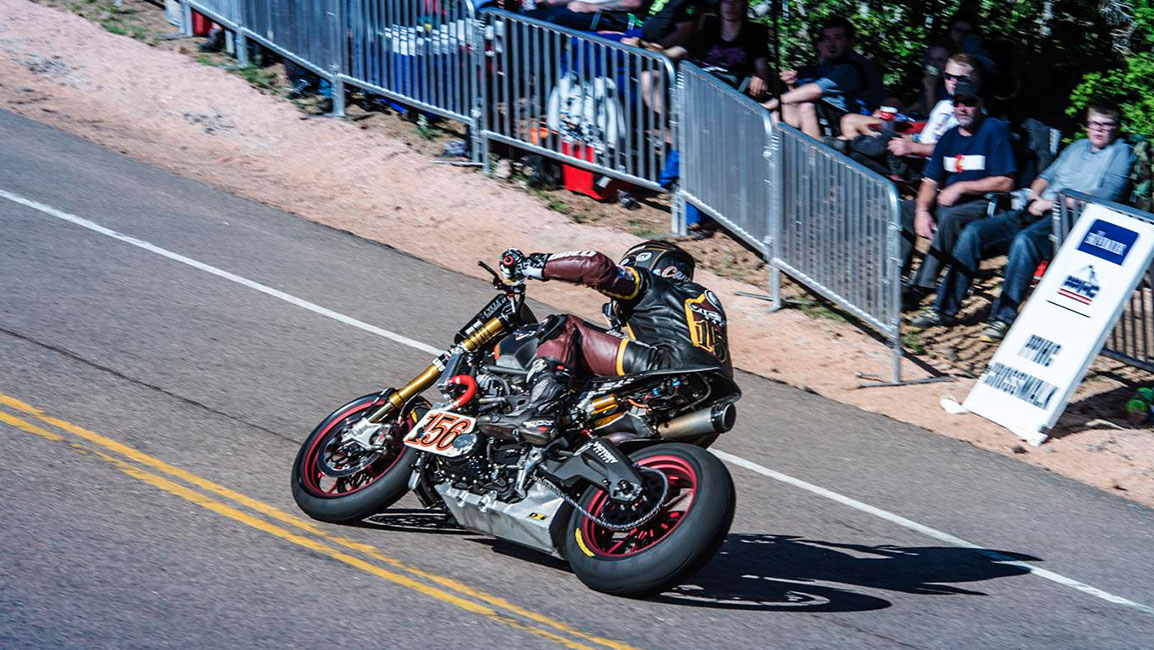
Please let this be true: Production version of Victory's Project 156 may still happen

ADSENSE HERE

There are fresh rumors that a road version of Victory's Project 156 bike is in the works and may arrive as soon as this year. And no, I don't mean another cruiser.

Project 156, of course, was the name for Victory's effort last year to conquer the Pike's Peak International Hill Climb. Powered by a rip-snorting prototype 1200cc liquid-cooled V-twin engine, the naked race bike was designed in part by Roland Sands and ridden by Cycle World editor Don Canet. Although the Project 156 attempt was ultimately unsuccessful, the bike Victory produced for the event drew a great deal of attention and raised many motorcyclists' hopes that a production version would soon become available.

Those hopes were raised even further in the weeks leading up to last month's unveiling of the Victory Octane, a 103 hp cruiser that some felt didn't quite live up to the Project 156 ethos. Many expressed disappointment that Victory had not delivered a model more faithful to the original Pike's Peak bike.

But now British motorcycling newspaper MCN is suggesting motorcyclists should not yet give up on the idea of a super naked from Victory. The paper claims a Polaris insider has told it: "The intention is still to create a production bike with similar levels of performance and looks for the road in the near future."

MCN says this bike "could be revealed later this year." The paper bolsters its claim by pointing out that Victory will again be racing at Pike's Peak this year. And, indeed, a quick glance at this year's competitor list shows Victory will actually be running two bikes up the notoriously difficult mountain course.


Don Canet will be back, this time astride a prototype electric motorcycle. And a 2016 version of Project 156 will be ridden by 2014 Pike's Peak Open Class winner Jeremy Toye, indicating that Victory are very serious about taking the prize this year.

Not surprisingly, Victory is saying nothing about all this. The company's standard response to any questions about what may or may not be in the works has always been: "We don't ever talk about future products."

And in this case, you can't blame Victory for keeping tight-lipped. An over-enthusiastic PR campaign for the Octane left some motorcyclists upset and may have convinced Victory that it's better to take a "less is more" approach when it comes to unveiling new models.

However, when I spoke last year to Victory/Indian external relations manager Robert Pandya about that year's Project 156 bike he did say: "Obviously we're doing this for a reason."

He also offered some hope to motorcyclists pining for an American bike that isn't a cruiser by pointing out that Victory was aware of the desire for such a thing.

"Certainly there's been interest from our existing customers" he said. "And our desire is to draw in new customers in different categories. We've got different venues we can play in, in terms of the overall opportunity on market. There are spaces where American bikes are not currently present, and maybe there's an opportunity for us."


That's an observation that feeds into a statement made earlier this month by Polaris President of Motorcycles Steve Menneto regarding the future of Victory and Indian. He told Minnesota's Star Tribune: "We project that [sales] volume will increase [and] we will double our market share over the next three years."

At present in the United States, roughly 50 percent of all street motorcycles larger than 600cc are sold by Harley-Davidson. It could be that Polaris has enough faith in the Indian brand that it thinks it can double its market share simply by cutting into Harley's piece of the pie.

Or, it may be eager to expand into other segments of the motorcycle market. Perhaps to naked motorcycles, which is the second most popular segment in the United States. And if that were the case, Victory has certainly made no secret of the fact that its aim is to focus on performance, cutting a distinct path away from the more traditional world of Indian. 

But all of these "what-ifs," "maybes" and "should-bes" are the sorts of things that led so many people to being underwhelmed by the Octane. So, personally, I'm a little skeptical of these new rumors. To build a road version of the Project 156 bike seems like too great a leap.

Victory has always been a forward-thinking company, blessed with engineers and designers capable of dreaming up ideas that are decades before their time. But it has also been pretty gun-shy when it comes to implementing those ideas.

If Victory wanted to fulfil riders' daydreams of a Project 156 bike for the masses, it obviously wouldn't be as simple as slapping an Octane engine into an upright chassis (which in itself isn't exactly "simple"). Riders would expect power north of 120 hp, as well as the bells and whistles found on many other super nakeds: ABS, traction control, rider modes, and so on. This bike would need to be at least as good as a Suzuki GSX-S1000, with many wishing it to be on par with a KTM 1290 Super Duke. That's a pretty tall order, and it's a hell of a lot to have to get right on your first try. It would, as I say, be a massive leap.


However, that doesn't mean I'm not eagerly looking forward to my first glimpse of the 2016 Project 156 bike. The look of that motorcycle may say a lot about whether production bike rumors are true. When building last year's bike, Roland Sands and his team were squeezed for time, so they used the swingarm and suspension of a Ducati 899 Panigale. Since Victory will presumably have had more time to prepare for this year's event it will be interesting to see if the chassis now has a more original "in house" look.

If it does, that may hint at production intentions. Or it may not. I guess we'll have to wait and see.

(Originally published on RideApart)
ADSENSE HERE

The Octane PR fumble: What does Victory do now?

ADSENSE HERE

The initial backlash against the Victory Octane was so intense that most of the reviews I've read of the bike have felt the need to mention it:
  • Motorcyclist: "Maybe Victory set expectations unreasonably high... enthusiasts like us were hoping for a high-performance machine more in the standard- or naked-bike realm than another midsized cruiser"
  • Motorcycle.com: "(M)any... felt misled by Victory’s references to the Project 156 Pikes Peak racer... I can understand riders’ desire to see this powerplant in a more standard or sporting chassis"
  • Common Tread: "There is a large incongruity between the motorcycle that Victory’s marketing department hinted we were going to get and the Octane that is actually going to hit the showroom floors."
As I said in my own early comments, Victory's PR led a lot of people to hear things that weren't actually being said. I include myself in that group. I wasn't expecting a naked or standard –– the two "concept" bikes from Urs Erbacher and Zach Ness had made it clear the Octane was a cruiser –– but I was expecting more power and perhaps something that wasn't 100-percent cruiser.

In conversations I've had with Victory folk since the Octane's launch they've quietly conceded their initial enthusiasm may have been just a little over the top. Fortunately, for Victory all the actual ride reviews have been positive. So, it's not in the position as Harley-Davidson was (is?) with the Street 750, where it said "Look at this amazing bike!" but delivered a stinker.


Instead, the general consensus is something along the lines of: "The Octane is a really good bike that isn't quite the huge leap forward some people thought it would be." 

From Victory's perspective, that's not an awful place to be. They have a solid platform they can build upon. And it's a platform they can be pretty sure will be profitable.

Which is an important thing to remember about Victory (and Indian) –– it's a business. Victory doesn't make motorcycles as an act of social good; this isn't some massive community service project. And Victory is a motorcycle business that operates first and foremost in the United States, where (much to my persistent confusion) Harley-Davidson sells roughly half the street bikes larger than 600cc.

I can't find any figures on what the rest of the market looks like, but by simply travelling around the United States it would appear the next biggest market segment is: "cruisers/big V-twins that aren't Harley-Davidsons." Let's imagine that makes up 30 percent of sales. Maybe even 35 percent. That leaves a not-so-big field of play for everything else.

Which is why I don't think Victory is ever going to completely abandon the cruiser market.

But, Polaris is an international company and it is already familiar with the idea of offering different products in different places. That's why we lucky Europeans still have the Judge. It's why the Octane (and Judge and Gunner and High Ball) is ABS-equipped, despite the feature not even being an option in the United States.


So, Victory could build a bike targeted more at markets outside the United States. And I suppose that's what I was hoping for. I had hoped the Octane would be a Victory Judge that lived up to the ambitions of a Judge. Apparently a flop in the US market (it only lasted two years there), the Judge was designed and marketed with a muscle car motif –– similar to what we've seen with the Octane.

The Judge has midset pegs, cool 5-spoke cast wheels, and an overall bad-ass look that I love. It remains one of my favorite motorcycles, but for the fact its single front disc brake isn't up to the task of stopping all that weight. The Judge weighs more than 700 lbs. sans rider. 

Plus it has a 33º rake, 16-inch tires, and 82 hp. It doesn't really live up to its "Modern American Muscle" tag line. 

But the fact it still sells in Europe is sign riders in Not America like the idea –– folks here are open to the concept. I had thought that since the Octane's engine was first unveiled in Milan and its first "concept" delivered by a Swiss builder, this would be a model aimed partially at the wider world. I pictured a lighter, more powerful Judge with dual front discs and tighter steering.

And, that may happen still. The Octane is sort of there already in some aspects (more powerful than the Judge, with tighter rake), and there are rumblings that Victory plans to expand the platform very soon. So, maybe we'll get an Octane S, similar to the way Victory offers a Hammer and a Hammer S.

But even if that doesn't happen, I've been thinking that building the Octane I want might not be impossible.


The first step, I think, would be to get my hands on some modifications from Lloydz Motorworkz, who have managed to boost the Octane's oomph by 16 hp and 14 ft.-lbs. of torque. That means 108.72 hp and 84.86 ft.-lbs. of torque, measured at the rear wheel (if you want to use Victory's at-the-crank numbers as a base, you could claim 120 hp and 90 ft.-lbs. of torque). That's a solid amount, I think; plenty for me.

As soon as I did that, though, I'd want increased stopping power. I'd want to equip the Octane with upside down front forks and dual front discs. I don't know how hard this is, but the fact Urs Erbacher did it in less than two weeks (that's the amount of time Victory gave him for the build) tells me it's entirely possible.

Lastly, I'd improve the suspension, possibly boosting travel in the rear by an inch. Though, I wouldn't want to do something so excessive it affects handling. Shame I don't know a damn thing about chassis dynamics.

I find myself thinking about all this so much that I plan to look into the expense of having it done. Exactly how much would it cost for me to have the Victory I actually want? Probably a lot, since I don't have the tools or knowledge to make any such modifications myself.

Obviously, the better solution would be for Victory to deliver an Octane S that has these features (to save on cost, I'd be willing to miss out on the engine mods). And after that, I'd like to see the Octane platform used to build a spirited tourer –– a kind of American version of the BMW R1200RT. A boy can dream. 

It feels Victory is on the verge of something really exciting. I hope that turns out to be the case.

ADSENSE HERE

Victory Octane: Flop or Underappreciated Genius?

ADSENSE HERE

Last month Victory Motorcycles delivered the unexpected when it pulled the cover off its long-teased Octane model. Though, it seems that for many the surprise wasn't necessarily a good one.

Reading through some 130 comments on different motorcycle websites the weekend after the Octane was released, I was able to find only three positive responses to the bike. Obviously the internet peanut gallery isn't the best place for reliable market research, but I doubt this is the reception Victory was hoping for.

The criticism seems to center on two issues: Firstly, the Octane bares a striking resemblance to the Indian Scout (Indian and Victory share the same corporate parent in Polaris) and secondly, the Octane's 104 hp and single front brake disc seem to belie some of the marketing hype about the motorcycle being intimidating to stand next to, etc.

I'll admit that my own initial reaction was something akin to disappointment. But I'll admit, too, that I am a Polaris fanboy, with Victory being the marque I lean toward most. So, after exorcising my own ridiculous complaints of "This Isn't The Sport Tourer I Wanted!" (get over it, Chris, no one but you wants a sport-tourer), I decided to look at this bike for what it is rather than what it isn't. And you know what? What it is, is a damned good-looking motorcycle.

Yes, I feel Victory's PR team may have gone just a little bit overboard, but it's hardly the case that no other manufacturer has done the same. I mean, you know that everything Harley-Davidson says about Harley-Davidsons isn't 100 percent irrefutably true, right? Or what BMW says about BMWs; what Honda says about Hondas... and so on. It's part of the marketing game.


In hindsight, the talk of sportbike heritage may have led many people to hear things that weren't actually being said, but that doesn't mean the Octane isn't a good bike. In fact, before most moto-journalists have had a chance to even see it in the flesh, we already know that it's a good bike because it shares a platform with the Indian Scout.

The gray lady of motorcycling, Cycle World, had exclusive access to the Octane before everyone else, and it says parent company Polaris is open about the fact the new Victory is "a platform play," sharing 35 percent of its parts with the Indian Scout.

And that's OK. When Yamaha uses exactly the same platform for the FZ-09, FJ-09, and XSR900 we think that's a clever use of resources. When Triumph contorts its Tiger Explorer into eight almost identical applications we say they're giving the customer what it wants. So, frankly, it is a little strange that so many people decided to fire up the hater machine when Polaris did something similar.

Two years ago, this wouldn't have happened. In a world that had yet to see the new Indian Scout, the Octane would have been met with whoops of glee. Here's an American motorcycle that costs less than a Harley-Davidson Sportster 1200, but delivers almost twice the power as well as 5 percent more lean angle.

In a pre-Scout world we would have been falling over ourselves with praise. In internet forums, people would have dutifully claimed that Harley was being made to look like fools by Victory. Dozens of moto publications worldwide would have listed the Octane as their motorcycle of the year. Every accolade that has been given to the Scout would have belonged instead to the Octane.


And arguably, that's how it was supposed to have been. In March 2014, five months before the Indian Scout was revealed at the Sturgis Motorcycle Rally, Motorcyclist revealed several sketches of what it said was a forthcoming liquid-cooled Victory model. Prophetically, the magazine chose to color in the most complete of the sketches using red. And, of course, a few months later we discovered this presumed Victory was, in fact, an Indian.

But is it so hard to believe that wasn't the original plan? Is it hard to believe that developing an all-new liquid-cooled 1200cc V-twin engine would take more than just three years? That's roughly the amount of time Indian had between being acquired by Polaris in April 2011 and the Scout's unveiling in August 2014. So it seems plausible to me that the Octane is not an expansion of the Scout platform, but the other way around: this bike was always supposed to be part of the Victory livery.

That's my own speculation there; I don't have any evidence that such a thing is true. I'm simply saying it strikes me as plausible.

Looking at the Octane and the Scout side-by-side, the Victory's aesthetics seem more "correct" to me. The Scout's awkward headlight, balloonish tires and front fender have always struck me as just a little off. The Octane's look seems to have better flow. Additionally, take a look at the rest of the Victory lineup — the Octane fits right in. It looks like a Victory. Whereas the Scout stands out amid the rest of the Indian lineup; it's the one blonde in a family of brunettes.

Consider, too, the quote by then Vice President of Motorcycles (now president) for Polaris, Steve Menneto, that led Motorcyclist to think those sketches were of Victory bikes. In 2013, he had told the magazine: "It's about time the Victory had a new powertrain."


Again, he said that in 2013. Another three years would pass before it happened.

I'm well off into the Land of Unfounded Speculation now, but I don't find it difficult to imagine a scenario in which a platform that Victory had been working on for a number of years was "borrowed" by Indian to help buoy its early success. That's the kind of stuff that happens in corporations all the time.

And if that's what happened, it's worked out really well for Indian. You'll notice that in that same time, though, Victory didn't do much more than repaint popular models, dropping a few along the way.

So, for me, the Octane isn't a case of Victory slapping its badge on a Scout and hoping the riding public is too stupid to notice. This is Victory finally being allowed to move in the direction it was headed several years ago. In that sense, the Octane's marketing hype was right: this is very exciting. This is totally new. The Octane is Victory's future.

The question is: What happens now?

It seems certain Victory will expand upon this platform. There are strong rumors that something more dramatic is not too far off. But don't expect a true sportbike. Considering worldwide interest in that genre is on the wane, and they've never been terribly popular in the United States, it was always unlikely Victory was going to build one.


But there are some interesting directions in which the Octane platform could more realistically go. Touring, for example. The Victory Vision has been around, unchanged, for roughly eight years and remains an incredibly good motorcycle. With a little less weight and the Octane engine it could be a great motorcycle. And I'll be surprised if this platform doesn't find its way into the bagger format.

Victory will take baby steps—it always has—but it's clear that the Octane really is a step forward. Perhaps those who are piling on criticism are simply failing to see the big picture.

(Originally published on RideApart)
ADSENSE HERE

Good news, bad news: Moto predictions for 2016

ADSENSE HERE

(This post was originally published in another form on RideApart)

Prediction 1: THE AMERICAN MOTORCYCLING RENAISSANCE

The good news: We're hitting a renaissance of American motorcycling. There are strong rumors of Indian delivering a bike this year called the Chief Springfield, which will be based on the existing 1811cc V-twin platform. It also seems inevitable that the Scout and Scout Sixty will head in different aesthetic directions.

Meanwhile, Victory has promised a 1200cc liquid-cooled V-twin for 2016. Based on the Combustion and Ignition concepts of last year, the final product will likely disappoint those hoping for the super naked, of which Victory is totally capable—but you know, baby steps. And remember that last year the company also trademarked the name "Victory Charger" for use on an electric bike, which will almost certainly be more than just a rebranded Brammo.

Elsewhere, it seems Harley-Davidson is (slowly) phasing out the Twin Cam 103, and its Street models will need updates (brakes, emissions) by the end of the year if they're going to continue to be legally sold in their target European markets. And Motus has finally (really, no for real this time—we mean it) started production of its MST and MSTR sport-touring motorcycles. Yes, in terms of electronics, the bikes are roughly 15 years behind every other sport tourer on the market (while still costing more), but they are a huge step forward within the American arena.

And therein will be the story of 2016: All of the above will combine to make it year one of a renaissance that will eventually see American motorcycle companies leading in more than just intangibles. 


The bad news: EBR and, by extension, Erik Buell will play no part. Maybe one day, many decades from now—in a spirit similar to the modern affection for Nikola Tesla—crowdfunding campaigns will ensure statues of Buell are erected at all of Wisconsin's major border points. But in the meantime, he's damaged goods. From a corporate perspective, the sum of Buell's career is that he has unintentionally proven there is no interest in American sportbikes. Even companies willing to push against that assertion will steer clear of Buell's bad mojo. 

Prediction 2: THE RISE OF ELECTRIC MOTORCYCLES 

The good news: Thanks to Polaris' acquisition of Brammo last year, Victory can awkwardly lay claim to the title of "First Major Manufacturer with a Production Electric Motorcycle." It's a title that will be held more securely if the company delivers the aforementioned Victory Charger in 2016. But it will have to do so quickly because Yamaha, Honda, BMW, Kawasaki, Suzuki and Harley-Davidson have all flirted with the genre.

And it seems a few of those are quite close to committing. I suspect we'll have a better idea of who's really willing to take the plunge this summer, when the Isle of Man TT Zero takes place.

Meanwhile, established e-bike manufacturer Zero will benefit from tax breaks in the United States, as well as its return to certain European markets from which it retreated a few years ago. And Italian firm Energica is in the process of expanding both its business and its lineup.

This all suggests that the long-predicted "Future of Motorcycling" may have finally have arrived.


The bad news: If the "Future of Motorcycling" has arrived, I think it will still take some cajoling to get motorcycle buyers to the same point. Motorcyclists are notoriously conservative and susceptible to hoodoo beliefs. A company may be able to deliver an electric motorcycle that will 100 percent satisfy a given rider's needs, but that's no guarantee that said rider will buy it, especially if oil prices stay low.

Depressingly, if the two sides can't meet soon it will probably result in the concept of e-bikes being shelved for a while.

Prediction 3: FORCED INDUCTION AWAKENS

The good news: Suzuki, Kawasaki and Honda are all known to be working on some form of forced-induction (turbocharged or supercharged) engine. Forced induction essentially means you can get liter-bike power from a 600cc machine while retaining the fuel efficiency of the latter.

All four of Japan's big manufacturers toyed with the concept in the 70s and 80s, but eventually gave up due to issues with turbo lag, heat, cost and reliability. However, the nearing implementation of strict Euro 4 emissions regulation has revived the concept. Most recently, we've seen it used in the Kawasaki H2 and H2R, but 2016 may be the year in which we see forced induction used in slightly more real-world applications (i.e., bikes that won't rip your arms off).

Suzuki seems most likely to get there first, having revealed its Recursion concept a few years ago, and a production-ready turbocharged engine at last year's Tokyo Motor Show.


The bad news: Without a doubt, Suzuki will pull the most Suzuki thing ever and put its new, fantastico engine in an all-rounder that possesses the visual excitement of a half-eaten bowl of Cheerios. Some time later, Kawasaki will deliver a bike that is less comfortable, less useful, and sickeningly green; and moto journalists from Santa Monica to Sidney will soil their pants in giving it praise.

Last to the party will be Honda, which will place its forced-induction engine in an automatic-transmission and airbag-equipped motorcycle that delivers just 40 hp and looks like a manatee, but has fuel economy of roughly 700 mpg. Some weird Austrian guy will buy one, and thereafter, spend 20 years traveling the world without ever needing to replace a part.
ADSENSE HERE

Ride Review: Victory Vision

ADSENSE HERE


I put more than 2,500 miles on a Victory Vision recently –– primarily on my trip to EICMA, but also on the familiar roads of Wales, where I live. I rode it in good weather and bad, at high speed, through cities, and down winding country roads.

Despite its contemporary looks, Victory's Vision motorcycle is hardly new, having first been introduced to the world in 2005 as a concept bike. 

Back then, it was presented as an 800-cc liquid-cooled parallel twin with automatic transmission. Its bulbous front end offered storage where the fuel tank would normally be. In other words, Victory invented the Honda NM-4

The mind spins at what might have been had Victory chosen to pursue such a direction. Instead, the Vision became a top-of-the-line tourer, powered by an air- and oil-cooled 1731cc V-twin. Brought into production in 2008, it remains relatively unchanged today, which seems to be the formula for tourers: Find something that works and don't fuss with it.

By and large, the Vision does work. It's insanely comfortable, ludicrously huge, and refreshingly, looks nothing like a Harley-Davidson. 


Engine

Without a doubt, the best aspect of the Vision is its mountainous Freedom 106 engine, which Victory wisely chose to showcase in the bike's design. It's the first thing to catch your eye about the bike. And, after covering so many miles, it's the thing that stays with me most.

I can still hear its sound — not of pipes, but the engine itself. Indeed, quiet standard pipes allow one to better appreciate the engine. Push it, accelerate hard, and the Freedom 106 roars like the muscle cars of teenage daydreams.

It's not something you hear on start up, though; the Vision is well-mannered below 3,500 rpm. Were it a person, you could invite it to dinner at your grandma's. Considering peak torque of 108 ft. lbs can be found at just 2,600 rpm, it wouldn't be surprising if many Vision owners never knew their bike's darker side. This would be a shame, because nearing peak horsepower (92 hp at 4,750 rpm) takes you closer to God.

I mean, I don't want to get weird here, but that engine spoke to me, man. It connected with my soul. It told me things.

At cruising rpm (below 3,500), the bike sails at 70-80 mph without strain. If Earth had an engine to keep it spinning through space this is what I'd imagine it to sound like: powerful, steadfast. It will lug around the Vision's 900+ lbs. all day. As well as whatever weight you might add in terms of rider, passenger and luggage. I suspect you could also tow a jet ski and not notice much change in performance.

Admittedly, all that power doesn't present itself in the form of bladder-loosening speed and acceleration, but that's not the point of a bike like this. And you'll still have plenty of "go" to beat most cars from a red light, as well as pass them on country roads.


Transmission

Clutchless upshifts are possible. Why you would bother to do such a thing on a Vision, I don't know, but the point is that you can. Which goes to show that the transmission is far slicker than it sounds.

I tend to enjoy the loud CLUNK that announces first gear on cruisers, as well as the slightly less loud THUNK that accompanies all other gear changes. You feel manly and Thor-like when you hear that sound.

Unless you hear it over and over and over and over. 

In heavy traffic situations, the sound of constant gear changing got on my nerves; the firmness of the clutch tired my hand. But, again, that sort of riding isn't the intended use. Avoid rush-hour traffic and the transmission will always sound bad-ass, while at the same time, as I said, being relatively smooth and assured.

False neutrals are few and far between. Shifting is never sticky.


Performance, Handling and Brakes

I was surprised at how light steering is. This has to do with the fact that the fairing isn't mounted to the handlebars. In very high winds, the steering can feel just a bit too light, but in all other situations it means the Vision is more maneuverable than you would expect.

That's the theme of this motorcycle: It's better than you expect. It corners better and leans further than any other big V-twin I've experienced, encouraging you to push harder through bends.

The brakes do a good job of slowing all that weight, but don't be so naive as to attempt to use just one finger on the brake lever. The stronger brake is the rear; mashing on it hard will help activate the bike's combined anti-lock braking system.

I got a chance to test that system on a foggy and wet highway — thanks to the lunacy of Italian drivers — and can happily report it works well. Unobtrusive at other times, the ABS kicks in steadily and with an assured quality that makes you want to send Victory a Christmas card.

The Dunlop Elite III tires that come standard on the Vision, however, will make you want to send a big box of your own feces. Simply put, the tires are an insult to this motorcycle. It angers me that tires so atrociously ill-equipped to handle wet weather have been placed on a vehicle designed to cover great distances.

In fairness, those great distances are at the heart of why the Dunlops are so poor. The compounds with which they are made give them longevity, allowing folks to claim upward of 20,000 miles on a set. The drawback is that those hard compounds make the tire unsuitable for anything less than ideal conditions.

Were it my bike, the Dunlops would be scrapped immediately. I'd rather suffer the expense of tires that allow me to ride than save money and sit at home each time it rains.


Electronics

The presence of the Vision's reverse gear is damned useful. It's engaged by pulling a lever near your left thigh and pushing the starter button. Perhaps to compliment this, Victory should consider adding something like the assisted hill start feature now showing up on so many of Europe's high-end heavy bikes.

To that end, I'd like to see more electronic wizzbangery on the Vision. That may just be personal preference, though; I'm a sucker for doo-dads. Perhaps something like traction control would be unnecessary on a bike with such smooth power delivery. And how many rider modes do you want for a tourer?

But a slipper clutch could be potentially useful. In fact, I wouldn't complain if the bike were equipped with something like BMW's Gear Assist Pro feature. Electronic suspension would be nice, too. The Vision's air-pump-adjustable rear shock is easy enough to use, but it's not something that can be done while riding.


Comfort and Features

Along with a great engine, comfort is this bike's biggest selling point. I have never ridden a motorcycle more comfortable than a Victory Vision. At the end of a 685-mile day I was tired, of course, but not physically worn down. I had no aches or pains the next day, and was happy to tackle an additional 300 miles. That's more than can be said for some cars I've owned.

The seat is enormous and offers just the right mix of support and wriggle room for long stretches on the road. Ergonomics are relaxed, like sitting in a chair, and massive floorboards offer plenty of space to move your feet around. They also serve to block severe weather. Pulled back bars mean no strain in the shoulders.

This talk of ergonomics comes with the caveat that I am 6'1''. Victory makes bikes suited to people my height, which I love. Those who are short of leg and arm may find the Vision unmanageable. I have a buddy who is 5'5'' and he was not able to get the bike off its stand.

Passenger accommodation is equally lush. My friend Jen is just shy of 6 feet tall and had plenty of room to stretch out as I sped her around town. When my wife (5'8'') sat in the passenger space she said: "If we had one of these we wouldn't need a car."

She's probably right. The Vision's electronically adjustable screen is tall enough to (just barely) put wind over the top of my helmet. Combined with heated grips and a heated seat, it meant I was able to ride through a 35ºF Swiss night without complaint.

Cruise control also makes long distances easier. The Vision's system is a bit rough on hilly sections — struggling to hold consistent speed — and the buttons to set it are too small and poorly placed. Were it my own bike, I would move the controls to the left handlebar to make it easier to set while holding the throttle steady. As with all Polaris motorcycles (both Victory and Indian), the button panel for cruise control looks like an afterthought — a shame for bikes that are otherwise so well put together.

I'm not a huge fan of stereos on motorcycles, but the Vision's system is decent. FM radio signal isn't quite as good as it could be, nor is there an option to choose digital channels. A small compartment in the front tank space has a connection for an MP3 player, but I didn't test this feature.

Again, if it were my own bike, I'd very seriously consider removing the stereo speakers and using the space for more storage. 


As things stand, the Vision offers 29 gallons of storage space — the bulk of that in its voluminous integrated top box. Easily capable of storing two full-face helmets, it was large enough to hold six days' worth of clothes, toiletries, and a two-liter bottle of water on my EICMA jaunt. The panniers, however, are disappointing. Although they look huge externally, the actual space was only enough to store a bike cover in the left pannier and a laptop bag in the right.

There is no integrated GPS on the Vision. And, although mounting one on the handlebars is easy enough, connecting it to a power source isn't simple. The MP3 compartment also contains a 12v plug, but the watertight nature of that compartment means running a cord into it might require some drilling.

Some of my favorite features on the bike are those blade-looking supports you see near the front and rear floorboards. These keep the bike from toppling all the way over on a low-speed drop. I had heard about this feature, but accidentally tested it at a gas station in Switzerland.

I had too lazily kicked out the side stand, so it sprung back as I stepped off the bike. I awkwardly fought to catch the bike for a moment but gave up after having this millisecond-long conversation in my head: "Dude, this bike weighs almost 1,000 lbs. Keep fighting and that's straight-up Joe Theismann territory. Time to step back and see if that anti-drop feature actually works."

It did. The bike fell to a steep angle and I had to do some serious power squat lifting to get it upright, but there was no damage. No crumpled fairing, no smashed mirrors, no broken levers. Victory was back on my Christmas card list.


Practicality

The Vision is obviously not an everyday machine. Though I found it far more adept at filtering (i.e., lane splitting) than I would have imagined, and fuel economy is equally above expectations. As a tourer, it's good enough that since riding one I have found myself entertaining constant fantasies of my wife and I selling the house, buying a Vision, and living life on the road.

If I did that, of course, I'd have to come to grips with the cost of replacing the tires often, as well as the bike's 5,000-mile service intervals.

Though, you don't need to take the bike to the shop every time. Oil changes are easy and can be done with the bike on its side stand. Annoyingly, you'll need someone to hold the bike upright in order to check the oil level.

The presence of belt drive means you won't have to worry about the mess or fuss of a chain. Though if you want to adjust the belt you'll have to remove the exhaust pipes to do so.

Speaking of which, checking tire pressure on the Vision is a pain in the caboose because the pipes hinder access to the rear tire valve. Especially if the pipes are hot.

Switches for the heated grips and heated seats are placed inconveniently, making them difficult to access while on the move. The heated seat's toggle switch underneath the passenger seat is most challenging, requiring a fair bit of twisting to reach when seated. Once you find it (not an easy task with gloved hands) there is no indication of which way to click for the seat's high and low settings; you just have to learn from experience.

The mirrors are massive and car-like, but I couldn't figure out how to adjust them. Surely it's possible, but the process isn't intuitive.

Lastly, the gear indicator is not as accurate as it could be. When I found myself constantly switching from first to second in utterly gridlocked Brussels traffic the indicator struggled to keep up.


Fit and Finish

There was a time when Victory's paint work left something to be desired. That's a reputation the company is still trying to live down in the UK, where a smaller customer base means ill will is more persistent. The Vision I rode, however, suggests those bad days are long gone. Paint is deep and rich, and did not scratch or chip when hit by hail or my clumsy boot or fumbled luggage.

Wiring is tidy and of good quality. The plastic of the fairing seems durable and the overall feel of the bike suggests it will easily last long enough for an owner to see it to go out of fashion, spend a decade or so being the butt of jokes, then return to fashion again. I can also say with absolute certainty that the panniers and top box are watertight. Locks are of good quality.


Final Verdict

One of the great joys of the Vision is the reaction it elicits from others. I mentioned above that I had put one of my best friends, Jen, on the back. She had never before been on a motorcycle and had hitherto offered a look of consternation when I talked about riding. Getting her to put on a helmet and get on the bike took about an hour of convincing. Within 7 seconds of my rolling the throttle, however, she was shouting –– hooting –– and slapping my shoulders with excitement.

Afterward, she had me take pictures of her on the motorcycle and she told her husband: "I think I'm going to get a bike."

The Vision inspires this kind of wild-eyed fascination from just about everyone you encounter, and for that reason alone it has value. But there is also that engine, the feeling of luxury, and the promise of covering countless miles of road.

The bike is starting to show its age in certain ways –– more rider aids would fit its forward-thinking look, and the entertainment package (if you must have one) is very much of the previous decade –– but I'd argue it is still mostly deserving of its hefty price tag.


The Three Questions

In every review I write I ask myself the same three questions:

1) Does it fit my current needs/lifestyle?
Not so much. There's no denying the Vision makes a solid tourer, but certain limitations to the bike are highlighted by the European landscape. The bike's weight and width make it less than ideal for use in Britain particularly.

2) Does it put a grin on my face?
Hell yes. I loved getting an opportunity to spend a few weeks with this bike and felt genuine pangs of ache when the time came to give it back. Honestly, if you can't have fun on a Victory you may want to make sure you've still got a pulse.

3) Is it better than my current bike?
My immediate answer is no. But, truthfully, pitting the Vision against a Suzuki V-Strom 1000 is an apples and oranges comparison. Many of the best qualities of the Vision are not present on the Strom, and vice versa. The Vision is definitely more comfortable than the Strom and possesses certain intangibles the Suzuki could only dream of, but for the demands I place on a bike –– and in light of the fact I can only afford one bike –– I still prefer my own.

Or, at least, I do if it's my money on the line. If someone offered to give me either, however, I'd go with the Vision.
ADSENSE HERE

Wind, rain, and terrorism on a Victory Vision

ADSENSE HERE

The original plan was to ride to EICMA on a Victory Gunner. I had come up with the idea in summer, imagining French back roads and Alpine passes.

When I get in touch with Victory's PR team in the UK, however, they gently point out the flaws in my thinking: EICMA takes place in mid November and I've given myself very little time to get there. Which means spending time on the motorway (aka freeway/interstate).

"You can do what you want, mate," says Victory UK's PR man, Steve. "I can get you a Gunner, no problem. But, well, have you ridden here in November?"

I have. Britain is terrible this time of year. Incessant rain and gale-force winds. The sun disappears until March. When Steve offers a Victory Vision as an alternative, I say yes before he finishes the suggestion.

The Vision is Victory's top-of-the-line tourer, happy to be brought up against the likes of the Indian Roadmaster, or Harley-Davidson Electra Glide. Relatively unchanged since being introduced in 2008, it maintains a contemporary look that puts it on the same aesthetic stage as the Honda Goldwing.

Twenty-nine gallons (132 liters) of storage space, full fairing, electronically adjustable screen, heated grips, heated seats, cruise control and stereo. All powered by a ginormous 1731 cc (106 cu. in.) V-twin. Yeah, that's the way to travel to Milan.

I pick up the bike in London and ride it back to Cardiff (where I live) to load its panniers and top box before heading out the next day. At first glance, the sheer enormity of the Vision intimidates me. Everything is big on this bike. Fairing the size of a Smart car, handlebars like the horns of a Texas steer, a seat large enough to accommodate an adult male polar bear.

Everything is big except the handlebar-mounted radio and cruise control buttons. They are too tiny for gloved hands. With the stereo, at least, there are additional controls on the bike's acre-sized tank. But those controls are out of my line of sight. So, there is a lot of haphazard mashing of buttons. Eventually, the radio comes to life and –– this really happened –– blares Steppenwolf's "Born to Be Wild"...

ADSENSE HERE

Bryan Harley, I hope you're right

ADSENSE HERE

By now you will have figured out I'm a Victory mark; I get grumpy when they don't do exactly what I wish they would do, I swoon every time that they do something cool, and I will bite on just about every rumour I hear. 

So, it goes without saying that I've been going out of my mind ever since I read speculation by MotoUSA's (a) Bryan Harley that Victory may be planning to unveil a new liquid-cooled model at EICMA

The basis of his speculation comes from a save-the-date-type email sent out last week to members of the media, letting them know the time and place of a "world premiere" at this year's EICMA show in Milan.

"Victory Motorcycles has been showcasing American Muscle throughout its product line and in racing," the email says. "Our pathway to the latest evolution of the brand will be revealed (at EICMA)."

Also within the email is the above photo of a Victory-branded case cover unlike those seen on any of the manufacturer's existing models. In fact, it looks a whole lot like (and may, in fact, be) the cover seen in this photo:


That, of course, is a picture of the engine that was used in Victory's renown Project 156 bike, that CycleWorld editor Don Canet rode as part of an effort to conquer Pike's Peak earlier this year. Although the effort wasn't successful due to incredibly bad luck, the snarling beast of a bike was a huge hit, serving as one of the best examples of American know-how and ability since... uhm... a hell of a long time. It sounded amazing, it looked fantastic and it moved.

Drawing on these two bits of information -- the cover and the email's text -- Harley has come to the conclusion that a long-awaited liquid-cooled Victory is finally set to arrive. And when I say "long-awaited," I mean looong.

I was writing articles wildly hoping for speculating on such a thing almost a year ago. Harley himself had been expecting the news even further back. In July 2014, when Victory brought moto-journalists to Las Vegas for what turned out to be the launch of the world's most disappointing bike, the Magnum, he had been expecting to be presented with a liquid-cooled model. After all, he reasoned, why else would you launch a bike in Las Vegas in the dead of summer?

Of course, Victory didn't deliver in that instance and thus far hasn't since. Which is a fact that lies at the heart of my cynicism toward Harley's speculation. Additionally, why EICMA?

A huge part of Victory's ethos is the fact that it's from 'Murica, y'all. It talks about "American muscle" and prides itself on the fact its first model was produced on the 4th of July (in 1998). Meanwhile, when Victory finally does deliver a liquid-cooled bike, it will undoubtedly be seen as the first step in Victory's new direction, the new way forward that has been promised and hinted at ever since Polaris resurrected Indian. Why would this American-flag-waving company choose to launch something so crucially important in Italy?

Perhaps, though, that's the point. By and large, Europeans don't have the weird obsession for air-cooled V-twins that Americans seem to have. And it's a good bet that anyone bothering to turn up at EICMA, even American journalists, will agree with or be sympathetic to that line of thinking. So, launching a liquid-cooled bike at EICMA helps Victory avoid the inane "OMGWTFBBQ!!" response that the American old guard are certain to deliver.

Additionally, to launch something at EICMA would be something of a declaration for Victory, a means of asserting itself on a world stage. It would be a way of saying: "We're not some 'also-ran' company. We are important and worth paying attention to."

Personally, I am desperately hoping that Bryan Harley turns out to be right. As it happens, I will be there in person to find out if he is (b).

I will be covering EICMA for RideApart and, in fact, I will be riding to Milan on a Victory Cross Country that the good folks at Victory Motorcycles UK will be lending me. I was already looking forward to the trip, and now I have even more reason to be excited.

But what will it be?

So, if it turns out that Victory actually does unveil a liquid-cooled something less than a month from now what, exactly, will it be?

Remember these sketches?

As much as it pains me, I doubt the new model will be the Victory adventure-tourer that I've daydreamed about. And I think it's even less likely that the company will deliver a pure sport machine. But sticking to the cruiser genre seems to me a bad idea, since I'd think a big part of Victory's modus operandi at the moment would be a desire to clearly set itself apart from Indian (which already has a liquid-cooled cruiser in the form of the Scout).

The picture sent in the media email (which I also got, by the way; and I am kicking myself for not putting the pieces together as Bryan Harley did) doesn't offer any clues. Indeed, it appears that in that particular shot there is no bike, just engine.

To that end, perhaps that's all that would be revealed at EICMA: an engine. Similar to the way Indian first launched the Chief Classic, Chief Vintage and Chieftain a few years ago. They teased us with the engine first, then revealed the actual bikes later. So, perhaps the actual bike reveal would coincide with Daytona Bike Week. After all, that event, which is technically centred around an actual motorcycle race, celebrates its 75th year in March. And it was that venue which Victory chose as a platform when launching both the Judge and the Gunner.

But a four-month tease seems a little long. Especially considering the fact that the fabled new liquid-cooled engine is almost certainly nothing more than a modified version of Indian's liquid-cooled V-twin. You don't need four months to hype that.

Perhaps a clue in what will come can be found in those sketches that were leaked back in March 2014. One of them turned out to be the Indian Scout, but we've still not seen anything like the other three. Disappointingly, the sketches were of cruisers, but at least two of them had mid-set pegs, putting the rider in a chair-like seated position, which Harley-Davidson and Star Motorcycles would call "sporty." So, maybe Victory will go back to the well from whence the Judge originally came.

I'd hope not. I'd hope that Victory would push a little further and perhaps deliver something to rival the BMW RnineT in style and power and handling. I sense they have it in them to deliver such a thing and to do it well. And, as Victory's head of external relations, Robert Pandya, told me back in June, the company is aware that a demand for such a thing exists.

"Certainly there's been interest from our existing customers" he said. "And our desire is to draw in new customers in different categories. We've got different venues we can play in, in terms of the overall opportunity on market. There are spaces where American bikes are not currently present, and maybe there's an opportunity for us."

Whether Victory seizes that opportunity and in what form it chooses to do so... well, maybe those questions will be answered in mid-November.

_______________


(a) Is it MotoUSA now? When did it stop being Motorcycle USA? I missed the memo on that one.

(b) Bryan, if you happen to be reading this I have memory of once promising to buy you a beer. I hope I'll get the chance to do that at EICMA.

ADSENSE HERE
 

Advertisiment