Advertisiment

Showing posts with label EBR. Show all posts

Proclaiming My Wrongness

ADSENSE HERE
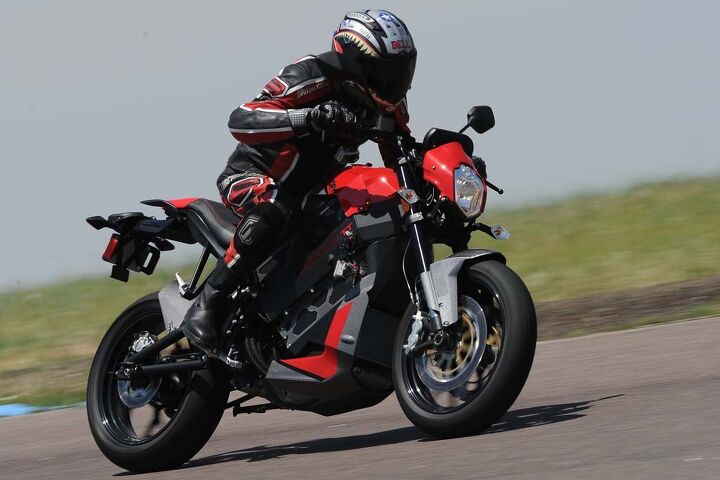
A few months ago, I wrote an article in response to the acquisition of EBR by a company known as Liquid Asset Partners, which describes itself on its website as specializing in "turning your underperforming assets into cash."

In that article I stated quite assuredly that Erik Buell's eponymous sportbike company was finally, truly dead.

"Let's be honest with ourselves," I wrote. "It's over. The final chapter has been written. EBR is no more, and nevermore shall be."

I had a handful of people take issue with me on that claim, calling me a hater who something something America something something engineering genius something something. I would soon be eating my words, I was assured, and EBR would rise again.

So confident was I, however, that I chose to double down on my claim, stating for all the interwebs to see: "I will be the first to cheer if I am ever proven wrong. I will loudly and happily proclaim my wrongness. I'll write... about what a cynical dummy head I've been. But I really don't think I'll get a chance to do that."

Of course, you know what happened next. Earlier this month, EBR announced that it is, indeed, back again. Liquid Asset Partners, despite its name, has apparently chosen not to liquidate all of EBR's assets but instead develop a "multi-year plan, and a 5- to 10-year vision" to put EBR back in the game. Production restarted on March 1st and the first bikes were expected to roll off the assembly line on St. Patrick's Day.


The company even invited the general public to celebrate at its East Troy, Wisconsin, factory on 18 March. 

All of which means I appear to have been wrong. A company that is 100% dead doesn't assemble bikes and offer free hot dogs. I guess I was being a cynical dummyhead, swimming the wrong way in a pool full of wrong juice while wearing my wrong pants.

So, here I am happily proclaiming my wrongness. Buell is back, baby, and everything is great. Nothing to worry about at all.

And yet...

I do wonder what's going to happen after this initial wave of bikes is gone. In an interview with the Milwaukee Journal Sentinel in July 2015, Erik Buell said that in the wake of EBR's collapse it had bikes "just sitting there, covered in plastic, waiting to be finished."

One assumes the bikes coming off the line now are those same bikes that have been sitting on the shelf for roughly a year — bikes that are no different than when introduced in 2014.

Whereas two years is practically nothing in the pace of change adopted by most American motorcycle companies, it's a decent stretch in EBR's chosen field of sport/performance bikes. Two years ago, the 1190RX was almost as good as the Ducati Panigale 1199, according to many moto-journalists. But now the Panigale is a 1299 and the 1190RX lacks the ABS and Euro4 compliance needed for it to even be legal in the European market, where the largest concentration of sportbike riders is found.


However, even in Europe, the popularity of sportbikes has plummeted in recent years. Wherever EBR sets up shop (it's still trying to put together a dealer network) it will be selling an outdated product to an ever-shrinking crowd.

And once the current stock of bikes runs out, once those bikes from 2014 are sold off at firesale prices to sentimental patriots, what then? What happens when EBR has to make truly new motorcycles? Does it have the equipment, the resources?

Maybe it does. Maybe the promised 1190AX adventure sport model was close to being ready when EBR collapsed a year ago and can get off the ground quickly. Maybe the company didn't lose that model in the split with Hero Motor Corp. Maybe it has the supply network and wherewithal to produce that bike and seize upon the current adventure-sport craze. Maybe the 1190AX is good enough to compete. And maybe the 1190RX and 1190SX will be updated, as well, to put them more on par with their competition. Maybe dealers and consumers will get fully behind EBR despite previous stumbles. 

Maybe. Maybe. But that sure is a lot of maybes. And I just don't see it happening.

Liquid Asset Partners has said EBR has "financial stability," but in the same breath expresses an interest in "new partnerships or investment." It's entirely possible that I don't understand the business side of motorcycling well enough, but that doesn't sound like a company on solid ground.

I find it so difficult to be anything other than cynical when I consider the future of EBR. But that wasn't the deal two months ago. I can't move the goalposts. I didn't say I'd proclaim my wrongness as soon as EBR delivered new, desirable models and turned a profit. I simply said I would apologize if I was wrong about EBR being dead.

And it's not dead, so, again, I was wrong. Wrong, wrong, wrong. Wrongity Wrongman from Wrongtown. 

My apologies.

(Originally published on RideApart)
ADSENSE HERE

What has Erik Buell taught us?

ADSENSE HERE

(Originally published on RideApart)

Sportbikes still matter in Britain. Less so than they once did, but enough that MCN —a weekly motorcycling newspaper with a readership of roughly 330,000 — dedicates several pages each week to superbike competition.

Read motorcycle reviews in UK publications and you'll notice a distinct sportbike tinge in the interpretation of a given motorcycle's qualities. The more a motorcycle displays sportbike-like features, the more reviewers are willing to forgive shortcomings.

Many British riders view motorcycling through a similar filter. They coo and swoon for machines that are unmanageable, uncomfortable, impractical and, often, unreliable, because said bikes are capable of going really, really, really fast. Keeping this in mind, I'll tell you about an experience I had in 2014.

I was at the UK's largest motorcycle show, Motorcycle Live, which draws thousands upon thousands of riders who feel it their duty to sit on every single bike. Or, well, almost every single bike.

Whereas I had to throw elbows to get close to other models, the area displaying the then-new EBR 1190RX was completely devoid of life. No one — I mean, not one person — gave a damn about it or the 1190SX. That's when I knew EBR was doomed. If you can't get people to look at your sportbike here, you've screwed up. It's like not being able to sell barbecue in Texas.


Less than five months later, EBR tanked. Some indeterminate part of the company fell into the hands of erstwhile partner Hero MotoCorp. The other indeterminate part (exactly what was sold was never fully explained to the public) was set to go to New Jersey businessman Bruce Belfer.

But after months of Belfer failing to raise the actual cash (no shame there, I suppose; I wouldn't be able to put together $2.25 million either), those indeterminate bits of EBR were sold last week to a company called Liquid Asset Partners, who specialize in, yes, liquidating assets.

There are a handful of Buellistas out there with enough faith to start a new religion (expect them to show up on your doorstep soon with pamphlets), and they swear unto their dad-jeans-wearing god that EBR is not dead (it's pining for the fjords, perhaps). They will point aggressively, full of hope, to a Liquid Assets Partners press release that uses the word "maybe" four times in a sentence. 

(UPDATE: That press release is no longer available on LAP's website. The company has removed all references to wanting to sell EBR as a single entity and has begun selling off whatever parts they can)

But let's be honest with ourselves: it's over. The final chapter has been written. EBR is no more, and nevermore shall be.

I'm inclined to believe that this is more or less the last we'll hear of EBR's eponymous founder Erik Buell. He's been eligible for AARP benefits for almost 16 years now and it seems unlikely that anyone will want to bankroll a venture in which he might hope to be involved.


Take that with a grain of salt. I've never met Erik Buell and I can't speak to what he will or won't do, or what he's capable of. However, a handful of established moto-journalists who have met him say he's the sort of person who should never be written off.

But, as many more people who have never met him will almost certainly point out in the comments below, Buell has been involved in multiple failed motorcycle companies. That sort of thing puts a mark on a fella, and in the skittish, hoodoo world of modern business, it may be an indelible mark. 

So, if this is the end, what lessons can we learn? What has Erik Buell taught us?

First and foremost I think he's taught us that the motorcycle business is kind of hard. And from that truth we can perhaps start to see why Buell was very much on his own in trying to make sportbikes over the years.

Because another thing Buell taught us is that Americans aren't all that into sportbikes. At least not enough that the things are going to just sell themselves—not the way cruisers do. I don't know why Americans love cruisers so much. I'm genuinely baffled every time I see that Harley-Davidson motorcycles still account for 50 percent of the bikes 600cc or larger sold in the United States. The sun is yellow, the sky is blue, Americans buy a lot of cruisers. Some things just are.

That's not to say American motorcyclists are completely homogeneous, it's simply that there aren't enough riders in a given non-cruiser category that you can throw any old bike out there and expect it to sell... especially since those non-cruiser riders are used to looking beyond US borders. Patriotism doesn't necessarily work on them.


Buell's motorcycles were innovative in certain ways, but none were ever truly better than their foreign competition. This was a fact especially damaging to Buell considering his chosen style; electronic whizbangery is an inherent part of the sportbike genre.

So, the third lesson from Buell is that if you're going to build something other than a cruiser in America, you can't rely on intangibles to make it sell. America's major manufacturers have already taken note.

This past November, I got an opportunity to corner Gary Gray, product director for motorcycles at Polaris (parent company of both Indian and Victory). I looked him right in the eye and I said: "You know there is a desire out there for something other than a cruiser, right? You're making great bikes, I love them, but surely you've heard the voices calling for these engines in a different platform?"

His answer, diplomatic and far more tactful than my question, was effectively: yes, they are aware of those voices, and they don't dismiss them outright, but they are also alert to the fact that anything they do has to make economic sense.

This is what Buell taught them: If US companies are going to answer the voices calling for non-cruisers, they have to be damned sure those voices will translate into sales. Otherwise, they face the curse of the fifth thing we've learned from Buell, which is that American motorcyclists hate failure.

Oh, man, do we hate it. Hate, hate, hate it. Take a look at the vitriol against Buell that you see in some forums and internet comments. You'd think the man had been making the seats for his bikes out of kittens.


All in all, there is a sadness in looking at the career of Erik Buell. A sadness that is sad in part because it's an unfair weight to place on his shoulders. After all, Buell has in his career accomplished a whole hell of a lot (he may accomplish even more, who knows?). But there is the deep-sigh ache of what could have been, what might have been — what, maybe, almost was.

Almost. And more than once.

As I suggested in my 2016 predictions, there may be a day, many moons from now, when people will look back on the legacy of Erik Buell with kinder eyes and he will receive the accolades he seems to be missing out on now. Maybe then someone, or some company, will be inspired to make an American motorcycle that isn't a cruiser. And maybe, because they will have learned from Buell's experiences, it will succeed.

They'll have to call it something other than an EBR, though. Because, odds are, that name will still be in legal limbo.
ADSENSE HERE

Good news, bad news: Moto predictions for 2016

ADSENSE HERE

(This post was originally published in another form on RideApart)

Prediction 1: THE AMERICAN MOTORCYCLING RENAISSANCE

The good news: We're hitting a renaissance of American motorcycling. There are strong rumors of Indian delivering a bike this year called the Chief Springfield, which will be based on the existing 1811cc V-twin platform. It also seems inevitable that the Scout and Scout Sixty will head in different aesthetic directions.

Meanwhile, Victory has promised a 1200cc liquid-cooled V-twin for 2016. Based on the Combustion and Ignition concepts of last year, the final product will likely disappoint those hoping for the super naked, of which Victory is totally capable—but you know, baby steps. And remember that last year the company also trademarked the name "Victory Charger" for use on an electric bike, which will almost certainly be more than just a rebranded Brammo.

Elsewhere, it seems Harley-Davidson is (slowly) phasing out the Twin Cam 103, and its Street models will need updates (brakes, emissions) by the end of the year if they're going to continue to be legally sold in their target European markets. And Motus has finally (really, no for real this time—we mean it) started production of its MST and MSTR sport-touring motorcycles. Yes, in terms of electronics, the bikes are roughly 15 years behind every other sport tourer on the market (while still costing more), but they are a huge step forward within the American arena.

And therein will be the story of 2016: All of the above will combine to make it year one of a renaissance that will eventually see American motorcycle companies leading in more than just intangibles. 


The bad news: EBR and, by extension, Erik Buell will play no part. Maybe one day, many decades from now—in a spirit similar to the modern affection for Nikola Tesla—crowdfunding campaigns will ensure statues of Buell are erected at all of Wisconsin's major border points. But in the meantime, he's damaged goods. From a corporate perspective, the sum of Buell's career is that he has unintentionally proven there is no interest in American sportbikes. Even companies willing to push against that assertion will steer clear of Buell's bad mojo. 

Prediction 2: THE RISE OF ELECTRIC MOTORCYCLES 

The good news: Thanks to Polaris' acquisition of Brammo last year, Victory can awkwardly lay claim to the title of "First Major Manufacturer with a Production Electric Motorcycle." It's a title that will be held more securely if the company delivers the aforementioned Victory Charger in 2016. But it will have to do so quickly because Yamaha, Honda, BMW, Kawasaki, Suzuki and Harley-Davidson have all flirted with the genre.

And it seems a few of those are quite close to committing. I suspect we'll have a better idea of who's really willing to take the plunge this summer, when the Isle of Man TT Zero takes place.

Meanwhile, established e-bike manufacturer Zero will benefit from tax breaks in the United States, as well as its return to certain European markets from which it retreated a few years ago. And Italian firm Energica is in the process of expanding both its business and its lineup.

This all suggests that the long-predicted "Future of Motorcycling" may have finally have arrived.


The bad news: If the "Future of Motorcycling" has arrived, I think it will still take some cajoling to get motorcycle buyers to the same point. Motorcyclists are notoriously conservative and susceptible to hoodoo beliefs. A company may be able to deliver an electric motorcycle that will 100 percent satisfy a given rider's needs, but that's no guarantee that said rider will buy it, especially if oil prices stay low.

Depressingly, if the two sides can't meet soon it will probably result in the concept of e-bikes being shelved for a while.

Prediction 3: FORCED INDUCTION AWAKENS

The good news: Suzuki, Kawasaki and Honda are all known to be working on some form of forced-induction (turbocharged or supercharged) engine. Forced induction essentially means you can get liter-bike power from a 600cc machine while retaining the fuel efficiency of the latter.

All four of Japan's big manufacturers toyed with the concept in the 70s and 80s, but eventually gave up due to issues with turbo lag, heat, cost and reliability. However, the nearing implementation of strict Euro 4 emissions regulation has revived the concept. Most recently, we've seen it used in the Kawasaki H2 and H2R, but 2016 may be the year in which we see forced induction used in slightly more real-world applications (i.e., bikes that won't rip your arms off).

Suzuki seems most likely to get there first, having revealed its Recursion concept a few years ago, and a production-ready turbocharged engine at last year's Tokyo Motor Show.


The bad news: Without a doubt, Suzuki will pull the most Suzuki thing ever and put its new, fantastico engine in an all-rounder that possesses the visual excitement of a half-eaten bowl of Cheerios. Some time later, Kawasaki will deliver a bike that is less comfortable, less useful, and sickeningly green; and moto journalists from Santa Monica to Sidney will soil their pants in giving it praise.

Last to the party will be Honda, which will place its forced-induction engine in an automatic-transmission and airbag-equipped motorcycle that delivers just 40 hp and looks like a manatee, but has fuel economy of roughly 700 mpg. Some weird Austrian guy will buy one, and thereafter, spend 20 years traveling the world without ever needing to replace a part.
ADSENSE HERE

Is Belfer for real? Thoughts on the future of EBR

ADSENSE HERE

I watched a lot of professional wrestling when I was a kid. This was during the dying of the light for wrestling territories. Down in Texas it was all about World Class Championship Wrestling. I remember, too, watching Mid-South and a fledgling World Championship Wrestling. When my family moved to Minnesota I got to see the American Wrestling Association in its final two years. I never watched WWF; I didn't like it.

The common thread in the wrestling I liked was that it was based in the Southern or Central parts of the United States. In those wrestling promotions (and in my wider Texas-born world), people from the East Coast were always bad guys. They were condescending, arrogant, unethical, smarmy –– always trying to trick you. These themes still run as subtext in American country music, but in the unfettered days before cable TV dominance (and, later, the internet), they were rife in the South. 

As a result, oh my goodness did I hate the East Coast. I hated it in the pure and unquestioning way only a child can. Although I've grown up and now have the ability to override childhood prejudices, some intrinsic distrust remains.

I tell you all this to explain my illogical and totally unfair gut reaction to Bruce Belfer.

Belfer is the owner of Atlantic Metals Group LLC, the company that recently purchased Erik Buell Racing from receivership. And one of the first things Belfer seems to want people to know is that he is from New Jersey. Or, rather, "Jersey." 

Which is something I find infuriating. He is not from Jersey. That's an island in the English Channel. Belfer is from New Jersey. How arrogant is it for a person to think that where he or she is from is so significant they don't have to correctly identify the name of that place?


Ugh. Sorry. Breathe. See what I mean? It runs deep. And, as I say, it's totally unfair. 

It is also silly and personally frustrating. Because on the strength of his words Belfer is someone I really like. He's recently given interviews with both Motorcycle.com and the Milwaukee Business Journal, and in them he's said things I not only agree with but that cause me to pump my fist in celebration.

For example: "America needs another cruiser manufacturer like it needs a hole in its head."

Yes! Yes to this a thousand times.

I also think Belfer is spot-on when he says the main reason EBR failed was that it got "distracted from its primary business of manufacturing motorcycles... [it] did not focus its energies well. So, what was missing from the equation was service to the customer base, in the form of parts and warranty service and new models. At base, the core business was being ignored."

Belfer talks a lot about "the core" in his interviews, which I think is, again, spot-on. A few months ago, Cycle World ran a three-part interview with Harley-Davidson CEO Matt Levatich in which he used the word "core" 14 times.


"Core is critical," Levatich told Cycle World. "Clarity of direction is critical... We are not going to confuse ourselves with... other things because that would take us away from being great at motorcycles."

Considering Harley-Davidson controls more than 50 percent of the U.S. market for motorcycles with engines of greater than 600 cc, I think Belfer is wise to follow the same strategy. There seems to be a consensus amongst the keyboard quarterbacks that too much focus on racing is the thing in particular that "distracted" EBR into failure.

Erik Buell has always loved racing, considerably more than the overwhelming majority of American motorcyclists. The feeling is that his dedication to the former resulted in his being unable to deliver a desirable product to the latter.

In a July interview with the Milwaukee Journal Sentinel, Buell effectively denies this, saying that racing "didn't cut too deeply" into EBR's revenue. Which, of course, means that it did. If it was cutting into EBR's revenue at all, and EBR's revenue was such that the company found itself being walloped more by than $20 million in liabilities, it was inherently cutting too deep.

Read between the lines and it would appear that Belfer agrees with this assessment. Tactfully, he told Motorcycle.com: "you can't really separate the EB from the R. They've cut their teeth in racing. Having said that, applying those skill sets to a broader range of products makes a lot of sense to me... we have to hold onto the Erik Buell Racing definition of EBR, and we have to expand it to Engineered By Riders."


Lest there be too much grey for you in that statement, Belfer clarifies his position by saying: "A racing program is one of the most expensive things a company can undertake, and I will not sacrifice the core business for a racing program... [Racing] is a huge part of the brand. But for me it has to be about business. For EBR and its employees, it has to be about business."

Superbike racing is pretty niche in the United States. By extension, so, too, are supersport motorcycles. EBR's opening shots at the motorcycling market were via the supersport 1190RS and 1190RX. In their very existence, these bikes asked the question: Is there room in the market for another expensive supersport that is as good but not significantly better than existing supersports?

In the United States the answer to that question was (and, I suspect, always will be) "no." Arguably, you'll get the same answer on a global scale. Name one company on the planet that is successfully staying afloat selling only sport bikes. EBR eventually produced the 1190SX but I think that came too late.

So, Belfer's strategy of focusing on the core is, in my opinion, a good one. The question from there is: who is the core?

If Belfer (rightly) believes there is no need for another cruiser company, if he believes, as Victory Motorcycles Head of External Relations Robert Pandya told me in an interview a few months ago, that "there are spaces where American bikes are not currently present," and that some of these spaces can be successfully filled, who does Belfer think he'll be selling to?


It won't be the same "core" that Harley-Davidson are chasing. It won't be the too-small-to-be-relevant core of American superbike enthusiasts. Look to interviews Belfer has given and he's admittedly somewhat vague on defining the core, but he offers a few hints on who he thinks it is.

At one point in his Motorcycle.com interview he says the reborn EBR's first order of business will be "to reward the faithful." At another point in the interview he lets slip this fact: "I originally tried to reach out to Erik Buell when the Harley situation came apart for him, being a lifetime fan."

Belfer is the faithful.

So, who is the core? People like Belfer. And from what I can pick up, Belfer is one of those folks who didn't so much love EBR as admire it because of what it had come from: Buell Motorcycle Company. Indeed, check out the EBR Facebook page or pay close attention to internet comments from EBR fans and you'll note that a whole lot of them don't actually own EBR bikes. They have Buell machines.

So, I sense that the EBR that Belfer wants to build is the Buell Motorcycle Co. that he believes could have been had Harley-Davidson not derailed the whole thing with its lack of faith. Buell Motorcycle Co. made sportbikes, yes, but it also produced naked/standard motorcycles, the infamous Buell Blast, and the ahead-of-its-time adventure-sport Ulysses model.

In a broader sense, then, the core that Belfer is hoping to reach is also someone like me: someone who wants an American-made motorcycle that isn't a cruiser and that isn't hyper-niche/hyper-expensive. I want a motorcycle that isn't painful to sit on for more than 45 minutes, a motorcycle that isn't ridiculously low to the ground, and a motorcycle that can be put to use in a number of different scenarios. I want an American motorcycle that is like so many other motorcycles made by BMW, Ducati, Honda, Kawasaki, KTM, Moto Guzzi, Suzuki, Triumph, and Yamaha.


Cynics might say that this core rider doesn't exist in great enough numbers. If it did, why did Buell Motorcycle Co. tank? Why did Harley-Davidson lose faith in it and drop it like a burrito filled with pubic hair?

Well, firstly, I think Harley-Davidson was too focused on its own core to be able to see any other kind of rider. But, I also go back to a post I wrote a while back that everyone totally misinterpreted, in which I suggested that for many years Harley-Davidson skewed the motorcycling landscape. They defined what an American motorcycle was and, by extension, what it was supposed to be.

But you will notice that in the last few years Harley-Davidson has been changing far more rapidly than it had in the decades before. Why? Why are they changing and why would Buell Motorcycle Co. now succeed?

Simplifying things somewhat, the answer comes in the pervasiveness of the internet. Specifically the fact that social media is everywhere. In the short time since Buell Motorcycle Co. was scrapped social media has spread beyond the phones of college kids into everyone's lives everywhere. And in so doing, it has given everyone a voice.

Meanwhile, motorcycle publications have all but left store shelves and now reside primarily on the internet. There is no hardcopy version of RideApart or Bike EXIF, for example. And by existing in such a fluid and vocal space these publications have discovered that there are a lot more motorcyclists –– and potential motorcyclists –– out there than we thought who want something other than a cruiser, who don't think certain technologies (e.g., anti-lock brakes) are an affront to their manhood, or who, indeed, are not even men.


The Harley-Davidson vision of motorcycling no longer suppresses other interpretations. If this environment had existed 10 years ago, Harley-Davidson might never have pulled the plug on Buell Motorcycle Co. Now that the environment does exist, I think Belfer's EBR might have a chance.

Well, in theory it might.

In an article I wrote for RideApart recently I identified a number of issues that make me cynical about EBR's future. My biggest concern is how EBR handles its old debt. If I understand the rules of receivership, Belfer's EBR doesn't have to pay its old debts. But it seems to me it will want to make some sort of peace with the holders of those liabilities if it wants to be able to move forward. I mean, the motorcycling world can't be so big that you can go around burning bridges with suppliers and dealerships.

For his part, Belfer is again saying all the right things.

"Our first order of business at EBR is to reconnect with our dealerships to figure out who's still on board," he told Motorcycle.com. "There may be some attrition, it wouldn't surprise me, but I'm hoping it will be minimal, and that the best players stay in the game.

"I can't speak for them. I can speak to what we're going to do, and we're going to do right by our dealers. And we're going to do right by our clients. The first thing we have to do is step up."


I also like how Belfer plans to "step up." He says he's a strong believer in American manufacturing, in creating American jobs for American workers.

"I feel very strongly that the only way for this country to return to its glory is to make things," he said. "The only way for the U.S. to get back on its feet... is by being productive."

Which brings us back to my illogical and totally unfair gut reaction to Belfer. On paper, based on what he's saying, I love this guy.

I want to believe that he has a genuine grasp of the challenges EBR faces and that he equally possesses the skills, drive and business acumen to overcome them. I want to believe that the 1190AX adventure sport that was rumored to be just around the corner will be resurrected and that I'll be riding one within three years. I want to believe that EBR will slowly, steadily grow and that its success will force America's other manufacturers to diversify their models, and in some glorious future people will be talking about the dominance of motorcycling's Big Four and they will be talking about American machines. I want to believe. I want so much to believe.

But I don't. I don't believe it at all. I expect EBR to flounder for a while, promise things it can't deliver, maybe take the Motus route of offering an out-of-date motorcycle with Givi luggage and an astronomical price, then collapse before 2020.

Maybe the reason I don't believe it is because the 8-year-old in me sees a man who is just trying to connive his way into winning the heavyweight title. Or maybe it's worse than that. Maybe I've lost faith in the American Dream.

I don't believe Bruce Belfer. But I hope I'm wrong. I very sincerely hope that Belfer will make me eat my words.

ADSENSE HERE

EBR we hardly knew ye

ADSENSE HERE

By now you will have heard the news that EBR is no more. Out of the blue this week, the company announced it was shutting its doors, laying off all 126 employees and selling off assets to try to cover a $20 million debt.

That's a damned shame. And it's really surprising. OK, when I was at Motorcycle Live last November I did note a certain dearth of interest in the bikes (as I wrote at the time: "I probably could have wheeled one out of the hall without being noticed"), but overall I felt things were moving in a positive direction for the company. I really imagined that within 5 years or so, Erik Buell Racing could be a legitimate player and that it could be a source of pride for motorcyclists in the United States.

There were all sorts of reasons to believe such a thing. The 1190RX (introduced in 2013) and the 1190SX (introduced in 2014) had both received critical acclaim. Sure, there were some first-effort quibbles but no one really held that against EBR. A lot of motorcycle publications chose to pit the 1190RX against the Ducati 1199 Panigale in comparisons and found it to be a solid, viable contender. Cycle World said: "If you have one molecule of national pride, now is the time to be proud that we finally produce a motorcycle like the 1190RX."

In competitive racing, EBR was holding its own against far larger, better-funded and more-experienced teams. Last year, it had established a base in Europe. And in 2013 it had partnered with India-based Hero MotoCorp, giving it access to better funding and distribution.

People like me were starting to look forward to seeing what EBR could do. True fact: The day before I learned of EBR's collapse, I was planning to write a post about how eager I was to see EBR produce the adventure-styled 1190AX. I was planning to declare: "When they make it I will buy it."

Now I won't get that chance. The bottom has fallen out.

We don't really know why. One gets the sense that it has something to do with the fact that being good at designing motorcycles doesn't inherently mean you are good at selling them. EBR bikes still needed a little bit of work -- they hadn't truly arrived in terms of aesthetics and features -- and it's difficult to get someone to fork over $20,000 for a bike that isn't perfect.


Add to this the fact the brand had not had any time to develop a personality. I mean, not too long ago I was lamenting that 17-year-old Victory lacks a true identity. EBR had been producing street bikes for less than two years.

Then there was the partnership with Hero. I think a lot of people might have misinterpreted it to think that EBR had effectively become a foreign company, or that EBR bikes were being manufactured in India. That perception wouldn't have helped. But also there's the fact that Hero is a gigantic corporation and Erik Buell doesn't seem to know how to protect himself from getting screwed over by gigantic corporations.

Americans hate a failure and a lot of the reaction I've seen to EBR's shutting its doors has been, in my opinion, unnecessarily mean-spirited. I guess some American riders would prefer we not try, rather than look silly trying to catch up. For me, I take the news with a feeling of sadness.

EBR seemed like America's best hope of producing a bike that isn't a cruiser. This is a common lament for me. I like cruisers -- I like them a lot -- but it irks me that cruisers are the only thing American businesses seem willing to manufacture. See, because I am one of those people who likes to say that America is awesome. But I'm also one of those people who doesn't like to be full of shit. And where motorcycles are concerned it is presently impossible for me to be both things at once.

Cruisers we've nailed. Harley-Davidson, Indian and Victory are unquestionably better at making a gigantic rumbling torque beast than anyone else. The fellas at Triumph definitely get it, but the Yanks are still better. Everything else, though? We don't even try. We should be kicking ass in every genre, because that's how you earn the right to go around telling everyone you're the best -- you be the best -- but we won't even throw our hat in the ring (a).

I had thought that with big corporate funding EBR was going to change things. They were able to compete in the rarefied air of supersport machines. I really believed that with a little time they'd be able to stand on top. Equally, I pictured the 1190AX as one day being good enough that Japanese manufacturers would start trying to copy it, in the way they're currently chasing after the Ducati Multistrada. Or, at least good enough to encourage Polaris to live up to its potential and produce the best adventure bike in the world.

Indeed, that was my main hope for EBR: that it would encourage America's other manufacturers to come out of their cruiser caves. Harley-Davidson isn't staffed by idiots; it could produce a standard or a sport or an ADV bike if it wanted to (Ever heard of the Nova Project?). Polaris definitely could. Hell, the Indian Scout is almost there already.

But for the time being it seems unlikely that American manufacturers will try to do such a thing. Especially when there's no home-grown competition to spur them on. And I find that upsetting.

Meanwhile, I wonder about the fate of Erik Buell. He's 65 years old now. Perhaps it's time to call it a day and retire. A few comments I've seen insist he'll bounce back, and that's certainly the suggestion made in the statement he released about EBR's closure.

"While this is a sad ending, I personally hope for a new and better beginning," he said.

But who's going to believe in Buell now? If in a year or two there were a bike with some new permutation  of Buell's name on the tank, would you have any faith in it? I wouldn't. I'd think: "No thanks. Any parts/dealer support for this bike will disappear within a few years."

So, another motorcycle manufacturers disappears in a poof of disappointment and thoughts of what might have been...


____________________

(a) Some of you may respond to this by saying: "Chris, what about Motus?" Yeah, I've given up on them. They still haven't actually put a bike out and the bike they plan to release costs thousands and thousands of dollars more than any competitor whilst being decades behind in certain technical aspects (e.g., no ABS, traction control, electronic suspension or other features that are increasingly standard on other sport tourers). To me, they've become an embarrassing joke. Though, having said that, I would absolutely love for Motus to make me eat my words. If anyone at Motus is reading this, please, please, please make me look like an ass for criticising you and put out a truly awesome bike. If it costs what a sport tourer actually should cost, I will find a way to buy one and I will say a little apology to each and every one of you every time I press the starter.
ADSENSE HERE

A look back at Motorcycle Live

ADSENSE HERE
I went to my first motorcycle show recently: Motorcycle Live. The show takes place in Birmingham every year and is reportedly the country's largest.

I can believe that claim. The show runs for nine days, thereby incorporating two weekends, and when I was there on a Wednesday it was packed. Test rides booked up within minutes, empty places to sit were few and far between, and you had to do some pretty aggressive hovering to be able to sit on the models that appealed to you.

The models of motorcycles, that is. As opposed to the other type of model. I'm not sure we would have been allowed to sit on the underfed girls who prowled the convention halls shoving leaflets into people's hands.

I can't find any recent figures, but in 2011 the show drew more than 112,000. If you consider that the European economy has improved (just a tiny bit) since then, and there have been a huge number of new and interesting bikes announced this year, it's safe to say they are on track to do better this year. (UPDATE: 117,000 attended this year) I'm terrible at gauging such things, but I'm willing to bet I was one of at least 10,000 people on the day I visited.

There was plenty of space for us, to be fair, with the hundreds of exhibitors and manufacturers spread through a number of gigantic aeroplane-hangar-sized halls. I suppose the cost of heating such an enormous space is where the bulk of one's £17 ticket price goes. And to that end, I don't imagine I'll go to Motorcycle Live again in the future. I loved getting a chance to see and sit on so many bikes, but overall I don't think it was worth the money, nor the effort I had to put into getting there. Birmingham is 125 miles from Cardiff; riding there in a cold drizzle was a whole lot of not-fun. Riding home in the same conditions was even worse in the dark.

Still, there were a number of positives and I came away from the show with lots of things for my motorcycle-loving brain to spin around on for the next several months. Here are my impressions of the show, organised by the manufacturers that drew my attention most.

BMW
Tiny men love this bike. 
Short guys fucking love the R1200GS. I don't understand this at all, considering it is such a tall bike, but they were swarming around this machine, almost crawling on top of each other for the opportunity to sit on it, squeeze the levers and click the gears up and down.

This is what you do at a motorcycle show, it would appear: click those gears as if they were your path to the Heavenly Kingdom. Make sure you put on a very serious face when you do it, too. You are testing the... uhm... something. It is serious business that demands a serious face. Equally, you should bend down and stare intently at a random part of the engine. Poke it and furrow your brow, so people know you are seriously assessing this bike seriously.

BMW fans were easily the most guilty of this behaviour. They were primarily also white males over the age of 40, with expensive shoes and hairstyles that would have been stylish 10 years ago. Being amongst them made me feel a little sad. I don't want to be one of these guys. But I sure as hell would love to own a BMW. 

I have already stated my desire to own a BMW F800GT. Finally getting to sit on one at the show only increased that desire. I also found myself intrigued by the F800R, which costs less than its fully-faired sibling and isn't as ugly as it looks in pictures. I was surprised to find myself generally unimpressed by the RnineT, but I really dug the R1200RS and R1200R models. I did not dig their prices. The R1200RS will start at £12,500 in Her Majesty's United Kingdom.

Meanwhile, the staff at the BMW area knew very little about BMWs. This was a common theme for all the exhibiting manufacturers. The F800GT on display was kitted with panniers and other extra bits, so I found a woman and asked her if she knew how much that bike would cost.

"There's the... uhm... on the... uh..." she said, pointing to a display board next to the bike.
"Yes," I said. "The standard price is there, but this bike has panniers, a top box, and some other stuff."
"If you... uhm.. ah..."
"You don't know, do you?"
"No. Sorry."

She directed me to a bloke who also didn't know.

Ducati
I couldn't care less about a Panigale; my attention went instead to the new Scrambler, which looks pretty damn good in person. Though, I'll admit that something –– I don't know what –– cooled me on the bike a little. Maybe I'm just not that big a fan of scramblers. Maybe it's the fact that I really can't imagine quite how a Scrambler would fit to my actual life.

I liked it. I just didn't find myself sitting on it and thinking: "Oooh, I need this."

EBR
The same could be said of the EBR 1190RX and 1190SX. Poor EBR got very little love from show attendees. People walked by without even glancing at these American-made machines. They were so ignored I felt I probably could have wheeled one out of the hall without being noticed.

That made me feel just a little sad, because I'm an American and I want to see American things do well. But I have to say I don't really blame all the people who ignored the EBR bikes. In person, they are not terribly exciting. The ergonomics of the bikes are awful for someone of my height and the seats are about as comfortable as laying a sweatshirt across a keyboard.

Harley-Davidson
Impractical but sexy –– Harley-Davidson Seventy-Two
I don't really know what Harley's doing in terms of marketing in the United States these days, but over here they've gone for a completely different vibe than the one I had always known. This is a good thing, in my opinion. Remember that all the old dudes on Road Kings I used to see when growing up in Minnesota are what put me off biking for so many years.

I saw none of that at Harley's area of Motorcycle Live. There were no leather vests with patches. No bandannas and long beards. No biker babes. None of the clichés. Instead, the exhibit area had a live DJ mixing house music replete with bleeps and bloops added via Launchpad. None of the stuff contained in that last sentence ("house music," "Launchpad") would make a damned bit of sense to the Sturgis crowd, and I love that fact.

Not too long ago, I had a conversation with the former head of marketing for Mercedes, who told me that one of the most important things to do when promoting a brand is to reduce your philosophy to three words –– four at the most. From there, you make sure that everything you do fits that three-word definition. Here, the three words I would have used for Harley-Davidson were: Unique, Intelligent, and Modern. If allowed to add a fourth, I would say Urban. I like seeing Harley-Davidson perform this tack.

I sat on a number of bikes and found them to be ergonomically awkward compared to those offered by other manufacturers. This is the same thing I experienced back when I got a chance to test ride the Sportster 1200 and the 883 SuperLow. Harleys just don't seem to fit me well. The exception is the Seventy-Two, which I got to sit on and really enjoyed. I can't imagine how I could ever argue such a bike from a practical side, but man it was cool. Somebody buy me one, please.

Herald
Ever heard of Herald Motor Company? Neither had I. They seem to be a Chinese outfit, offering a load of 125cc machines. But they are pretty cool-looking 125s. Odds of my ever owning one are extremely low. They drew my interest simply because I have a long-running fantasy of duping Jenn into riding by showing up one day with a 125 for her to learn on. She prefers "real" motorcycles, so the aesthetics of these machines would suit her.

Honda
Probably not the demographic Honda was
hoping to capture with the Vultus.
Take the number of short dudes clamouring for a glimpse of the BMW R1200GS and increase it by a zillion: therein you have the number of bald and semi-bald white dudes in their 60s and beyond who were swarming the bulk of Honda's offerings. This made me a little sad considering I am a Honda owner, a general fan of Hondas, and a white guy. I don't want to be anyone's grandfather yet. But here I was hanging out with loads of them and finding much in common.

The redeeming aspect of this is that when you look at Honda owners in general they are a grubby crew who ride their bikes into the ground. Their gear is worn to hell from use. And I suppose, ultimately, that's the group you'd want to be associated with, even if they don't look as flashy as the BMW guys.

Meanwhile, as far as the actual bikes were concerned, I didn't really find myself swooning over them. Many models (e.g., the ST1300 Pan-European and the VT750 Shadow) are long in the tooth and in need of a refresh. Whereas others (e.g. NC750X, et al.) were so mind-numbingly practical I felt I needed a nap.

Also, the Vultus looks terribly cheap in person, and its ergonomics were awkward. It's definitely off my list.

Some positives, however: Honda's sport bikes were drawing a decent amount of attention from younger white males, many of whom still had their hair or, at least, the wisdom to cover things up with a baseball cap. The look of CTX1300 continues to grow on me, though I still struggle to imagine scenarios in which I would choose to buy it over the similarly priced Victory Cross Country. And I found the CB500 series of bike (CB500F, CB500X, CBR500R) to be more formidably sized than I had previously realised. I could definitely picture myself getting by on a nicely-kitted CB500X –– still perfectly able to travel anywhere in the United Kingdom.

The new True Adventure bike revealed at EICMA was on display, and I found one aspect of that bike to be particularly interesting: there was no clutch lever or gear pedal. That suggests Honda will be equipping the machine with the DCT automatic transmission, and creates a whole lot of questions.

Honda seems to be going all-in with its 750cc DCT platform, using it to create the NC750S, NC750X, NC750 Integra, Vultus, and probably soon in the bike currently known as the CTX700 (not sold in the UK) once Honda runs out of old 700cc stock. And now, apparently, the True Adventure. So, what does that mean for the NC750X? Does it get scrapped? Does Honda rework the X's engine to get a little more oomph and transform it into a middleweight adventure-tourer? Will the True Adventure be an expensive novelty machine like the Vultus?

Indian
I got a chance to test ride an Indian Chief Classic as a part of the show and will be writing up a review in the near future. The short review is that it is an amazing machine.

What I was most looking forward to seeing, however, was the new Indian Scout. It is a beautiful machine up close and I am delighted to report that its ergonomics were perfectly agreeable to my 6-foot-1 frame.

I am looking forward to test riding the bike once it officially arrives in Blighty in March. The day the Scout was launched back in August I called my nearest Indian dealership, Blade Victory and Indian in Swindon, and asked to be contacted as soon as test rides are available.

Swindon is some 80 miles from Penarth, which would be a pain in the ass if I were a Victory or Indian owner and needed work done. Though, the guys at the Indian area of the show said the company is working on expanding its dealer network.

In contrast to the image of urban modernity being promulgated Harley-Davidson, the three words I would use for Indian's approach are: Authenticity, Heritage, and Quality. Again, though, there were no leather vests with patches, no biker girls, no incessant blaring of "Born to Be Wild." The feeling was high-end, and I think it "sold" well to the crowd. In a country where cruisers get the least amount of love, Indian was garnering quite a lot of wide-eyed attention. I found it especially refreshing to note how many women were keen to sit on these bikes.

Indeed, throughout the show I noticed that women gave most of their attention to cruisers and classic-styled machines –– the "real" motorcycles my wife likes. I would hope that some of the manufacturers' marketing teams were there to notice this. With the exception of Harley-Davidson, too many manufacturers are ignoring women as customers.

Kawasaki
Kawasaki Vulcan S
Women were giving a lot of love to the new Kawasaki Vulcan S, too. Though, they weren't the only ones. Indeed, with the possible exception of the Triumph Bonneville range, I saw no other bike at the show drawing so much attention from such a wide range of ages, genders and social classes. Kawasaki had three models of the Vulcan S on display and still you had to muscle your way through the crowd to sit on one.

Previously I described the Vulcan S as looking a little "meh" to my tastes, but I rescind that criticism having now had a chance to see it in person. It has a great, quality look, is nice and roomy, and is comfortable as all get out to sit on. I have promised myself that I will test ride one as soon as I can. This is dangerous, because the Vulcan S is "affordable" (less than £6,000) and a positive test ride might result in my just going nuts and getting one.

Royal-Enfield
The Continental GT; what a joke. Uncomfortable to sit on, tiny, and looks cheaply made. I was thoroughly underwhelmed. As were most show attendees, it seems –– the Royal-Enfield area was almost as quiet as the EBR space. Whereas it makes sense for a small, relatively new American company to get little attention it felt a little sad to see a long-standing brand like Royal-Enfield being so ignored.

The bikes getting the most attention were the Classic 500s. They were quite popular with ladies who appeared to be in their 70s and 80s. Seeing this, it suddenly became clear why Royal-Enfield has struggled in recent years to find a UK distributor.

Suzuki
Whereas some of Honda's models are long in the tooth almost all of Suzuki's are. And even those that aren't look that way. Case in point: the "new" GSX-S1000F. Its awful paint scheme makes it look 10 years old. Playing the three-word marketing game with Suzuki, the words that come to my mind are: Affordable, Decent, and... uhm... Affordable. Suzuki's bikes are just a little underwhelming.

Regardless, I am still saving up to get a GSX1250FA. To that end, I spent a lot of time staring at and sitting on the GSX1250FA that was on display at the show. I am pleased to report that I found the ergonomics to be quite agreeable.

Additionally, I found myself warming to the V-Strom 650. It is a formidably sized machine and for all the European journeys that I imagine myself taking on a GSX1250FA, I suspect the V-Strom would be just as well suited if not in some cases better. And it gets better mpg. This is something Bob Leong told me years ago; I trust he's in heaven now saying "I told you so."

Triumph
You have to pay extra for a fuel cap that locks.
Because Triumph.
The staff at the Triumph area knew very little about Triumphs. They did not know when the Bonneville line will get ABS. They did not know if the alloy-wheeled Bonneville can take radial tires. They did not know whether certain Bonneville accessories would fit the Speedmaster. They did not know if you can simply add cruise control to the Tiger XR or if you inherently have to get a Tiger XRx. And on. It was annoying.

That didn't stop me from falling in love with the Thruxton, though. My local dealership doesn't have one on display, so I'd not really had a chance to stare at one in person before. Yes, it uses stupid bias tires and the mirrors are only a tiny step above useless and I wouldn't even consider buying one until Triumph adds ABS and you have to pay extra to get a fuel cap that locks, but it is so cool! I mean, really, really cool. Especially in green.

That bike is so cool some part of my brain has already started to rationalise getting one. My ultra-practical side, the side that is trying to keep me from locking myself into the challenge of making monthly payments, is clinging to my ABS dogma like a priest clutching a crucifix at an exorcism. When Triumph eventually delivers anti-lock brakes (I would expect to see it announced before the summer), I may not be able to hold out any longer. Practicality be damned.

Victory
Speaking of bikes that look good in green, oh my goodness is the Gunner a sexy beast. I have never seen a picture of this bike that manages to capture just how attractive it is in real life. Sitting on the machine, I felt a deep urge to just hug it and thereafter refuse to let go. I could easily imagine a scenario in which staff from the National Exhibition Centre were having to pry me off the bike as I wept and shouted: "It's mah baby! She needs me!"

The seat of the Gunner is ridiculously comfortable; the overall ergonomics of the bike felt ideal. Whether the Gunner is £1,300 better than the £9,000 Victory Vegas 8-Ball, however, is up for debate. I realise the former is presently the only Victory cruiser with ABS as an option, but oof.

Meanwhile, I continue to be disappointed by Victory's marketing strategy. Here is where you hear classic rock being blared. Here is where you see scantily clad women tottering on high heels who don't know a goddamn thing about the bikes they're shilling. I mean Not. A. Single. Fucking. Thing.

At one point in the afternoon, there was a guy who demonstrated that Victory bikes can actually be manoeuvred into very tight turns (if you've had shedloads of training and you don't mind the very high possibility that you'll drop your bike). As he was setting up, one of his crew was flirting with a Victory girl and showing her how to start the bike. He had to show her how to twist the throttle.

I almost started screaming. That kind of bullshit is everything that's wrong with motorcycling. All those females at the show who were paying attention to cruisers and classic-styled machines, you will never sell to them if the underlying message of your marketing is that women exist solely to be stared at.

Don't get me wrong, I like sexy women; I married one. But I can just imagine what my wife's response would be if I were to take her to a Victory event where Lycra-clad anorexics galumph about on 6-inch heels amid a soundtrack by The Offspring. In the game of trying to convince her that bikes are a really good idea we should spend money on, I'd be set back a decade.

Motorcyclists often scoff at this idea –– and there are always exceptions –– but when you buy a bike you are buying into a lifestyle. Or, at the very least, you are buying into an acceptance of a lifestyle, a willingness to be associated with that lifestyle. Buy a Honda and you are embracing all those raggedy old white men. Buy a BMW and you are welcoming the association with short, rich guys. Buy a Suzuki and you're telling the world you're a cheapskate. Buy a Triumph Bonneville and you're showing love for those who take facial grooming very seriously. I'd accept those other associations. I do not want to be a part of or condone the idiot misogyny implied by Victory's marketing.

I weep for Jaqui van Ham.

WK Bikes
WK 650TR (aka CF Moto 650TR)
For quite some time I have pondered whether the WK 650TR –– aka the CF Moto 650TR –– is a bike worth having. A China-made machine whose engine copies the Kawasaki Ninja 650 (aka ER-6 outside the United States) and wears the aesthetics of a Honda ST1300, its price is incredibly appealing. In the UK, it will set you back just £5,200

For that, you get a fully faired bike capable of nigh 68 hp that has incorporated hard panniers, a fancy little 12V plug for your sat-nav/phone, and some nifty wee storage compartments in the fairing. By comparison, if you were to get an actual Ninja 650R (known as an ER-6f in the UK) and add accessory panniers and 12V plug, you'd likely be paying close to £7,200.

Of course, you'd also be getting a Kawasaki. With the WK, you get a bike whose name changes depending on which country its sold in and a sparse dealer network made up of independent shops that look as if they are about to shut down. In fact, they frequently do –– a number of dealers listed on WK's site no longer exist.

But still. What if? That's what any economy-minded motorcyclist asks. What if this WK 650TR were actually good enough? What if I really could get all that bike, brand new, for so little money?

I know other people ask this, too, because the two 650TR machines on display were drawing a decent amount of attention at Motorcycle Live. And clearly all of the people looking had similar concerns about quality. Every bloke I saw get near the bike would first take a furtive glance to make sure no staff were watching, then strike some part of the bike with a certain amount of force. They were yanking on the panniers, banging the tank with their wedding rings, tugging at the doors of the fairing compartments, thunking the mirrors, mashing the pedals, squeezing the levers and otherwise treating the display models as roughly as they felt they could get away with. And when I say "they" I mean "we."

If you consider that thousands of people were doing this day after day, it seems the build quality of the 650 TR is pretty good. What that says for the actual running of the bike, I'm not sure. The truth is, I still don't think I'd trust it. Not least because the 650TR does not come with ABS. A quick glance at AutoTrader tells me that a 2010 ER-6f with antilock brakes and less than 5,000 miles on the odometer can be had for £3,100. Givi panniers and a 12V plug will add another £500 or so. That leaves you paying £1,600 less than the asking price of the 650TR, with a still-higher resale value and a legitimate dealer network.

Oh, and I forgot to mention that the 650TR's 12V plug is oddly located right where my knee pushes against the fairing, which means it would probably be useless. My leg would be accidentally disconnecting whatever I had plugged in. I realise I am a bit tall for the bike but I can't imagine anyone being so tiny they would not disrupt the plug. Except for a baby. And babies really should not be riding full-size motorcycles; it's dangerous.

Yamaha
Yamaha MT-09 Tracer (aka FJ-09)
Instead of getting a 650TR you could get an MT-07. Because that is one of the best bikes I've ever ridden. Equipped with ABS it costs just £100 more than the Chinese bike. No, it doesn't have any wind protection or panniers but it is so much fun you won't care.

The bike of most interest to me at the Yamaha exhibit, however, was the newly announced MT-09 Tracer (aka the FJ-09 in the United States). It's got the look of a legitimately solid and useable machine, comfortable ergonomics and will be priced at £8,100 in the UK. That puts it at almost £2,000 less than most of its competition and still several hundred pounds cheaper than the new Triumph Tiger XR, while offering more standard amenities.

Though, you know, if you do a side-by-side comparison, the difference in price is somewhat visible. Just by looking, a person could probably guess the cheaper bike. That's OK, because the MT-09 Tracer is still (probably –– I haven't test ridden one yet, obviously) a good bike. But it's something to be aware of.

What's baffling is that you would have the same experience when comparing the XV950 (aka Star Bolt) and the Harley-Davidson Iron 883. But in this case you'd be wrong about the cheaper bike. The Yamaha actually costs more in the UK. I personally think the Yamaha is overall the better bike, but it is not so much better as to be worth more than a Harley. This is especially true when you can do such direct comparisons in build quality.

I was able to look at the H-D Iron, then walk across the hall and look at the XV950 and see that the latter really doesn't match up. It doesn't even match up against the Kawasaki Vulcan S, which costs almost £2,000 less (the ABS-equipped Vulcan S costs £5,950; the Harley-Davidson Iron 883 with ABS costs £7,650; the XV950R [ABS equipped] costs £7,800). That's a damn shame because I really, really like the XV950. You'd be silly to pay so much more for it, though.

Other stuff
  • Did you know Peugeot makes scooters? I didn't either. That's probably down to the fact that I pay almost no attention to scooters. If I lived in London or an equally sprawling mega-city, I'd probably be crazy for them. They certainly look like fun and I dig how much stuff they hold.
  • I saw three black people at the show. Three. This was in Birmingham, which is one of the most ethnically diverse cities in Britain and home to the largest black population outside of the London metropolitan region. Three black people, y'all. Whereas there is still work to be done in attracting women to motorcycling there is a whole lot of work to be done in attracting minorities.
  • £10 for a cheeseburger, fries and a soda.
  • The NEC offered free, covered, secure motorcycle parking. Through this, one of the highlights of the show for me was the opportunity to chat with different people about the bikes they rode. I got into a particularly long conversation with an old white dude from East Anglia about his 11-year-old Honda ST13000 Pan-European, upon which he had ridden some 87,000 miles thus far. Apart from brake pads, tires and the like, he had experienced no problems with the machine and lamented the fact he had no reason to get rid of it. I decided he was a pretty cool dude and secretly admitted to myself that if the opportunity ever presents itself, I will definitely get an ST1300. Though, if I do, I will in my mind probably associate myself with Steve Johnson, who is neither old nor white.
ADSENSE HERE
 

Advertisiment