Advertisiment

Showing posts with label Indian Motorcycles. Show all posts

Ride review: Indian Scout Sixty

ADSENSE HERE

When I was 21 years old, I decided I no longer cared about political science and dropped-out of classes at my dreary college in Northern Minnesota on the promise of working in a tourist trap at Lake Tahoe. I packed a duffle bag, told my roommate he could keep, sell or trash everything else, and spent several days making my way to the Silver State.

My pickup truck had no air conditioner or radio; everything was barebones. I often look back on that trip, and my decision to make it, as being a pivot point in my life. In the Story of Chris, it's impossible to get here –– to the person I am now –– without first going there. So, I'd never undo the experience. But if I could be 21 now, in 2016, I'd make a change: I'd sell my truck and get to Nevada on an Indian Scout Sixty.

Because the Sixty is that kind of bike. It is a cross-the-country-and-figure-out-who-the-hell-you-are bike. A tell-your-grandkids-about-it-in-60-years bike. A motorcycle of the sort that inspires people to write novels and listen to The Sam Chase on repeat. A motorcycle your girlfriend will accuse you of loving more than her; and deep down in your soul you'll know she's right.

It's not perfect. The Sixty's chassis doesn't quite live up to the engine's promise, and Indian has cut some odd corners in keeping the price low, but it is a very, very good bike.

First Impressions

It's strange to call the Sixty small. It has a 1000cc engine, weighs in at 561 lbs. wet, and is 4 inches longer than a BMW R1200GS. It's not small. But when you drop yourself down onto its solo seat, just 25.3 inches above the ground, "small" is one of the first words that come to mind. Or, it is if you are 6 foot 1.


The good news is that it doesn't feel cramped. With its standard set-up, the Sixty is not really designed for someone my size, but it works well enough. Extended reach and reduced reach options are available to fine tune things. My friend Sash is a wee 4 foot 11 and she swoons over her time with the Scout, which is effectively the same bike, save the engine.

When I first picked up the Sixty in London, facing a 200-mile journey back to my home in Cardiff, Wales, I made a promise to myself to stop every 40 miles to stretch. I expected this motorcycle to cause ache in knees and back. To my utter surprise, more than 100 miles passed before I even started to look for a place to stop.

Engine and Transmission

The Sixty's liquid-cooled 999cc V-twin is undoubtedly the star of the show. Unless you hate happiness, you will love this engine. Effectively the same lump found in the full-size Scout but with different bore and stroke, it puts out a claimed 78hp and 65 ft.-lbs. of torque.

I'd say those numbers are more or less accurate. More important, however, is how usable are the power and torque. Indian Scout Sixty Power delivery is stupid smooth. Well, for the most part; I found some anomalous jerkiness when maintaining 30 mph in third gear. And even that is very subtle (I only noticed late into my time with the Sixty –– when I was searching for negatives so as to avoid having this review come off as a lovefest).

At that speed and in that gear, the engine is barely ticking over idle. The Scout's rev limiter kicks in north of 8,000 rpm but you'll never get there by accident. The engine is surprisingly relaxed even at highway speed –– 70 mph sees the tachometer only flirting with 4,000 rpm. All this means you don't get the rattling performance that some manufacturers claim as character. The engine simply does what an engine is supposed to do: it goes.


For me, the smoothness and calmness of the engine make it ideal for the bike's stated purpose of cruising. But don't be fooled. Twist the grip with a little more enthusiasm and the Sixty takes on a different personality; it's like that scene in films my fraternity used to watch, where the librarian tears her dress and lets her hair down. Something deep within this bike whispers to the rider: "Hey man, let's play."

And it is a whisper. The Sixty's exhaust won't get you in trouble with neighbors. The sound of the engine is that of a sleeping lion, a bass that rattles deep within an enormous set of lungs. A part of me would like pipes that allow the Sixty to roar, but I'll admit there's a certain charm in being understated.

Meanwhile, the transmission is smoother than I remember on the Sixty's larger sibling, the Scout, which means it is pretty much the smoothest American transmission I've encountered. First gear is announced with a gentle clunk, but shifting up and down in heavy traffic requires no greater effort than in many other bikes. Clutchless upshifts are manageable outside of first and second.

The Sixty is equipped with just five gears. But the nature of how those gears are set up means you genuinely don't miss sixth. If you're a cynical person like me, you'll suspect I'm stretching the truth when I say that. Certainly that's what I thought when someone first told me such a thing. But, to my complete surprise, it's true. The Sixty manages to do it all with five gears. Really.

Ride Quality and Brakes

Within the realm of what it's supposed to be –– a cruiser –– the Sixty's suspension performs admirably well, especially considering its price tag. On good, fair, or decent roads it handles imperfections with relative ease. Lean angle is generous enough that standard curves are welcomed and enjoyed.


But things get downright hectic when you push beyond those happy boundaries. Whacking into potholes will leave you struggling to stay in your seat, taking sharp corners with too much gusto will shred the pegs and put you in a panic.

That's what people always say about cruisers, though, and I feel the need to stress that these faults present themselves later than they would on, say, a Harley-Davidson Sportster, Yamaha Bolt (aka XV-950), or Triumph America. The problem is that the Sixty's engine is so much better than in any of the bikes I just mentioned. It wants to play. And that creates situations where the Sixty can suffer an identity crisis.

"Let's go, baby! Let's do this!" the engine will say as you power hard toward a bend in the road.

"Sweet Lord in heaven! What is wrong with you?!" the suspension will yelp as you go all kinds of wrong in said bend.

In other words, if you limit the Sixty to the sort of activity it was designed for, everything will be fine. But its fantastic engine will sometimes make that difficult.

The engine's being liquid cooled means no heat is felt on the legs, even when sitting still in heavy city traffic. However, I wonder if a passenger would be as happy; the Sixty's pipes get pretty hot. The plus side is that the bike still makes that air-cooled "tink-tink-tink" noise when you shut it off after a long ride. I loved this aspect of the Sixty and if Indian did it on purpose I think its engineers are geniuses for accomplishing this level of old-school feel on a modern bike.


The balloon-like Indian-branded Kenda tires are something I'd look forward to replacing if I owned a Sixty (which I've been seriously considering). They've earned a particularly bad reputation amongst British moto-journalists because they lack feel and grip in the wet. Having ridden the Sixty in Britain and Ireland I can confirm the tires' wet-weather inadequacy, but will say they aren't as bad as expected. The Sixty feels far more flickable than it looks, but also suffers a bicycle-like "floatiness" at speeds in excess of the legal limit. Not so much, however, that I would describe it as unsteady or worrying.

Brakes, meanwhile, are adequate. Especially within the aforementioned boundaries. You won't be doing any stoppies with the single-disc front brake, but I suffered no panics. In Europe, the Sixty is equipped with a rudimentary anti-lock braking system that is about as unobtrusive as ABS can be. Indian does not yet offer the feature on bikes sold in the United States, but I reckon it's only a certain amount of time until they do. And I'll bet the feature will be retrofittable.

The Sixty weighs a hell of a lot when you're muscling it around a driveway –– especially if that driveway has an incline. On the move, though, the weight is no hassle thanks to a low center of gravity.

Filtering (aka lane splitting) is easy. I mean, really, really easy. Off the top of my head, I can't think of a motorcycle I've ridden that's more effective at navigating through thick traffic. Though I wouldn't complain if the clutch lever were a little less stiff.

Comfort and Features

As mentioned above, the Sixty is more comfortable than expected. I am too tall for the standard set-up and had no screen, but was able to clock up just shy of 2,000 complaint-free miles over the space of a week.


Though the Sixty's seat is comfy it keeps the rider in a set position; you can't help but squirm after a while. Discomfort sets in at roughly the 100-mile mark, which I think is pretty good for a bike that wasn't set up for me and isn't targeted at long-distance riders.

Its 3.3-US-gallon tank is evidence of the latter. I'd normally complain about such a small tank, but the Sixty isn't too thirsty; 130 miles can be had before the fuel light comes on. So, something like 45 mpg reliably. Judicious riding will deliver better results.

Sans screen, the Sixty is most comfortable below 70 mph. Above that, you feel strain in your forearms. The good news, though, is I didn't experience the infamous cruiser head waggle at higher speeds.

The bike is minimalist, with a single display up front in the form of an analogue speedometer with digital information below. Mileage, trip meter, tachometer, engine temperature and gear indicator are all available via the display. The gear indicator isn't terribly reliable but you soon get used to the old-school method of keeping count in your head. Whereas the speedometer is spot-on accurate.

Out of the box, there's not much more to the Sixty in terms of features. Even bungee points are hard to find. I ended up strapping my bag to the rear shocks.

Practicality

You wouldn't necessarily think of a cruiser as an all-the-time everyday machine, but the Sixty could easily fulfil that role. Especially if you're willing to splash out on an accessory rack and windscreen. It's ideal for lane splitting, it's comfortable, and it's relatively economical in terms of fuel consumption. It would be a great way to commute in style.


Thanks to its simple design, the Sixty is really easy to clean –– just hit it with a hose –– and belt drive means you never have to fuss with a chain. Changing the oil requires minimal effort, though you'll need a pretty shallow oil pan to accommodate the bike's ground clearance.

Rear tire valve access to check tire pressure requires a certain amount of dexterity and is all but impossible if the exhaust is hot, but I suspect I'm the only person in the world who checks tire pressure as much as they tell you to.

The old-school-styled round headlamp is surprisingly good at throwing light.

Build Quality

The Sixty is built to a price point, which is something you notice a little in the tires, suspension and aesthetic minimalism, but it is high-end inexpensive. The overall feeling is one of quality and durability. You could drop this bike and not have it bite you in the wallet.

In addition to the five-gear transmission, cost has also been saved in eschewing the chrome engine covers and cylinder heads found on the Scout. And the Sixty's seat is vinyl rather than leather. Personally I prefer the Sixty's look, and I feel that vinyl is less hassle –– especially considering how easy it is to remove/steal the Sixty's seat (no tools or keys required, just yank on it).

However, my biggest complaint about the bike is the cost saving that resulted in the Sixty's ugly, loose-wire-laden triple tree. It's a blemish on an otherwise beautiful bike and feels like a particularly strange cost-cutting measure.


On the larger Scout, the tree wiring is covered by a simple plate. Indian will sell you that plate, which pops right onto the Sixty, for roughly US $50. The absence of the plate feels like cost cutting for the sake of cost cutting. Though, to be fair, it's hard to think of anything else Indian could have shaved off on such a minimalist bike. Plus, it's an aesthetic sin you don't notice when riding the bike. It's easily covered; I found that space was perfect for a Kriega US10 dry bag. And, really, if the worst thing you can say about a bike is that it has some unsightly wiring, you're not doing too bad.

Chatting with a dealer about it, he and I half wondered if Indian didn't leave the wiring exposed on purpose, to serve as a quirky feature of the bike. Perhaps in 70 years a retro movement will see bikes of all brands copying the look of the Sixty's loose wires.

Final Verdict

Taken for what it is and what it is supposed to be, I'd argue that the Indian Scout Sixty is one of the best bikes out there today. Yes, you can get bikes that are faster, bikes that are cheaper, bikes that come equipped with more standard features. But overall, total package, the Sixty is hard to beat.

Very few of those other bikes will have people running out into the street to talk to you about it.

The Sixty can frustrate when its delightful package leads to thoughts beyond the perimeters of what it is and what it is supposed to be. I sincerely hope Harley-Davidson sells a bajillion Roadsters, if not simply to convince Indian that doing the same thing with its Scout/Scout Sixty platform is a good idea.


Back within the reality of what the Sixty is –– a cruiser –– one thing I really appreciate is how good a motorcycle it is at base price. You can always improve a motorcycle with aftermarket modifications, but I'm of the mind that the basic package should be good enough that those modifications don't feel like requirements. You can add to the Sixty, certainly. But you don't need to go diving into your pocket straightaway.

The Sixty is there to be enjoyed and loved as is. Simple, easy, fun, and very, very good.

The Three Questions:

Any time I review a bike, I try to think of it from a consumer's perspective, imagining that I'm being asked to spend my own money on the bike. In doing so, I always ask myself these three questions:

1) Does it fit my current needs/lifestyle?
Not really, but I like to think that with a little investment perhaps it could. Maybe. I don't know. The bike is good enough, though, that a part of me would like to try. However, I used to phrase this question as "Will it fit in my garden?" to which the answer here is no. The Sixty is too awkward to be maneuvered into the space I have for a motorcycle.

2) Does it put a grin on my face?
Yes. A huge one. The only time I was ever unhappy on the Sixty was when I had to give the keys back to Indian. Comfortable, fun, unique, and cool.

3) Is it better than my current bike?
That's a tricky one. On paper, the answer is no. But, as I say, the Sixty is a good enough motorcycle to make a person somewhat willing to forego the benefits of a Japanese bike for the inherent coolness of this one. Really, rather than being better than my beloved Suzuki V-Strom 1000, the Sixty is fantastic enough to make me ponder the practicalities of owning two motorcycles.


(Portions of this article were originally published on RideApart)
ADSENSE HERE

Exploring the Scout Sixty's Irish Heritage

ADSENSE HERE

When several weeks of gentle pleading recently resulted in Indian Motorcycle handing me the keys to a Scout Sixty, I knew exactly where I wanted to go: Ireland.

That's probably not what you were thinking. After all, the Sixty is a motorcycle imbued with more than a century of American heritage, seemingly designed first and foremost for the American road. But, as with so many American things, if you trace its history back far enough you'll find an Irish beginning.

In this case, that beginning is Charles B. Franklin, an engineer and motorcycle racer born in Dublin in 1880. There's a plaque commemorating Franklin's achievements outside the house where he was born. And, because among those achievements are the designs of both the original Indian Scout and Scout 101, it makes sense to ride the Sixty there.

My adventure starts, though, in Cardiff, Wales –– separated from Dublin by about 300 miles, roughly 80 of which are across the Irish Sea. I schedule a night ferry and set out to cross the breadth of Wales, which –– you probably didn't know –– is the birthplace of St. Patrick (yes, that St. Patrick). For me, the whole trip will be like this: tiny connections within tiny connections.

I learn of Prince's death just as I'm putting on my jacket to leave. Pointing the Sixty westward, I take certain pride in the fact its modern liquid-cooled V-twin engine was designed in Minnesota.

The roads are empty; the best time to travel across Wales, it seems, is after 9pm on a Thursday. This means I can relax and keep the bike below 65 mph. With no screen, that's where I'm happiest. The engine is capable of more (on another day I'll hit 105 mph) but going slow means not having to lean hard into the wind, not having to fight to hold on.


I've strapped a Kriega US10 bag to the triple tree and managed to secure an Oxford T50 Aqua rollbag to the fender, despite the lack of any bungee points. It's back-to-basics traveling. You know those hipster videos where some sexy tattooed person in a shirt that costs more than your monthly income straps a rolled Mexican blanket to the 'bars of a Sportster and takes six days to ride from San Diego to San Luis Obispo? That's how I feel: like someone cool.

No, that's not quite right. I feel legitimately cool. I like this vision of me. Everything feels right.

The Sixty's engine is smooth and drones into the darkness. To my surprise, despite the fact I am 6 feet 1 inch tall and the Sixty is mega-low, I am happy-comfortable. I arrive at the port too early, pull a Thermos of tea from my bag and wait.

After a while another motorcyclist shows up. He's just bought a BMW K1600GT in England and is taking it back to Ireland. Apparently he's saved a lot of money by buying it in the UK. We pass the time together trying to figure out what all the buttons and wheels and switches on his bike do. He delights in playing with the electronic suspension.

"Watch this, Chris," he says, making the bike go up and down. "Watch what she does."

I'm a big fan of techno whizzbangery, but the excessive amount of it on the K1600GT makes me appreciate the relative simplicity of the Sixty. Just turn the key and go.

Eventually, the handful of overnight travelers are allowed to board just before 2am. Four and a half hours later I roll off the boat at Rosslare with a lot more time to kill. Dublin is less than 100 miles away and the friend I'm staying with won't get home from work until 5 that evening. The best course of action is to try to get lost.


I adopt a tactic of approaching people and saying: "I'm trying to get to Dublin, but want to go by a really scenic route."

The Irish, though, know their country –– no wildly inaccurate suggestions are made. Not only do people give good directions, but offer suggestions of interesting things to see along the way. Even with tourist stops, though, I'm within The Pale by lunchtime, so I divert down into the Wicklow Mountains, the area that provides water for the Guinness brewery.

The narrow mountain roads here are of abysmal quality and too much for the Sixty's suspension. Fortunately, no one else is around. I slow to 10 mph and bounce along imagining I'm crossing the Himalayas. Every few miles I have to stop to re-secure the Oxford bag. There's something strangely fun about all this, but in hindsight I probably should have asked Indian to equip the bike with a rack.

This road was built by British soldiers in the early 1800s to allow them to hunt down Irish rebels. These days it connects a handful of charming towns, dotted by the odd pub or cafe in between. I stop to have tea and cake, and find myself in conversation with a 90-year-old woman who is baffled by Donald Trump. The Irish love to talk politics but her issue with him is a little less ideological.

"I can't understand how the hell any woman could go to bed with him," she says.

A little more than a century ago, the British would have still been patrolling these mountains. Charles Franklin would have been selling Indian motorcycles in Dublin and racing the bikes at the Isle of Man. He competed in the famous road race every year from 1908 to 1914. When World War I hit, a 33.3-percent tax on foreign luxury goods (such as motorcycles from America), designed to raise money for the British war effort, put him out of work.


Franklin landed on his feet, though, earning a position within Indian's design team and setting sail for Massachusetts in late 1916.

On my second morning, I have a severe hangover and have lost my voice from shout-talking with friends in the pub. This happens every time I come to Dublin, but today it's a little worse because I hadn't realized that the lager of which I consumed seven pints was 7 percent. I'm less resilient than I used to be...

I don't get moving until mid-afternoon. Eventually, though, I am steady enough to ride into the heart of Dublin. Almost exactly 100 years after Franklin left the city I find his house and park the Sixty in front of it to take pictures. Perhaps things were quieter when he lived here, but these days the road is busy, so I'm drawing a crowd.

"Jaysus! I never knew," exclaims one man after I explain what I'm doing. "I walk by this house every day, an' I never knew dat. She's a beautiful machine, man. An' yer man who's responsible was from right here. Dat's amazin'!"

As I take pictures he takes it upon himself to tell every passerby the story of Charles Franklin, which grows more elaborate with each telling. At one point, an open-top tourist bus is stopped in traffic and he's shouts up at them: "Do ye see diss gorgeous machine here? Diss amazin' American motorcycle here? It's the best motorcycle in the world, and the man who designed it was born an' raised right here in diss house!"


Franklin never returned to the house after 1916. He brought his family to Springfield, Massachusetts, in 1920 –– the same year he designed the first Scout. Two years later, he was responsible for the first Indian Chief. Then the lesser-known single-cylinder Prince in 1924, and the Scout 101 in 1928. The latter, of course, is the bike everyone remembers, the bike still favored by Wall of Death riders.

On this weekend the country is commemorating 100 years since the Easter Rising. Irish history is anything but clear cut, but some see that event as the beginning of the Irish revolutionary period –– the spark that helped lead to a free Ireland. Riding around on these streets, I wonder what Franklin must have thought about all that.

Of course, you can get too lost in thinking about these things. That night, my friend and I go to see an independent wrestling show and one of the bad guys is from Northern Ireland. The crowd chants "Sitch-yee ay-shun" ("situation" in a Northern Ireland accent) and he eggs them on in faux protest.

On my final day in Dublin, I pack up the bike under weak spring sunshine as my friend bounces his son on the Sixty's seat.

"Where to now?" he asks.

"I'm going to wander for a few days before catching the ferry back," I say. "I'm aiming for Tipperary today, then west to follow the coast."

"It's a long way to Tipperary," he says.

"So I've heard."


Sticking to smaller roads, I make leisurely progress south. The secondary roads, known as N roads, are gentle and undulating. The speed limit on them is 100 kph (62 mph), and Irish drivers are surprisingly respectful of the law. It all makes for an environment that leaves me imagining something more than looks has been carried forward from the Scout models of yore.

The Irish spirit is in there, too. The Sixty fits this place well. And the country's citizens somehow sense the connection. When I'm stopped, or even just moving slowly through villages, people walk out into the road to talk to me about the bike. Parents ask to have their children be photographed on it.

With the exception of mountain passes, most of the roads are good and I manage to avoid heavy rain. Even going slow, though, the smallness of Ireland reveals itself. I get from point A to point B far too quickly, so I loop back and ride the same roads again.

In this way I suppose the bike reveals its American nature; it makes me long for roads that never end.


–––––––––––––––––––––––––
–––––––––––––––––––––––––

This June I'll be taking part in the Royal British Legion Riders 1000 ride, helping to raise money for the Poppy Appeal. Please check out this page to learn more and donate in support of British veterans, currently serving military personnel, and their families.

––––––––––––––––––––––––
––––––––––––––––––––––––
ADSENSE HERE

Good news, bad news: Moto predictions for 2016

ADSENSE HERE

(This post was originally published in another form on RideApart)

Prediction 1: THE AMERICAN MOTORCYCLING RENAISSANCE

The good news: We're hitting a renaissance of American motorcycling. There are strong rumors of Indian delivering a bike this year called the Chief Springfield, which will be based on the existing 1811cc V-twin platform. It also seems inevitable that the Scout and Scout Sixty will head in different aesthetic directions.

Meanwhile, Victory has promised a 1200cc liquid-cooled V-twin for 2016. Based on the Combustion and Ignition concepts of last year, the final product will likely disappoint those hoping for the super naked, of which Victory is totally capable—but you know, baby steps. And remember that last year the company also trademarked the name "Victory Charger" for use on an electric bike, which will almost certainly be more than just a rebranded Brammo.

Elsewhere, it seems Harley-Davidson is (slowly) phasing out the Twin Cam 103, and its Street models will need updates (brakes, emissions) by the end of the year if they're going to continue to be legally sold in their target European markets. And Motus has finally (really, no for real this time—we mean it) started production of its MST and MSTR sport-touring motorcycles. Yes, in terms of electronics, the bikes are roughly 15 years behind every other sport tourer on the market (while still costing more), but they are a huge step forward within the American arena.

And therein will be the story of 2016: All of the above will combine to make it year one of a renaissance that will eventually see American motorcycle companies leading in more than just intangibles. 


The bad news: EBR and, by extension, Erik Buell will play no part. Maybe one day, many decades from now—in a spirit similar to the modern affection for Nikola Tesla—crowdfunding campaigns will ensure statues of Buell are erected at all of Wisconsin's major border points. But in the meantime, he's damaged goods. From a corporate perspective, the sum of Buell's career is that he has unintentionally proven there is no interest in American sportbikes. Even companies willing to push against that assertion will steer clear of Buell's bad mojo. 

Prediction 2: THE RISE OF ELECTRIC MOTORCYCLES 

The good news: Thanks to Polaris' acquisition of Brammo last year, Victory can awkwardly lay claim to the title of "First Major Manufacturer with a Production Electric Motorcycle." It's a title that will be held more securely if the company delivers the aforementioned Victory Charger in 2016. But it will have to do so quickly because Yamaha, Honda, BMW, Kawasaki, Suzuki and Harley-Davidson have all flirted with the genre.

And it seems a few of those are quite close to committing. I suspect we'll have a better idea of who's really willing to take the plunge this summer, when the Isle of Man TT Zero takes place.

Meanwhile, established e-bike manufacturer Zero will benefit from tax breaks in the United States, as well as its return to certain European markets from which it retreated a few years ago. And Italian firm Energica is in the process of expanding both its business and its lineup.

This all suggests that the long-predicted "Future of Motorcycling" may have finally have arrived.


The bad news: If the "Future of Motorcycling" has arrived, I think it will still take some cajoling to get motorcycle buyers to the same point. Motorcyclists are notoriously conservative and susceptible to hoodoo beliefs. A company may be able to deliver an electric motorcycle that will 100 percent satisfy a given rider's needs, but that's no guarantee that said rider will buy it, especially if oil prices stay low.

Depressingly, if the two sides can't meet soon it will probably result in the concept of e-bikes being shelved for a while.

Prediction 3: FORCED INDUCTION AWAKENS

The good news: Suzuki, Kawasaki and Honda are all known to be working on some form of forced-induction (turbocharged or supercharged) engine. Forced induction essentially means you can get liter-bike power from a 600cc machine while retaining the fuel efficiency of the latter.

All four of Japan's big manufacturers toyed with the concept in the 70s and 80s, but eventually gave up due to issues with turbo lag, heat, cost and reliability. However, the nearing implementation of strict Euro 4 emissions regulation has revived the concept. Most recently, we've seen it used in the Kawasaki H2 and H2R, but 2016 may be the year in which we see forced induction used in slightly more real-world applications (i.e., bikes that won't rip your arms off).

Suzuki seems most likely to get there first, having revealed its Recursion concept a few years ago, and a production-ready turbocharged engine at last year's Tokyo Motor Show.


The bad news: Without a doubt, Suzuki will pull the most Suzuki thing ever and put its new, fantastico engine in an all-rounder that possesses the visual excitement of a half-eaten bowl of Cheerios. Some time later, Kawasaki will deliver a bike that is less comfortable, less useful, and sickeningly green; and moto journalists from Santa Monica to Sidney will soil their pants in giving it praise.

Last to the party will be Honda, which will place its forced-induction engine in an automatic-transmission and airbag-equipped motorcycle that delivers just 40 hp and looks like a manatee, but has fuel economy of roughly 700 mpg. Some weird Austrian guy will buy one, and thereafter, spend 20 years traveling the world without ever needing to replace a part.
ADSENSE HERE

Indian's new Scout Sixty: Who is this for?

ADSENSE HERE

(This article was originally published on RideApart)

Less than two months have passed since Indian's new Scout Sixty was unveiled in Milan, and the classically styled modern cruiser has already racked up a fair amount of accolades.

I've yet to ride the bike myself (I'm working on changing that soon), but by the accounts of other motojournalists, the 999-cc Scout Sixty maintains all the positives of the 1131-cc Scout from which it is derived. The Scout Sixty loses a little bit of horsepower to its bigger sibling, as well as a sixth gear, but also sheds $2,300 from its US price tag.

That's no small amount. With the money saved you could spend a full two weeks staying at the Holiday Inn Express in Clute, Texas. Why you would want to do such a thing, I don't know; the point is that you could.

But is that enough? It seems the reason the Scout Sixty is winning so much praise is the simple fact it is, essentially, a Scout. It looks like a Scout, sounds like a Scout, rides like a Scout, and handles like a Scout. It weighs roughly the same as a Scout; it has the same seat height, the same ergonomics.

So, why not just buy a Scout?

I like the Scout Sixty, but ever since it was revealed I've struggled to understand who it's for. What segment of the motorcycling population does the Scout Sixty reach that the original Scout does not?

When you have two bikes that look almost exactly the same, it's obviously not a case of appealing to different tastes as might be the case with, say, Harley-Davidson's Iron 883 and Sportster 1200 Custom.


A common tack adopted by many motojournalists (including myself when I first wrote about the bike last November) is to suggest the Scout Sixty is aimed at new and returning riders. But, really, I don't think that explanation holds much water.

Ignoring the fact that buying a brand-new bike as your first is a terrible idea—there's nothing about the original Scout to scare off newbies. I've ridden it, and although it possesses a claimed 100 hp, it's far from being an untameable hell beast. Power delivery is smooth and manageable, especially if you adopt the traditional cruiser technique of short shifting.

Actually, perhaps I'm looking at this the wrong way. The major difference between the Scout and Scout Sixty is 22 horses: the Scout makes 100 hp, the Scout Sixty delivers 78 hp. That latter number is still plenty. More than plenty. It's more than you'll get from a Harley-Davidson Sportster 1200 (65 hp), and considerably more than the 54 hp offered by Triumph's new Bonneville Street Twin. It's more, even, than the 75 hp produced by the Ducati Scrambler, which is a bike everyone tells me isn't comparable to the Scout Sixty even though I think it is.

On paper, the Scout Sixty outmatches almost any bike you might choose to compare it against, and a fair few that you wouldn't. So, perhaps the real question is: Why would anyone buy a Scout instead of a Scout Sixty?


Has Indian shot itself in the foot by delivering a bike that is almost in every way as good as the Scout while costing $2,300 less? Probably not. But I'm stumped in trying to determine the sense of this situation.

My guess is that before long, possibly within the next eight months, we'll see the two models heading in different stylistic directions. Maybe the larger-engined Scout could be reworked into a kind of touring platform. After all, a liquid-cooled engine comes in handy when covering long distances in summer. Or maybe, as hinted by the Roland Sands flat trackers, Indian could use the Scout Sixty to finally fulfill my wish for a Scout Scrambler (or any sort of standard).

It's exciting to think of where the Scout and Scout Sixty could end up, but I'm still confused by where they are now.
ADSENSE HERE

Ride Review: Indian Chieftain

ADSENSE HERE

That screen, though.

I have quite a lot of good things to say about the Indian Chieftain –– it is, after all, easily one of the best motorcycles coming out of America at the moment –– but the bike's windscreen is so awful that, for me, it would be a potential deal breaker.

OK, I'm probably lying. If I somehow had enough money to buy a Chieftain I'd probably be so eager to own one that I could be placated with a free keychain or some other trinket. But I'd like to think I'd have the principle to insist that any dealership expecting me to fork out £20,500 (or $22,000 in the United States) for this bike must replace the screen at no additional cost.

I'd like to think that if they refused, I would have the testicular fortitude to walk right... across the showroom floor to cast an eye on the Victory Cross Country, which costs several thousand pounds/dollars/euros less.

After all, both motorcycles claim Polaris as their parent company, so they're effectively the same machine, right? Uhm, well, no. The Cross Country is awesome, but the Chieftain, even with it's crappy screen, is objectively awesomer.

Start with the fit and finish of the bike, for example, and you can see the Indian earning its higher price tag. With a few disappointing exceptions, each of the bike's features seems to have been intently thought out. Every line, every curve has the look and feel of being crafted. The Chieftain is a stunning –– and gargantuan –– work of art from a distance, but step in close and you'll be rewarded even further.


The engine, of course, is the showpiece of the whole thing. The massive 1,811-cc Thunder Stroke 111 V-twin is more than just eye candy, though. Larger and more powerful than the Freedom 106 engine currently found in all of Victory's V-twin offerings, it is coupled with a slightly better gear box. Though you still get that visceral, wrench-in-a-bucket "CLUNK" when hitting first gear.

Twist the tree-trunk-sized throttle and you are pulled forward with a tidal wave of smooth torque. Smoothness is the name of the game with the Chieftain, to the extent that there is something almost car-like about the ride. This is a feeling reinforced by a number of things, including the large dashboard contained within the bike's unique and enormous fairing.

The very first time I saw the Chieftain in person I found it to be intimidating. By the time I actually got a chance to ride the bike more than a year later I had come around to accepting its elephantine proportions but I still can't imagine ever seeing it as anything but excessive.

A 12v plug is intelligently placed in the dash, providing a place to hook up your GPS or heated gear. Analogue dials give information about speed, RPM and fuel, while a central readout offers pretty much everything else: time, temperature, compass, trip meters that measure both distance and time, fuel range, fuel economy, gear, tire pressure, heated grip setting (if equipped), and, of course, radio.

As a fan of techno-wizardry like ABS, traction control, electronic suspension, etc., I probably don't have much right to criticise, but: radio? I'm not a fan of radios on motorcycles. It's a feature that triggers an emotional gag reflex for me.

Admittedly, the Chieftain's radio is responsible for one of the more entertaining moments in my motorcycling life so far. At a stop light, I found myself between two leather-cut-adorned bikers with the radio blaring Taylor Swift's "Shake It Off." Within a millisecond, the three of us fell into a synchronized dance routine, waving our hands and singing, to the bafflement of surrounding car drivers and passengers. (On a side note, the boys in the RBLRB have got some pretty good moves.)


Despite that, a radio is not a feature I want on a motorcycle. In a car, sure. But not a motorcycle. The only reason I was listening to it is that I could not figure out how to turn the damned thing off. The ugly controls on the Chieftain's left grip are anything but intuitive and have the look of something slapped on at the last minute.

The same can be said for the for the cruise control switches on the right grip. I had been eager to test the bike's standard cruise control system but couldn't figure out how to activate it. Obviously, a little time and some studying of the owner's manual would help you get to grips with the bike's features but the fact that it's not intuitive means it will be distracting (and therefore dangerous) the first few times you use them.

The presence of a radio and cruise control as standard speaks again to the Chieftain's car-like feel. Something that is reinforced by the sheer size and weight of this machine; it is more than 3 feet wide and it weighs 850 lbs. Other amenities, such as the bike's keyless start and keyless panniers carry forward the four-wheeled spirit.

These aren't criticisms necessarily, but observations. The Chieftain is a different sort of motorcycle, perhaps one you've not encountered before. But just because the experience is notably different doesn't mean you'll complain. You especially won't complain about how comfortable it is. The leather seat is large and accommodating, the suspension plush. The presence of waterski-sized floorboards means you can move your feet around and stay comfortable over long hauls.

I've read a number of internet comments claiming the Chieftain is a bit small if you're over 6 feet tall. I don't agree. I'm 6 foot 1 and I had no issues with the ergonomics.


The suspension is adjustable, but you will have to do so manually and you'll have to remove a panel to do it. You'll get no fancy electronically adjustable suspension here. No rider modes or traction control. Pretty much the only modern rider aid you'll find is ABS. To this end, some snarky part of me feels obligated to point out that the BMW K1600 GT LE costs less than a standard Chieftain and offers more technological hurly-burly than you can imagine.

But admittedly, the K1600 and the Chieftain are something of an apples-and-oranges comparison, and the nature of the Indian's power delivery is such that you really don't need traction control. And as much as I talk about its girth and car-like nature, there's no denying the Chieftain is a joy. While test riding this bike I had a very real vision of not giving it back.

It is exactly as awkward as you would expect a bison-sized motorcycle to be at slow speed, but above 5 mph the bike is surprisingly nimble and well-balanced. Its 31ยบ lean angle and 5-and-a-half-inch ground clearance meant I didn't experience any scraping when taking sharp corners. On the go, the Chieftain rides wonderfully and it is evident that the people who put this bike together put a lot of time and thought into it.

Which makes the screen all that more frustrating. Electronically adjustable, it seems like the windscreen should be yet another feature speaking to the class and luxury of the bike. But I found I suffered pretty intense buffeting regardless of where I set the stupid thing. Perhaps this is what guys over 6 feet tall are actually complaining about. For someone my height, the screen either needs to be taller, to block out the wind, or shorter, to allow the wind to hit my helmet uninterrupted. In its standard state, however, it is awful.


The range of different heights for the screen is not that great, and I found that in all cases the lip of the screen ran right across the line of my vision and made it difficult to confidently read the road when going into corners. Additionally, the curve of the screen was catching the sun and shining it in my eyes.

As my test ride wore on, my deep love for the Chieftain was soon overshadowed by my deeper hatred of its screen. This is why I would want to insist that a dealer resolve the problem free of charge. Indian have a taller screen listed in their accessory catalog; I would want this installed before I made final payment.

There are other minor quibbles. There's the ugly switchgear I mentioned earlier, of course. And the fact that the seat has fringe. I hate fringe. I despise fringe. But obviously that's just a matter of taste, and removing it isn't that hard.

Possibly also a manner of taste, but I think more a matter of safety, is my qualm with the fact the Chieftain runs on tubed tires. Bias tires blow up. That's what happened to Motorcycle.com's John Burns when he test rode the Indian Chief Vintage, which, like the Chieftain, comes with bias tires. However, the wheels on the Chieftain are alloy, so I'd suspect it possible to equip the bike with a decent set of radials.

The dashboard is hard to read in direct sunlight, but it may be that you can boost its brightness. No doubt you'd figure out how to do that whilst wading through the owner's manual for an explanation of how to turn the radio off.


The hard panniers are too small to hold a full-face helmet. I can't find any information on the bags' capacity but it didn't look like much. If you were planning to do some serious miles on the Chieftain, you'd probably want to invest in an accessory luggage rack.

And, of course, if you own a Chieftain you'll spend a fortune in chrome polish. But, really. the only complaint I have is the bike's screen. Fix that and I'd be very, very happy to own one.

So, with that all said:

The Three Questions

1) Does it fit my current needs/lifestyle?
No. As much as I love the Chieftain, the odds of my ever owning one are actually pretty low. If I were looking to buy a bike of this sort, I'd still be far more likely to spend my money on a Victory Cross Country. That decision, though, would only come after I had convinced myself I didn't want a BMW R1200RT or a Triumph Trophy. And at the moment none of those bikes are on my radar, all being both too large to fit in my garden and well out of my price range.

2) Does it put a grin on my face?
Yes. Even with the horrible screen, I loved the Chieftain. It is a quality bike from top to bottom and if you happen to be an American, it's a bike that will give you a sense of pride. Yes, the United States is behind the rest of the world when it comes to motorcycling, but Indian is proof that things are changing. The Chieftain is a machine I was really happy to be seen on.

3) Is it better than my current bike?
Not in any measurable way, no. It costs twice as much as a Suzuki V-Strom 1000, weighs 330 lbs. more, gets less impressive fuel economy, and, despite having an engine that's 800 cc larger, it produces less horsepower. It is not as capable for all-round use, it's suspension isn't as easy to adjust (on the V-Strom you can adjust the rear whilst riding), and it's almost certainly more of a pain in the ass to clean.
However, motorcycles aren't just the sum of their numbers. And from an emotional standpoint, the Chieftain wallops any number of bikes. Fifty years from now no one in the old folks home will be impressed by the fact I used to ride a V-Strom. But if I could tell them about the Chieftain I rode cross country they'd swoon with wide-eyed jealousy.


ADSENSE HERE
Ride Review: Indian Scout

ADSENSE HERE

"It reminds me of bikes from the 70s," says a leather-vested balding man also test-riding the new Indian Scout. "I mean, it just feels like those bikes, you know?"

I don't know. But from his enthusiasm I take this comparison to be positive. You can see it in his eyes; some part of him is back in another place, another time. The Scout is transporting him to that wonderful period of a man's life when girls were so easy to get that you didn't even care.

Some of us have never actually experienced that period in our lives, but as time puts more distance between the present and the past we start to think we did. Or that we could have. Especially if we had been riding around on a Scout.

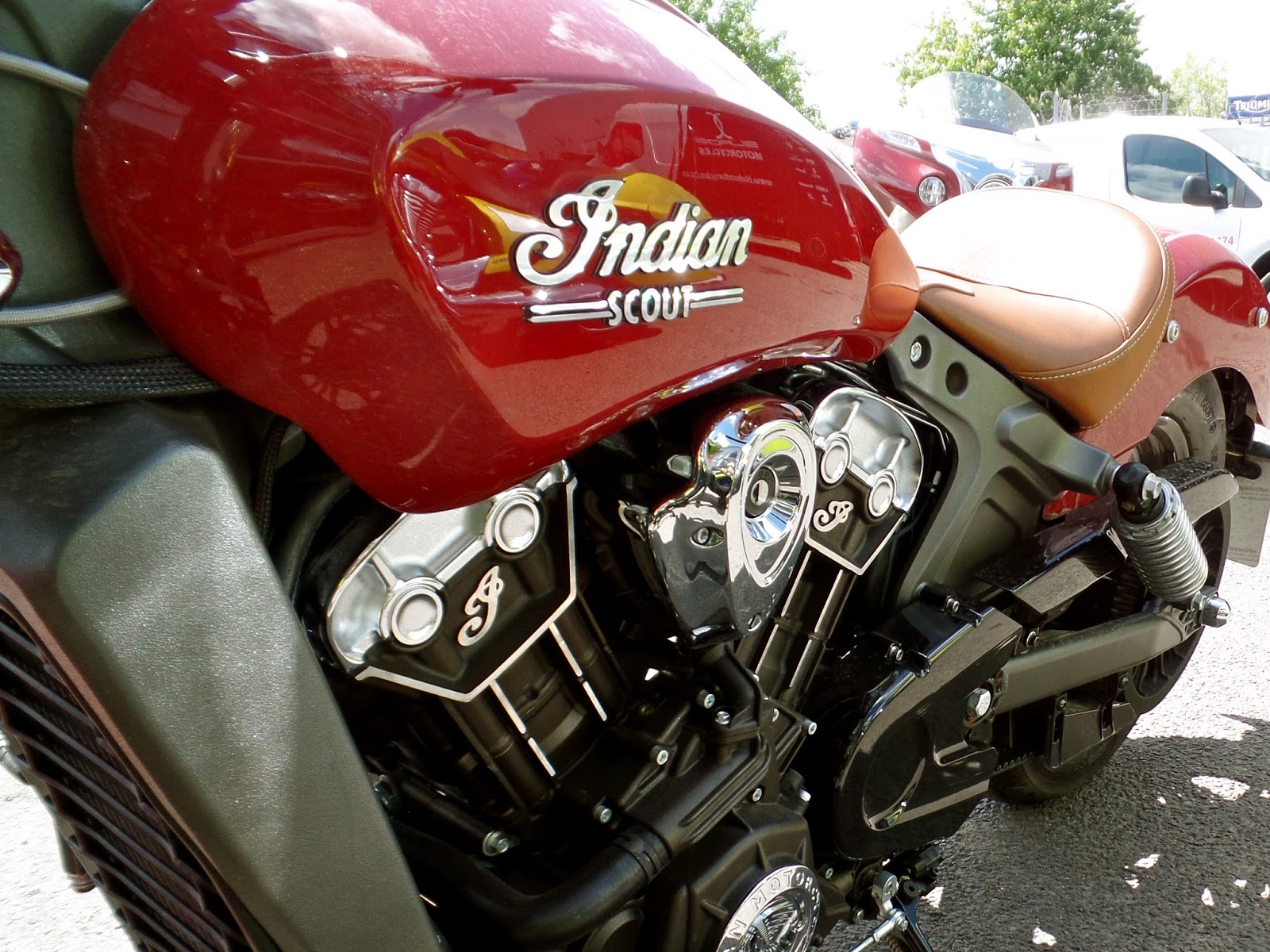
I will credit the Scout that much. Deep within my soul I feel that if I had been riding this bike in my early 20s I would have had to fight girls off with a stick. The bike is nothing short of amazing. And that's an important thing to note in this review: I think the Scout is amazing. Really. Genuinely.

I'm not the only one saying that. Motorcyclist recently named it Best Cruiser in its 2015 Motorcycle of the Year Awards. It earned the same accolade in Motorcycle.com's Best of the Year awards. And in Cycle World's Ten Best Bikes of 2015 it came runner-up in the Best Cruiser category (losing out to the incomparable Indian Chief Classic).

But despite that, I feel the Indian Scout is not as good as it could be. Because it is being hemmed in by the category in which it won the above accolades. The Scout is just too good to be a cruiser.


The Good

Let's start with that engine. To describe it as a sportbike engine is pushing things just a little. Although if you're particularly clever in terms of mechanics you could easily turn it into a sportbike engine. Polaris won't say either way, but it's generally believed that the engine used in Victory's Project 156 was a modified version of the Scout's.

The liquid-cooled V-twin engine is more rev-happy than something found in an old-school cruiser. Pushing the bike toward 8,000 rpm will reward you with catapult-like acceleration. Heading onto the motorway, I found myself in excess of 90 mph before I was even halfway down the entrance ramp.

Although the performance of the Scout is kind of Japanese (in a good way) its gearbox remains solidly American. Shifts are noted with a THUNK that I initially found to be a little annoying in light of the engine's performance, but one that I quickly grew to appreciate. I'm not sure, though, that clutchless upshifts would be possible with such an agrarian set up.

The brakes are solid. I'd still prefer to have two discs up front, but I have to admit the bike had no problem coming to a stop, even when squeezing the front brake lever with just two fingers. ABS comes standard in the United Kingdom and the rest of Europe. In the United States it'll cost an extra $1,000, because, uhm, freedom?


By and large, fit and finish are what you would expect from Indian. This is a motorcycle you will enjoy staring at. It's beautifully simple from a distance but come close and you'll spot all kinds of fantastic little details that let you know Indian put a lot of effort into this machine. This is something worth holding on to, something worth treasuring. The leather seat is certain to be an aspect that only improves with age (and care). If I had kids, I'd probably buy a Scout despite my reservations about it, just for the sake of being able to pass this piece of American history down to my children.

Instrumentation is pretty basic. The dash consists of an analogue dial speedometer, with a digital tachometer contained within. I'd prefer it the other way around, making it easier to switch from mph to kph when you ride across borders. You can switch the tachometer display to also show a trip meter or engine temperature. You'll get no fuel gauge or gear indicator, however.


The Bad

One comment that comes up in a number of reviews for the Scout is that it's small.

It's not small. Take a look at official specs and you'll see the Scout is longer, wider and heavier than my Suzuki V-Strom 1000. It is "small" only if you are using motorcycles to compensate for your personal inadequacies. What leads people to say it's small is the fact that its ergonomics are quite compact. And the seat is particularly low to the ground.

If you are long in the leg (I'm 6 foot 1), these factors lead to your feeling a bit cramped. Indian offer different pegs and seat to help stretch things out somewhat, but I personally can't see those fixes being to my taste. I don't want to ride a motorcycle with my legs splayed out as if I were in an obstetrician's stirrups. And for me, the Scout's 25-inch seat height is just too low.

The vast majority of my criticisms of the Scout could be fixed if Indian were to answer the plea I made in RideApart for a Scout Scrambler. It doesn't have to be a scrambler per se, but the Scout deserves a platform that better allows a rider an opportunity to really enjoy its amazing engine. Something akin to the BMW RnineT, perhaps: a retro-influenced roadster.

The engine makes you want to play; it makes you want to go. But in going around corners I found myself consistently scraping the Scout's pegs. The awesomeness of the bike is diluted by the category of the bike.


I understand why Indian did this: it operates first and foremost in the United States, where the cruiser is the unquestioned king of motorcycling, and it wanted the Scout to succeed. But considering Indian had already delivered the Best Cruiser Ever in the form of the Chief Classic (and, if you like fringe, the Chief Vintage), you'd have hoped the company would be a little more willing to take a risk.

Make something that hasn't existed within the American context for a very, very long time: a standard. My hope (and it seems a reasonable one, to be fair) is that the Scout is the first step toward a whole range of machines, similar to Triumph's Bonneville platform.

If so, this first step is a very good one, but it still leaves you with a motorcycle on which you're going to end up dragging pegs. You'll probably also be rubbing your back after a long ride, because the suspension suffers from all the inadequacies inherent to a bike with only 5 inches of ground clearance. And the seat tends to lock you into a single position.

As good as the brakes are, I did find them to be just a tad off/on. Subtle braking was a challenge. Slow-speed manoeuvres were particularly awkward because the seating position makes it difficult to operate the rear brake with a great deal of finesse.

The lack of a passenger seat means you'll have to risk damaging your marriage to ride a Scout, or you'll need to fork out the extra cash to dig into Indian's accessories catalogue. You'll generally need to do the same if you want to carry any luggage (although, the Scout's sturdy metal fender allows for the judicious use of bungee cords).

The gas tank is a bit small, but considering the Scout's ergonomics you'll probably be eager to stop before the bike demands it. Especially if you're travelling at motorway speeds without a screen. The wind blast is pretty intense and will have you looking like a bobble-head doll when trying to make good time.


The Ugly

The Scout's indicator lights are quite flimsy. At idle you can see them jiggling around. In RevZilla's review of the Scout Lemmy points out that this is so they'll give way, rather than break, should a rider accidentally drop the bike. When I heard that, I immediately thought: "Ooooohhh! Indian, you are so clever!"

But without knowing that I just thought they looked cheap.

Related to that, how much does a gear indicator and fuel gauge cost? The Scout doesn't have these things and I think that's silly. You get gear indicators and fuel gauges on Japanese 125s these days. Surely the presence of such simple, useful features wouldn't have bumped up the asking price that much. If at all. Whereas the absence of them gives the bike a sting of cheapness. It feels like savings for the sake of savings.

This negates the quality inherent in the rest of the bike. I'd be happy to forgo the seat's genuine leather (which will only soak up rain, anyway) in exchange for a gear indicator, fuel gauge, and better looking turn signals.


The three questions

Overall, the Scout is one of the best motorcycles to come out of the United States in the last decade. My frustration remains, however, because it really could have been so much more. I feel Indian was playing not to fail here, rather than playing to win.

Timidity seems to be a family trait amongst Polaris brands. Hopefully, though, the Scout's success will convince Indian it's on the right track and encourage it to step out of the cruiser box before too long.

So, that leaves the three questions I ask of every motorcycle I test ride:

1) Does it fit my current lifestyle/needs?
Not really. However, forking over great quantities of cash could equip the Scout with a screen, passenger seat and panniers, which would bring it more in line with what I want out of a bike. I'm not sure it would fit in my shed, though.

2) Does it put a grin on my face?
Yes. As much as I complain about the Scout not being exactly the bike I want there's no getting away from the fact that I loved riding it. It is so much fun that I think it creates a slight flaw in Indian's positioning it as an entry-level machine. A person who gets used to the fun of this engine may be disappointed by the relative sluggishness of a larger air-cooled V-twin. Thrill-wise, the Chief Classic might actually be a step down from the Scout.

3) Is it better than my current bike?
In terms of price, features, handling, usability and engine, no, the Scout is not better than a Suzuki V-Strom 1000 (some people would be surprised to find out what a hoot the V-Strom's engine can be). But the V-Strom is not something I would ever consider holding on to for a really long time. I'm already daydreaming of what I'll replace it with in two or three years.
Whereas the Scout possesses an intangible that you want to keep with you. There's something in the Scout that speaks to the soul, that makes a person want to sink the time, money and effort into fixing its little flaws and making it one's own. The Scout makes me think of the pickup truck I had when I was in college –– the GMC Sonoma I drove all over the United States. I can remember often thinking that all I needed in the world was that truck. And I can imagine a person feeling that same sort of thing toward his or her Scout.

For me, right now, at this time and this place in my life, the Scout isn't THE motorcycle, but I can understand how it could be for someone else. I have to admit I'm just a little bit jealous of that person. And when Indian finally makes the Scout roadster I want, I'll be joining them.

ADSENSE HERE
Ride Review: Indian Chief Vintage

ADSENSE HERE

The Indian Chief Vintage is an interesting bike in the sense that it is simultaneously amazing and awful. The good news is that this awful can be fixed with a pair of scissors. The better news is that the awful of which I speak is completely subjective; you may, in fact, love it.

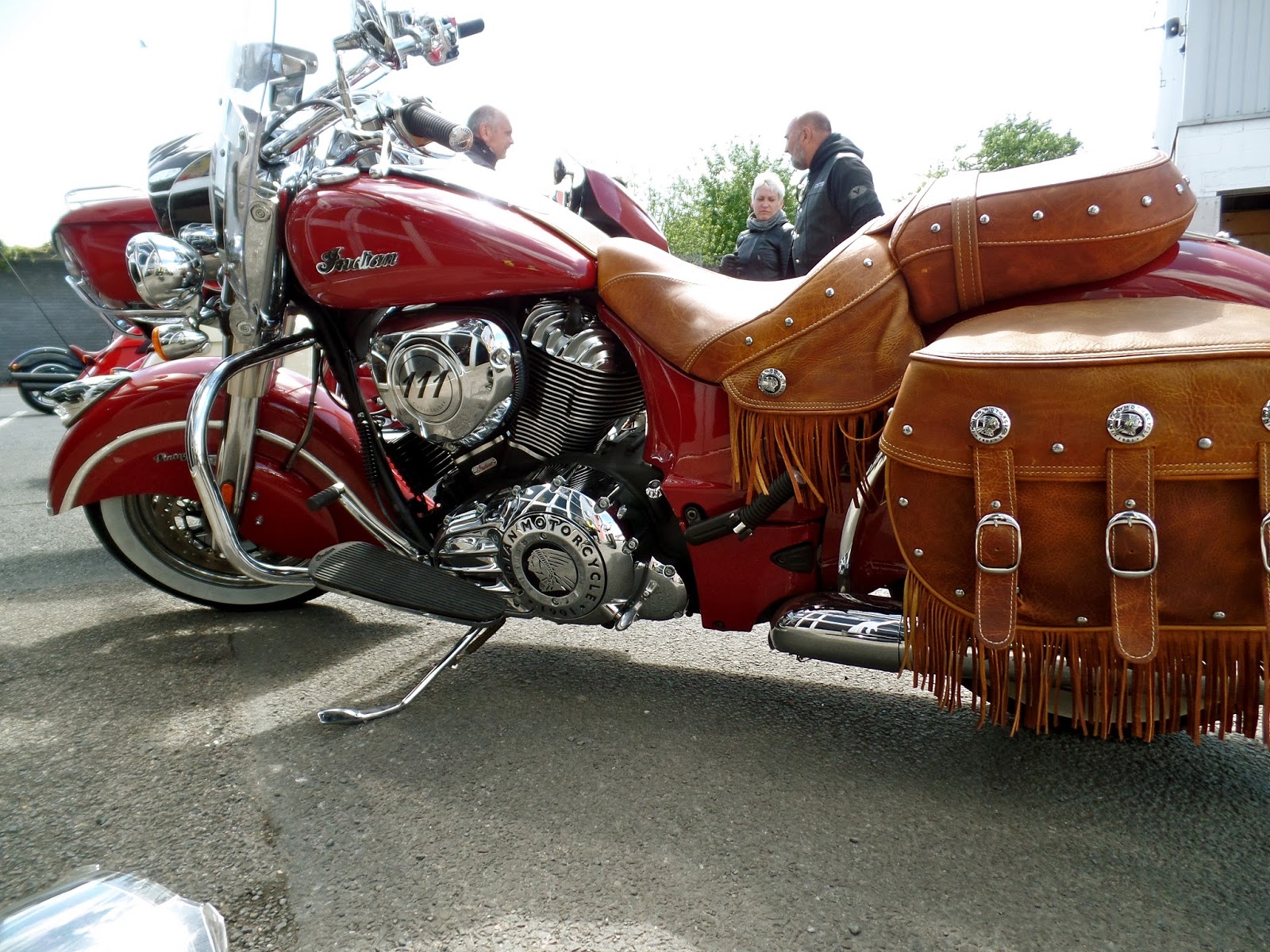
What I'm talking about is leather fringe. It is a prominent feature of the Chief Vintage and I hate it. Apart from one of those Babes Ride Out girls who would do so ironically, I cannot imagine the sort of person who would desire leather fringe on a motorcycle.

I mean, fringe. Leather fringe, for Pete's sake. Fringe.

What weird, fetishist pack of Minnesotans did Indian dig up for a test marketing group that the motorcycle company came away with the belief that bedecking one of their bikes in leather fringe was a good idea?

I don't even...

I think the reason I get so annoyed by the Chief Vintage's fringe is that it is otherwise a pretty fantastic bike. After all, the Chief Vintage is nothing more than the Chief Classic with a few bits of the Indian accessory catalogue thrown at it.

When I rode the Classic back in November I declared it to be the best motorcycle I had ever ridden. By and large, I still stand by that statement. (Though, having now also ridden the Indian Chieftain [review coming soon] I might be inclined to give that bike the top slot if something could be done about its screen.)


But back to the Chief Vintage. There is nothing subtle about this motorcycle. Dripping with chrome, it is oversized in every way. The handlebars are massive, the headlight fixture is the size of a Shetland pony skull, That famous valanced fender and war bonnet pull the eye, especially when accompanied by a two-tone paint scheme.

Stock pipes offer a pleasing sound reminiscent of family cars from the early 1960s, whereas the accessory Thunder Stroke Stage 1 exhausts offer a deeply satisfying but not-too-dickish rumble. Either way, however, it is not the sort of bike you want to ride if you are the shy, retiring type. Anyone riding an Indian should accept that every single stop will take three times as long because people will want to talk to you about it.

Weighing in at just shy of 380 kg, the Chief Vintage is a beast of a machine, but at anything above 3 mph it moves with a lightness that somewhat boggles the mind. It corners decently, as well; attempts to drag the pegs at sane speeds and cornering angles were unsuccessful.

Were you to be racing up Pike's Peak on the thing I'm sure all kinds of dragging would occur, but ride according to or near the speed limit and I doubt you'll ever hear scraping. And as more and more of the world becomes subject to the tyranny of speed cameras, I suppose having a bike that can tear through mountain passes at triple digits becomes less and less desirable.

Even within the limits of the law, however, the Chief Vintage is a lot of fun. Twisting the throttle produces oodles of smoothly delivered torque. Getting up to highway speed is effortless, and staying there is equally trouble-free. The bike's real oomph tapers somewhat above 90 mph, but there's still plenty of power left in the Thunder Stroke 111 to get your license revoked.


Not that you'll want to spend much time at that speed, however. At least, not if you're me. The actual motorcycle is steady enough at high speeds but the screen on the Chief Vintage makes it hell. I'm 6-foot-1, so I suspect those of shorter leg wouldn't mind so much.

I'm pretty sure the standard screen on the Chief Vintage is the tallest one offered by Indian, so it's a good thing the screen is easy to remove. In fact, I'd say it's a little too easy to remove. If you know what you're doing it will only take about 6 seconds.

To that end, if I were looking to get one of these bikes, I might choose instead to go for the cheaper Chief Classic and wait for an opportunity to steal a screen from someone's Chief Vintage. The Chief Classic starts at £18,500 in Her Majesty's United Kingdom, whereas the least you'll pay for a Chief Vintage is £19,700.

Admittedly, it's not just the screen you'd be missing out on with the Classic. You'd also have to live without the leather panniers that come standard on the Vintage. But in my opinion those bags aren't worth it. They are not wide enough to hold a full-face helmet, they don't lock, I suspect they are not waterproof, and they've got that damned leather fringe.

Indeed, when you think about it, the Chief Classic is the far better choice; it's cheaper and fringe-free.


So, with all that said:

The three questions

1) Does it fit my current needs/lifestyle?
Nope and nope. The bike in and of itself is a hoot but it is too big and too expensive to exist within my current situation. The presence of fringe, meanwhile, means that it is also ruled out of any lifestyle to which I might aspire.

2) Does it put a grin on my face?
Uhm. The bike itself does, yes. Getting beat up by the buffeting from the screen didn't make me smile, nor did the idea of riding around on a motorcycle with leather fringe. I talk a lot about the importance of aesthetics on a bike, how that aspect can vastly affect your psychology and how you interact with the bike. I would honestly have preferred to be seen on a bike covered with images of Disney princesses. Give me a Chief Classic, or even the fringe-free Anna & Elsa Edition and I'd be laughing in my helmet. The Chief Vintage, however; no lo quiero.

3) Is it better than my current bike?
Only in resale value. By the numbers, a V-Strom 1000 is lighter, faster, more powerful, more fuel-efficient, more nimble, has more features and better luggage, and is easier to maintain. Where it falls flat against cruisers is in aesthetics. Something like the Chief Classic or Victory Gunner or even Harley-Davidson Sportster will beat a Strom in the sexy game all day long. But fringe... By dressing up the Chief Vintage like a Dennis Hopper tribute act, Indian loses its trump card with this bike.


ADSENSE HERE
 

Advertisiment