Advertisiment

Showing posts with label The Journey. Show all posts

Exploring the Scout Sixty's Irish Heritage

ADSENSE HERE

When several weeks of gentle pleading recently resulted in Indian Motorcycle handing me the keys to a Scout Sixty, I knew exactly where I wanted to go: Ireland.

That's probably not what you were thinking. After all, the Sixty is a motorcycle imbued with more than a century of American heritage, seemingly designed first and foremost for the American road. But, as with so many American things, if you trace its history back far enough you'll find an Irish beginning.

In this case, that beginning is Charles B. Franklin, an engineer and motorcycle racer born in Dublin in 1880. There's a plaque commemorating Franklin's achievements outside the house where he was born. And, because among those achievements are the designs of both the original Indian Scout and Scout 101, it makes sense to ride the Sixty there.

My adventure starts, though, in Cardiff, Wales –– separated from Dublin by about 300 miles, roughly 80 of which are across the Irish Sea. I schedule a night ferry and set out to cross the breadth of Wales, which –– you probably didn't know –– is the birthplace of St. Patrick (yes, that St. Patrick). For me, the whole trip will be like this: tiny connections within tiny connections.

I learn of Prince's death just as I'm putting on my jacket to leave. Pointing the Sixty westward, I take certain pride in the fact its modern liquid-cooled V-twin engine was designed in Minnesota.

The roads are empty; the best time to travel across Wales, it seems, is after 9pm on a Thursday. This means I can relax and keep the bike below 65 mph. With no screen, that's where I'm happiest. The engine is capable of more (on another day I'll hit 105 mph) but going slow means not having to lean hard into the wind, not having to fight to hold on.
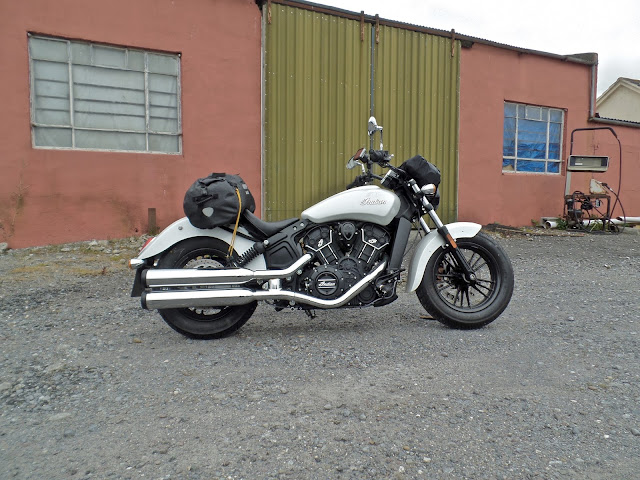

I've strapped a Kriega US10 bag to the triple tree and managed to secure an Oxford T50 Aqua rollbag to the fender, despite the lack of any bungee points. It's back-to-basics traveling. You know those hipster videos where some sexy tattooed person in a shirt that costs more than your monthly income straps a rolled Mexican blanket to the 'bars of a Sportster and takes six days to ride from San Diego to San Luis Obispo? That's how I feel: like someone cool.

No, that's not quite right. I feel legitimately cool. I like this vision of me. Everything feels right.

The Sixty's engine is smooth and drones into the darkness. To my surprise, despite the fact I am 6 feet 1 inch tall and the Sixty is mega-low, I am happy-comfortable. I arrive at the port too early, pull a Thermos of tea from my bag and wait.

After a while another motorcyclist shows up. He's just bought a BMW K1600GT in England and is taking it back to Ireland. Apparently he's saved a lot of money by buying it in the UK. We pass the time together trying to figure out what all the buttons and wheels and switches on his bike do. He delights in playing with the electronic suspension.

"Watch this, Chris," he says, making the bike go up and down. "Watch what she does."

I'm a big fan of techno whizzbangery, but the excessive amount of it on the K1600GT makes me appreciate the relative simplicity of the Sixty. Just turn the key and go.

Eventually, the handful of overnight travelers are allowed to board just before 2am. Four and a half hours later I roll off the boat at Rosslare with a lot more time to kill. Dublin is less than 100 miles away and the friend I'm staying with won't get home from work until 5 that evening. The best course of action is to try to get lost.


I adopt a tactic of approaching people and saying: "I'm trying to get to Dublin, but want to go by a really scenic route."

The Irish, though, know their country –– no wildly inaccurate suggestions are made. Not only do people give good directions, but offer suggestions of interesting things to see along the way. Even with tourist stops, though, I'm within The Pale by lunchtime, so I divert down into the Wicklow Mountains, the area that provides water for the Guinness brewery.

The narrow mountain roads here are of abysmal quality and too much for the Sixty's suspension. Fortunately, no one else is around. I slow to 10 mph and bounce along imagining I'm crossing the Himalayas. Every few miles I have to stop to re-secure the Oxford bag. There's something strangely fun about all this, but in hindsight I probably should have asked Indian to equip the bike with a rack.

This road was built by British soldiers in the early 1800s to allow them to hunt down Irish rebels. These days it connects a handful of charming towns, dotted by the odd pub or cafe in between. I stop to have tea and cake, and find myself in conversation with a 90-year-old woman who is baffled by Donald Trump. The Irish love to talk politics but her issue with him is a little less ideological.

"I can't understand how the hell any woman could go to bed with him," she says.

A little more than a century ago, the British would have still been patrolling these mountains. Charles Franklin would have been selling Indian motorcycles in Dublin and racing the bikes at the Isle of Man. He competed in the famous road race every year from 1908 to 1914. When World War I hit, a 33.3-percent tax on foreign luxury goods (such as motorcycles from America), designed to raise money for the British war effort, put him out of work.


Franklin landed on his feet, though, earning a position within Indian's design team and setting sail for Massachusetts in late 1916.

On my second morning, I have a severe hangover and have lost my voice from shout-talking with friends in the pub. This happens every time I come to Dublin, but today it's a little worse because I hadn't realized that the lager of which I consumed seven pints was 7 percent. I'm less resilient than I used to be...

I don't get moving until mid-afternoon. Eventually, though, I am steady enough to ride into the heart of Dublin. Almost exactly 100 years after Franklin left the city I find his house and park the Sixty in front of it to take pictures. Perhaps things were quieter when he lived here, but these days the road is busy, so I'm drawing a crowd.

"Jaysus! I never knew," exclaims one man after I explain what I'm doing. "I walk by this house every day, an' I never knew dat. She's a beautiful machine, man. An' yer man who's responsible was from right here. Dat's amazin'!"

As I take pictures he takes it upon himself to tell every passerby the story of Charles Franklin, which grows more elaborate with each telling. At one point, an open-top tourist bus is stopped in traffic and he's shouts up at them: "Do ye see diss gorgeous machine here? Diss amazin' American motorcycle here? It's the best motorcycle in the world, and the man who designed it was born an' raised right here in diss house!"


Franklin never returned to the house after 1916. He brought his family to Springfield, Massachusetts, in 1920 –– the same year he designed the first Scout. Two years later, he was responsible for the first Indian Chief. Then the lesser-known single-cylinder Prince in 1924, and the Scout 101 in 1928. The latter, of course, is the bike everyone remembers, the bike still favored by Wall of Death riders.

On this weekend the country is commemorating 100 years since the Easter Rising. Irish history is anything but clear cut, but some see that event as the beginning of the Irish revolutionary period –– the spark that helped lead to a free Ireland. Riding around on these streets, I wonder what Franklin must have thought about all that.

Of course, you can get too lost in thinking about these things. That night, my friend and I go to see an independent wrestling show and one of the bad guys is from Northern Ireland. The crowd chants "Sitch-yee ay-shun" ("situation" in a Northern Ireland accent) and he eggs them on in faux protest.

On my final day in Dublin, I pack up the bike under weak spring sunshine as my friend bounces his son on the Sixty's seat.

"Where to now?" he asks.

"I'm going to wander for a few days before catching the ferry back," I say. "I'm aiming for Tipperary today, then west to follow the coast."

"It's a long way to Tipperary," he says.

"So I've heard."


Sticking to smaller roads, I make leisurely progress south. The secondary roads, known as N roads, are gentle and undulating. The speed limit on them is 100 kph (62 mph), and Irish drivers are surprisingly respectful of the law. It all makes for an environment that leaves me imagining something more than looks has been carried forward from the Scout models of yore.

The Irish spirit is in there, too. The Sixty fits this place well. And the country's citizens somehow sense the connection. When I'm stopped, or even just moving slowly through villages, people walk out into the road to talk to me about the bike. Parents ask to have their children be photographed on it.

With the exception of mountain passes, most of the roads are good and I manage to avoid heavy rain. Even going slow, though, the smallness of Ireland reveals itself. I get from point A to point B far too quickly, so I loop back and ride the same roads again.

In this way I suppose the bike reveals its American nature; it makes me long for roads that never end.


–––––––––––––––––––––––––
–––––––––––––––––––––––––

This June I'll be taking part in the Royal British Legion Riders 1000 ride, helping to raise money for the Poppy Appeal. Please check out this page to learn more and donate in support of British veterans, currently serving military personnel, and their families.

––––––––––––––––––––––––
––––––––––––––––––––––––
ADSENSE HERE

My beef with Harley

ADSENSE HERE

It's an unfortunate truth of the internet that no matter what you say, somebody, somewhere will get upset about it. The persistence of that truth seems to increase roughly 1,000 percent when you say something about Harley-Davidson.

Doesn't matter what you say –– it can be good, it can be bad, it can be indifferent. You could make a seemingly innocuous statement like, "Harley-Davidson is a company based in Milwaukee, Wisconsin, that is best known for selling motorcycles," and someone will lose their mind.

"OMGWTFBBQ! THIS GUY IS SUCH AN IDIOT," an anonymous commenter will opine. "HE'S OBVIOUSLY BEING PAID BY THE COMPETITION!"

I don't really like that this is a truth of the internet, but it is. So, when a few people took issue with some of the things I wrote in a recent review of the Harley-Davidson Street Glide Special, I didn't really pay much attention. Haters gonna hate, after all.

But then RideApart's creative director, Jim Downs, brought it up with me in an email conversation.

"Playing devil's advocate, I have to ask," he wrote. "What's your beef with them?"

It was a question that knocked me back a little, because the short answer to his question is: none. I have no beef. After all, I first found RideApart (the site I now write for primarily) many years ago while in the process of searching for articles about the Iron 883, a bike that I loved the look of so much it made me want to return to motorcycling after a few years break.


When I eventually rode one, I was considerably less enthusiastic about the bike, but I still get all dreamy eyed every time I see one on the road. I'm like that for most Harley-Davidson motorcycles; I really like the looks of them. As I wrote of the Street Glide Special: "It looks fantastic. This is a motorcycle upon which any sane human being wants to be seen."

In that same review, I also wrote: "Riding a Harley is like riding a tractor. [And] riding a tractor is awesome."

Which, to me, isn't an attack — unless the definition of "awesome" has changed since I left the United States 10 years ago. I did have some criticisms of the bike, but that's part of a review: You look for things that might become issues to the people who eventually shell out thousands of dollars/pounds/euros/darseks for a bike. But, for the sake of answering Jim fully, I decided to sit back and ask myself, honestly: Am I, in some way, biased against Harley-Davidson?

I think it's impossible to write about motorcycles without some kind of bias. Otherwise every article would just be a list of numbers. The trick to writing honestly, I think, is adjusting your bias to favor the motorcycle-in-question's stated strengths. For example, no one ever complains that a BMW S1000RR isn't suitable for off-road trails, or that a Honda Goldwing can't do the Kessel run in 12 parsecs. We don't expect those things.

So, the real question is not whether I'm biased, but whether I'm failing to adequately adjust my bias when assessing a Harley-Davidson. Am I expecting things that shouldn't be expected? Well, I don't know. To me, if you sell a motorcycle for more than US $23,000 and you tell people that it is "plush, top-end touring technology," that's kind of what I expect.


My experience was that the bike in question didn't meet those expectations. It was uncomfortable and not up to the given task of touring. Even there I didn't feel I was being excessively harsh. I went so far as to point out that my experience might be unique (my 6-foot-1 frame is apparently beyond the target audience of Harley ergonomics) and suggest that if a rider's expectations were different than my own — if he or she planned to use the bike less for touring and more for stylin' and profilin' — it might still be worth the asking price.

I feel my expectations were fair. Or, would have been fair if I had been riding any other bike... But it's not any other bike, is it?

A Harley-Davidson is a wholly unique thing, and perhaps to assess it you have to do so in a wholly unique way. Maybe part of the unique way is to be consumed of the same mindset that makes so many of its customers so vociferously loyal. You have to be able to place yourself under the Harley spell.

Because I was uncomfortable, because the bike hurt my lower back and gave me a headache, I wasn't really able to do that. I wasn't able to connect on a metaphysical level, and as a result, was left to evaluate the bike as just a material thing.

So, whereas I don't possess a bias against Harley-Davidson products, I equally lack a bias in favor of them. And perhaps, for some people, that is the real problem. Because part of the Harley experience is being wrapped in the Harley mystique, having the faith.

If I have a "beef" with Harley-Davidson, then, maybe it's that I don't get it; I'm unable to comprehend the emotions that lead other people to get tattoos of this corporation's logo. And maybe –– maybe –– because of that, I'm jealous. I'm annoyed that I don't feel the spirit.


I use religious allusions because, in a way, the whole thing reminds me of when I joined a church group in college. I did that primarily because there was an extraordinarily gorgeous girl in the group whose Kentucky drawl and affinity for tight jeans absolutely melted my brain. And ohmygoodness the way she moved! To me, she was clear evidence there must be some kind of God.

But the group's interpretation of that God was something I didn't jive with, its focus too narrow for my tastes. And as a result, I never really connected with any of them. While they were jumping around and shouting, I was thinking: "This music is kind of basic. This chapel is a little cold."

Unable to get myself to feel whatever they were feeling, I was left to assess it all as just a material experience, which of course meant I was missing the point. And that annoyed me enough that I was eventually able to convince myself it would never work out between myself and the gorgeous girl — even if she hadn't been dating a point guard.

Such is the case with the Church of Jesus Harley Latter-day Davidson, I suppose. I don't quite get it. I get cruisers, and ohmygoodness some Harleys look cool, but the thing that's not there, the thing that you can't attach a number to, the thing that would make me reach for my wallet, is the thing I'm missing.

I don't hold that against the faithful, though. I mean, what's wrong with loving a thing? The whole point of this website is that it's for people who love bikes. If a certain segment of those people love one brand of bike considerably more, well, they're welcome to do so.

That I don't feel that way isn't a beef, though. It's just lack of belief.

–––––––––––––––––––––––––
–––––––––––––––––––––––––

This June I'll be taking part in the Royal British Legion Riders 1000 ride, helping to raise money for the Poppy Appeal. Please check out this page to learn more and donate in support of British veterans, currently serving military personnel, and their families.

––––––––––––––––––––––––
––––––––––––––––––––––––
ADSENSE HERE

Living the Dream

ADSENSE HERE

I'm sitting in a hotel in Yorkshire as I write this — about 300 miles north of my home in Cardiff. Known as "God's own country" by locals, this region of England is rich in hills, curving roads, quaint villages and (when it's not raining) staggeringly beautiful sunsets.

I'm here to visit the factory where Alt-Berg boots are made. Primarily the maker of hiking boots, Alt-Berg also offers a handful of rigorously tested motorcycle boots popular among the Iron Butt/BMW-owning crowd.

Partially my visit is personal, seeking out a set of riding boots that meet my ambition to buy local. The factory is the only place to see/touch Alt-Berg's motorcycle offerings in person, and I'm the sort of old-school dude who thinks that's important. And partially my visit is professional, trying to determine whether there's a story to be had here and whether that story would fit on RideApart.

To the first purpose, the trip was a success. I ended up buying a set of Hogg All Weather boots, which will be made to order and shipped in the next few weeks. I got to wander around the factory where my boots will be made (amid a scrum of frightening machinery), and I got to meet Debbie, the woman who will be making my boots.

But to the latter purpose I question whether the fit would be a good one. The above paragraph is pretty much the meat of any story I might write about Alt-Berg — nice people making nice boots in a nice place — and it strikes me as perhaps a little too local for an international (often USA-focused) site like RideApart.

Riding back from the factory to my hotel, I got stuck behind one of Yorkshire's surprisingly numerous slow drivers (30 in a 60? For the love of Pete!) on a road where passing was not allowed. It started raining heavily and within a few minutes the not-Alt-Berg, not-waterproof boots I was wearing were soaked through. Wet, cold, frustrated and hangry (the factory visit had taken longer than expected and I'd not had lunch), I proceeded to throw a little tantrum in my helmet.

Harrogate, Yorkshire

For some reason I had decided to twist in my mind the whole purpose of this trip. I cursed the fact I had come here and that my story idea had met a dead end.

"What a waste of time this whole trip has been," said me.

Actually, I just thought that; it was an idea that flashed through my brain. But it was an idea well enough formed to have intonation — an intonation I did not like. There was arrogance in the thought, a sort of "I'm better than this" quality.

And instantly I felt stupid. I found a place to pull off the road, killed the engine, stepped off the bike and took a few deep breaths as the rain faded to light drizzle. In the distance, I could see the clouds breaking and radiant sun pushing through.

"You're riding a motorcycle, Chris...on a Wednesday afternoon," I reminded myself. "And, more or less, this is your job. Why are you bitching?"

This month marks the one-year anniversary of my joining the RideApart team, and moto-journalism became my full-time gig earlier this year. Although I have plenty of experience in other journalistic fields, I think it's fair to say I'm still something of a newbie on the moto side of things.

Though, from my past lives in television newsrooms and long-dead news websites, I know that one of the curses of a newbie is the fact that arrogance sometimes builds faster than experience. Which, I guess is more or less what happened to me on that ride. I had somehow managed to convince myself that I was an Important Person who did Important Things, and when faced with minor inconvenience I went all Stone Phillips on the road (a mentor of mine was a runner for NBC many moons ago and tells a story of the broadcaster losing his sh*t when she brought him a 7-Up, rather than the Sprite he had asked for).


But I'm not an important person, and I'm definitely not doing important things. I write about motorcycles, y'all. This is quite possibly the most ridiculous career a person could have. And although the pay's not great (I'd struggle to purchase any of the bikes I write about), I really have nothing to complain about. Even when a story idea comes to naught, even when I'm stuck behind someone's overly cautious grandmother, even when I'm hungry, even when it's raining.

Back in my hotel— fed, warm and dry —I felt stupid and embarrassed about the whole thing. But rather than keep it to myself, I've decided to write about it to perpetuate the embarrassment, to better crystallize the experience in my mind and hopefully hold it as something to keep me from pulling the same sort of nonsense again.

I'm living the dream here, and if I forget that fact I risk losing the sense of excitement that comes from getting to spend so much of my time astride a fire-driven dandyhorse. Which would be very sad from a personal point of view, and also negates my ability to do my job well.

So, yeah. I let myself temporarily forget how good things are. No one saw it, no one but me was affected by it, but I'm putting it out there on the internet so that, hopefully, it won't happen again.
ADSENSE HERE

GWTTA: Aberaeron

ADSENSE HERE

I first came up with the Great Welsh Tea Towel Adventure a few years ago. The idea was pretty simple: using the map on a touristy dish cloth (aka "tea towel"), I would visit some 66 different villages, towns and cities in Wales, as well as Snowdonia National Park.

The reason for this was twofold:

Firstly, it's an excuse to ride my motorcycle. Wales is a tiny country and just about any location within its borders can be reached and returned to from any other location within the space of a day. Wales has a number of exceptionally good roads for riding and if –– like me –– you live here, the proximity of everything to everything else means you can pretend you're on a fancy, exotic road trip without having to fork out for hotels.

The tea towel
The second reason was that I had developed a deep, unabiding hatred of Wales, and I found this to be somewhat detrimental to my overall wellbeing. I had come to Cardiff in 2006 full of incredulous belief I was moving to my spiritual home, that this would be my place of acceptance, my milltir sgwâr of belonging. But it turns out I was wrong.

In particular, I was wrong about the ever-dwindling community of speakers of Wales' native language. They are isolationist, exclusionary, and welcoming only in the sense that a really good B&B is welcoming. You may feel very cosy and happy and special in a B&B but there is always a clear you-and-them relationship. No matter how long you stay, how frequently you return, you will never be welcomed into the B&B owner's family; you will never become one of them; the B&B will never be your home.

That lesson was learned via a series of personal disasters that created in me a deep, festering bitterness toward Wales and everything in it. Which, as I say, was problematic. First and foremost because I was angry all the time. All I needed do to enrage myself was open my eyes and look at my surroundings. Was I in Wales? Yes? Cue rage. 

That was a silly way to be. Especially in light of the fact I had no solid plans to leave. Convenience and circumstance keep me here: free health care, the fact my wife and I own our home, the fact my wife (an Englishwoman) generally likes Wales, the fact her best friend lives roughly 45 seconds away, and other little things. I want to leave at some point, and have made my wife promise on numerous occasions that she will not bury me in Wales should I meet an untimely end, but leaving right now creates a stack of financial and personal burdens that, ostensibly, may not be worth shouldering for the simple joy of being able to skedaddle.

It took me a long time to come to terms with the Not Going To Leave Soon reality of my situation (I still haven't completely accepted it) but I realized that if I was going to survive here without developing stomach ulcers, I was going to have to find a way to accept Wales for what it is, rather than what it isn't.

The daffodil is the national symbol of Wales.

And what Wales is, generally, is a pretty-but-wet place populated by mostly nice people who will never show you true love. Which means that, of all the places you could end up, it's not actually that bad. I implemented the Great Welsh Tea Towel Adventure as a means of reminding myself of that.

But, as I say, that was a few years ago. The idea ran out of steam after a handful of trips and I soon found myself using my motorcycle more as a means of escaping Wales rather than improving my opinion of it. I was working a full-time job and I didn't want to waste those rare moments when good weather intersects with a weekend trying to change my opinion about a place.

Then, late last year, circumstance pushed me into the life of a freelance journalist. With my schedule now more flexible, I decided it would be a good idea to restart the GWTTA project. After all, the financial instability inherent in freelancing roots me even more firmly in Wales; no new home loans for me. And in restarting the project, I decided to go about things in a more systematic way: choosing to visit places alphabetically.

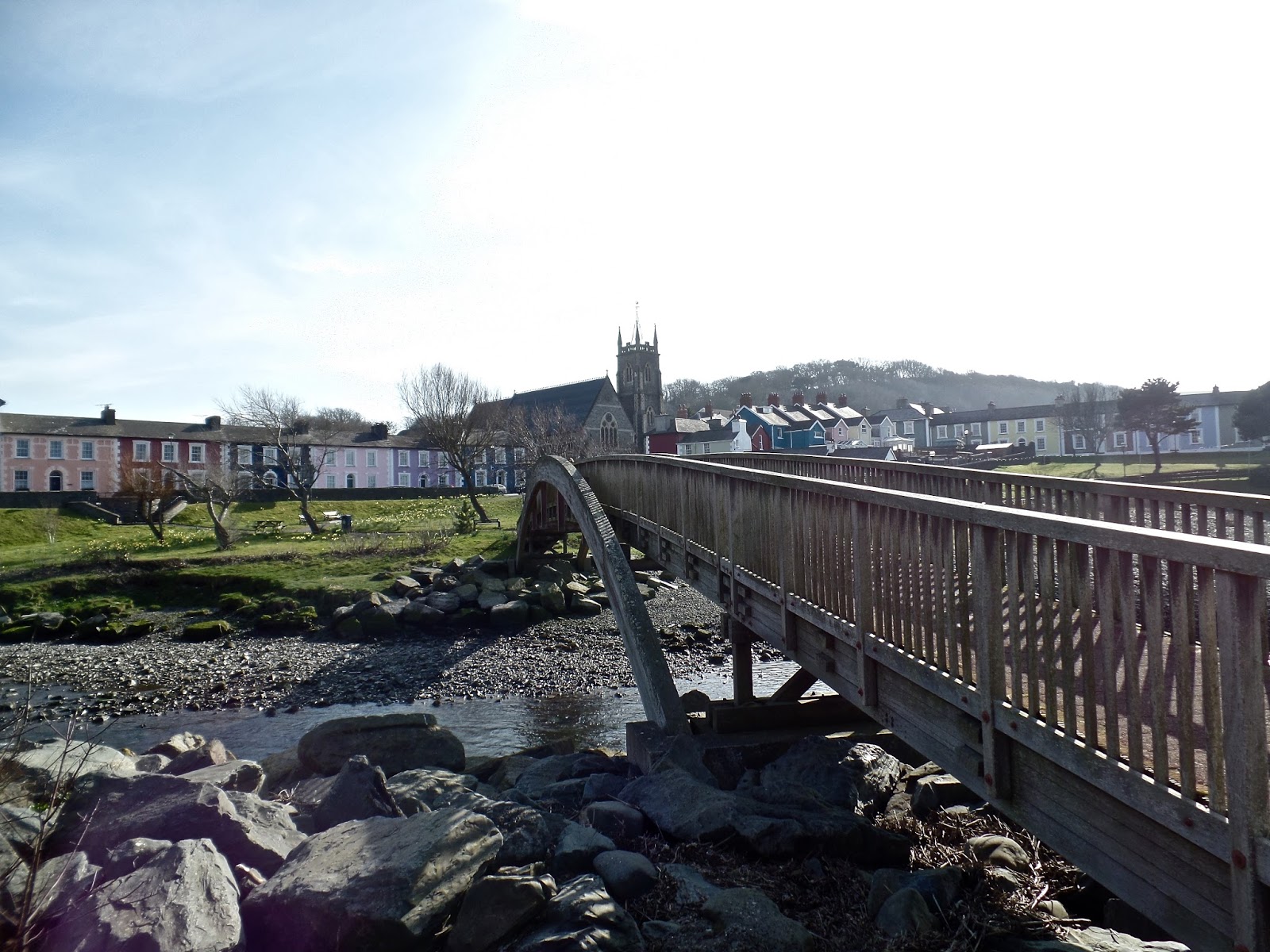
So, Aberaeron –– a small town on Wales' west coast –– was placed at the top of the list. Where it stayed for the next three months, thanks to one of the facets of Wales that causes me the most displeasure: weather. For three months not one day passed in which rain was not forecast for Aberaeron. Sometimes it was an all-day light rain, sometimes it was a heavy rain with gales, sometimes it was drizzle with freezing fog, but always there was rain.

Finally, just a day or so before my 40th birthday, my phone's weather app showed an open window. So, I threw my camera in my pocket, hopped on the bike, and pushed northwest.


Aberaeron is some 95 miles from Penarth via the "slower," more interesting route that I chose. Google Maps would have had me get there by a long stretch of motorway, running from Cardiff to Carmarthen on the M4, then trundling up the A485 and A487. But it's generally my experience that you can get somewhere in Wales more quickly if you avoid main routes, i.e., the routes suggested by mapping programs and GPS devices.

Partially this is because you'll be avoiding the route that everyone else is taking and partially this is because main routes tend to be the ones littered with speed cameras. I can too quickly start to sound like a libertarian wingnut in expressing the frustration and concern I feel toward speed cameras, but suffice to say I think they're a terrible idea.

Fortunately, Big Brother's reach isn't as vast in Wales' interior as other parts of Britain. And the fact that local authorities have abandoned actual policing in favor of stationary yellow boxes on main routes means that the odds of your getting in trouble for riding 110 mph on a 60-mph road are shockingly low.

My route took me first across an eastern section of Brecon Beacons National Park, where sheep served as the only witness to my Suzuki's high-rpm snarling. Twisting routes like the A4069, A4059 and A4067 provide scenic riding that –– in certain sections –– is on par with roads I've encountered in Italy. Sight lines are good across the moorlands, meaning you can see all the way through curves, and road quality is generally better than you'd expect for tarmac so exposed to the elements. Sheep poop and gravel are omnipresent, and overnight ice can sometimes linger into the afternoon, but sane riders can still enjoy spirited biking.


Further east, I hopped onto the A482, which winds its way through slightly more forested terrain all the way to Aberaeron. Technically the speed limit on large sections of this road is a bafflingly slow 50 mph, but, as I say, there is no enforcement. I made good time.

I don't know why my tea towel draws particular attention to Aberaeron. As far as I can tell it isn't noteworthy. It doesn't get a single mention in John Davies' A History of Wales, which, at 718 pages, contains exceedingly more information about Wales than anyone ever need know. 

More than 800 years ago, Aberaeron was home to a fortress known as Castell Cadwgan, named after one of the myriad squabbling warrior kings that fought over Wales until Edward I succeeded in conquering the region in 1283. 

There are no signs of the fortress now, and it was all but gone to the sea when the town was set up as a shipping port in the 1800s. For a very short while it supported the shipbuilding industry but by the start of the first World War it had generally turned its hand to the task of attracting tourists.

To that end it is a lovely place to visit on a sunny day. Aberaeron is located in the Welsh county of Ceredigion but it feels more Pembrokeshire to me. The latter county has been known since Tudor times as "Little England Beyond Wales" thanks to the fact it was the area of Wales most successfully held by the Normans in the 12th century, and roughly 1,000 years later it possesses a certain Englishness.

How you interpret that depends on your view of Englishness. To me it is good. Aberaeron is colorful and it has a handful of little shops, boutique restaurants and charming pubs. It is immediately likeable; it is the sort of place one might choose to take his parents were they to travel several thousand miles from another country. 


In contrast to its perceived Englishness, according to the ever-reliable Wikipedia, some 70 percent of the town's inhabitants speak Welsh. I suspect some fuzzy math there, however, because in walking around I didn't hear a single Welsh word being spoken.

Not that I cared, really. The sun was shining and it was warm enough for me to take my jacket off. I bought an ice cream and sat on a park bench overlooking the harbor and sent a text to my wife expressing my delight in having a freelancer's schedule. Far better to be doing this on a Tuesday afternoon than sitting in an office.

Aberaeron is home to the annual Cardigan Bay Seafood Festival in July, which might be worth returning for, but on a random weekday in March it was unsurprisingly quiet. Pretty, charming, but still not terribly noteworthy.

Once I had finished my ice cream I walked around town. Maybe I will come back with Jenn in the summer, I told myself. Aberaeron would be a nice place to spend the day –– eat some ice cream, go swimming in the sea. I guess it depends on how many other people have the same idea; the smallness of the town suggests it wouldn't be very enjoyable when crowded. And really, there are similar places –– in Pembrokeshire, for example –– that are easier to get to.

Either way, I suppose it was a good way to restart the GWTTA project. After walking around a little more and finding not much to pique my interest, I bundled up in my gear and sped home to Penarth. Next on the list: Aberdaron.


ADSENSE HERE

Gravity always wins

ADSENSE HERE

The other day, I read an interesting article by a motorcyclist going only by the name of Lobo, who wrote: "Motorcycles should pass the 'kick test.' You give them a kick and make them hit the ground. If you have no remorse and the bike is not broken, this is a good bike to travel to Morocco on."

I find that endearing, and it occurs to me that the kick test is a valid measure of a bike's worthiness even if you have no plans on riding to Morocco. Particularly if you're a new rider trying to decide upon your first bike.

Unfortunately — perhaps cruelly — I feel that's a mindset most people won't develop until after they've built up a few years of experience. I include myself among "most people." It was only recently I finally crossed the threshold.

The first time I dropped a bike was also the first time I took my wife out on a ride. At that point I had held my UK license for less than a month and was still getting used to the unusually top-heavy nature of the Honda CBF600SA I rode.

If you're new to this blog, you may not have heard of the CBF600SA. Effectively, it was a Hornet with its personality removed. I had chosen it because of familiarity, having used the same model in training for my license.

On one particular day of training, the instructor had taken myself and another rider to a parking lot to practice U turns, cones, and emergency stops. Every other time my fellow student attempted a U-turn she dropped the bike on top of herself, needing the instructor and me to help get her free. In one of these instances, as I was helping her to her feet, I allowed my internal dialogue to become my external dialogue and said aloud: "Man, maybe motorcycling isn't your thing."


It was at that exact point karma starting plotting my comeuppance.

So, there I was, about a month later, trying to show my wife how sexy I am by awkwardly ferrying her to the beach on history's most boring motorcycle. It was a beautiful day, and I decided to stop at a pub with outdoor seating for roughly 100 people. You can see where this is going, can't you?

The pub's beer garden was full. The only place I could find to park was right in front, on a potholed spit of gravel and uneven ground. I stumbled into the space, cut the engine, and, as my wife stepped off the bike, lost my footing.

I fought valiantly, but ultimately the 490-lb. bike came to a rest on its side with an unpleasant crunching sound. A sound immediately usurped by an ironic cheer from the drunken rugby team sitting 10 feet away.

My soul burned. I felt I was going blind from embarrassment. But the universe wasn't done with me. Out of nowhere, the world's loudest Australian appeared, dressed head to toe in Harley-Davidson gear. "LOOKS LIKE YOU DROPPED YER BIKE, MATE," he chortled. "YOU KNOW WHAT THEY SAY ABOUT A FELLA WHO DROPS HIS BIKE: HE'S A TW*T! HAHAHA!"

After muscling the bike up, I went to sit in a corner, refusing to even look up for half an hour. I would end up dropping that Honda again a few months later, in the rain, with no one looking, but the sting of embarrassment was no less acute.

I damaged my grip and snapped a brake lever when I dropped my Honda a second time.

There were a few incident-free years, then I got my Suzuki V-Strom 1000 and dropped it within a month of ownership — sort of. A brick wall "caught" the bike for me, but put a deep scratch on its much-ridiculed beak.

My initial response was one that has since become standard: shouting every combination of obscene words I know. (I'm still not at the point where I can drop a bike and think: "Ha-ha, silly me.") But within the hour, I was feeling dumb for having been so upset.

A motorcycle is a thing, after all — a jumble of metal and plastic and rubber. It is a thing you're supposed to use. And it is the nature of things that get used that they will endure scrapes and bumps in the process. My wife unwittingly helped me come to this realization by attempting to sympathize.

"It's OK to be upset," she said. "That bike is your baby, your precious thing."

Well, yeah, it is. But that's not something I want said out loud. So, I sucked it up and remembered the sage advice of 90s alterno-hippie band Poi Dog Pondering: "You should wear with pride the scars on your skin / To remember the adventures and the places you've been."

In my guise as a moto-journalist though, I've learned that accepting the reality of dropped bikes is so much easier when the bike you're dropping is someone else's. For example, when I dumped the Honda Africa Twin in some mud recently, I offered my usual screed of foul language to the heavens, but ceased caring almost immediately afterward. It's a bike. Bikes will drop. C'est la vie de la moto


But all of this does raise one question for me: Since tumbling to the ground is such an incredibly likely event for a motorcycle, why aren't more of them equipped to do so? We're expected to purchase all kinds of aftermarket bits and bobs — engine bars, frame sliders, etc. — but why don't these things come standard? Why aren't more bikes equipped with features like the tip-over protection on a Victory Vision? 

I accidentally tested that feature at a gas station in Switzerland a few months ago and as a result, my opinion of Victory shot up.

I realize not every bike can have awkward wings or engine bars, but it's interesting to me that more of them don't. Especially amongst classes of bikes targeted at new and returning riders. Those things should be far more durable.

Or maybe this doesn't really happen much to anyone else. Maybe that loud Australian guy was right about me. What's your experience?

(Originally published on RideApart)
ADSENSE HERE

An Iron Butt a day: Meet world traveller Urs ‘Grizzly’ Pedraita

ADSENSE HERE

On a tram in Zürich – en route to see native son Urs “Grizzly” Pedraita unveil the modified Victory Cross Country Tour he will use to try to break the world record for traveling around the world – I spot a newspaper on the seat next to mine. I don’t speak German but flip through it and find a story about the Swiss-Moto show, where Grizzly will be greeting the public before heading to Daytona to begin his record attempt.

In the half-page story, I manage to pick out only two names: Grizzly, and burlesque sensation Zoe Scarlett. It’s at this moment I realize Grizzly’s kind of a big deal.

“Normally, I’m that guy who likes to sit at a restaurant and just observe. I prefer being alone,” Grizzly tells me later. “But I don’t mind the attention. I’m going to be spending 100 days alone, so it’s good to meet the public and express my appreciation to sponsors.”

Admittedly, we are on Grizzly’s home turf. Switzerland is a tiny country – you can ride from one end to the other between meals – so, it makes the most of its heroes. If you haven’t heard of Grizzly, he’s planning to ride around the world, hitting every continent on its longest axis, in less than 100 days.

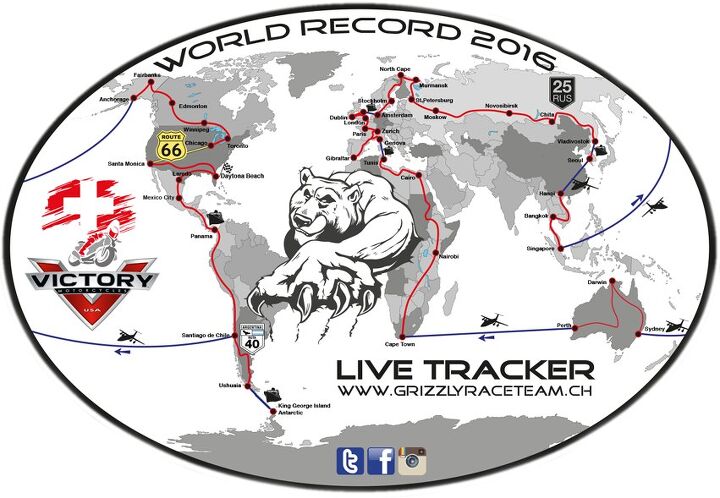
That’s different from simply circumnavigating the globe (which Grizzly has also done – in 16 days) and involves more than 60,000 miles of riding. The current world record holder for this sort of route is British adventurer Nick Sanders, who managed the journey in 120 days and 2 hours.

“I’m aiming for 99 days, 23 hours and 59 seconds,” Grizzly jokes. “But if I do it in 119, I’ll still have the record.”


The Swiss, as you would expect from a country famous for watches, possess a surreal punctuality. If a Swiss says he will meet you at 3 o’clock, he’ll be tapping his watch at 3:01. So, I don’t doubt Grizzly will accomplish his stated goal of 100 days. If that is, indeed, his goal.

In Zürich there is a rumor that Grizzly’s team has codenamed this effort “the Jules Verne project,” and he is, in fact, hoping to do it in 80 days. Feel free to guess how I would manage to pick up that rumor amid a throng of German speakers.

Regardless of whether he makes it around the world in 80 or 100 days, though, his record (assuming he sets it) will be hard to beat.

“How many miles a day do you think you’ll be travelling?” I ask.

“It depends on terrain, but 800 to 2,000,” he says.

“You mean kilometers?” I ask. “800 to 2,000 kilometers?”

“No. Miles.”

“Yikes! That’s, like, an Iron Butt ride every day.”

“Ha. Maybe they will give me a badge.”


Grizzly will leave during Daytona Bike Week. By the time those who bid him farewell are waking up to hangovers the next morning he’ll likely be in Mexico. Then it’s through Central America and all the way down South America. A boat to Antarctica to frighten a few penguins then back the way he came to Santiago, Chile.

A flight to Sydney, Australia, and a circuitous route to Perth before catching another flight to Cape Town, South Africa. Up through the African continent, passing through a number of countries with ongoing armed conflicts or that have been the target of attacks, such as Kenya, Ethiopia, Sudan, Egypt and Libya.

A ferry from Tunisia will get him to Italy before doubling back to Southern Spain. In Europe he’ll swing as far west as Ireland, then push north and east through Scandinavia and thereafter across the vast expanse of Russia.

He’ll skirt China before making it to Singapore and a flight to Anchorage for his final stretch. Running diagonally across Canada to get to Toronto and then, if there’s time, spanning the United States via Route 66 before hustling once again to Daytona.

“The magic word is constance,” he explains. “I will be making use of cruise control, trying to keep as much constance as possible. No, consistency is the word I mean.”

Both words work in my opinion. He will need to be consistently constant, constantly consistent.


“At the start there will be a learning process,” Grizzly says. “Training my body to do this every day, to overcome the physical pain that comes with tiredness. I have to go through a sort of ‘sleepy portal’ and it’s hard. That’s what concerns me most.”

“Not warlords or terrorists?” I ask. “Because, that’s what would concern me most.”

“I’m in denial,” he smiles. “But I will have some help. I’ll always be in contact with people who can let me know what’s up ahead. Members of the French Foreign Legion will be giving me advice in North Africa. I can always change route; I’ll trust my gut. If anything happens, though, I’ll run. I’m not going to pick a fight, but I’m not going to surrender. The bike is faster than anything they’ll have and there are a few extra things on it to help me escape.”

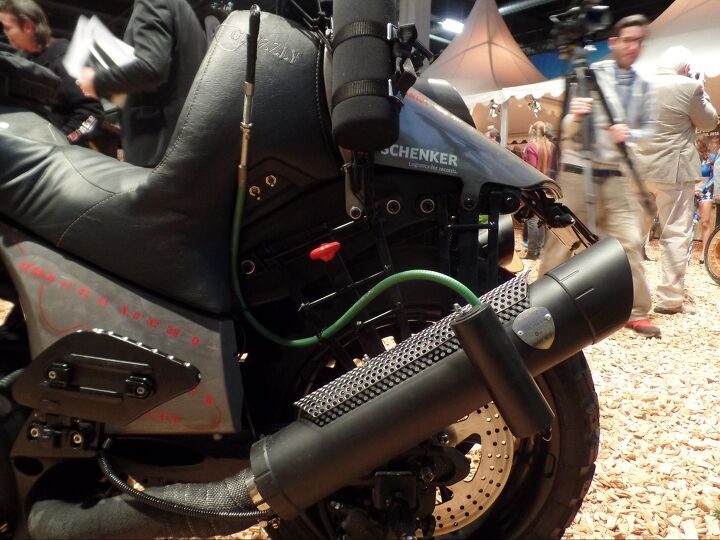
One of these things is a canister full of tire-piercing road tacks, which can be seen by the bike’s left exhaust. I press for details on any other tricks Grizzly may have up his sleeve, but he prefers to keep to them to himself. I don’t imagine there’s anything too exotic, though, because Grizzly will be passing through a lot of countries. And border officials, regardless of nationality, are a famously unforgiving bunch.

Grizzly’s riding career started on a moped at the age of 14. When he was 22, he bought a brand new Yamaha FJ1200 and set out to see the world. He eventually wandered to southeast Asia, where he spent a number of years bouncing between Thailand, Vietnam, Cambodia and Laos.

“That’s where I really learned to ride,” he explains. “I would deliver medical supplies and the like to faraway villages, and often the roads were terrible. If there were any roads. Thailand has hundreds of islands and some have no roads at all.”


Now 52, he’s making a name for himself as a long-distance traveller, uniquely choosing to do so not on a BMW R1200GS or some other bells-and-whistles adventure bike, but the Victory Cross Country platform.

“That chassis just makes sense,” Grizzly explained. “The first time I rode the bike everything felt right.”

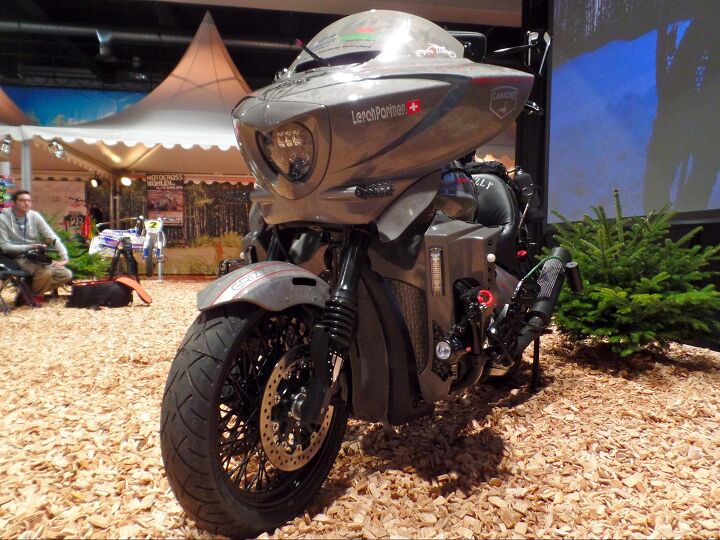
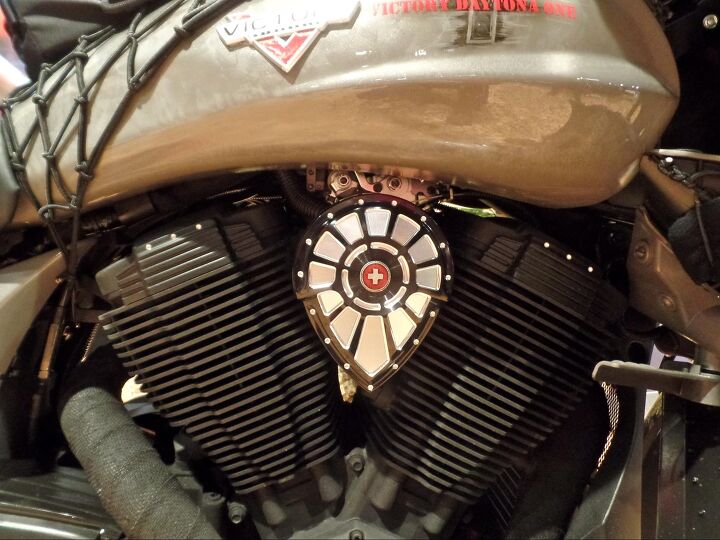
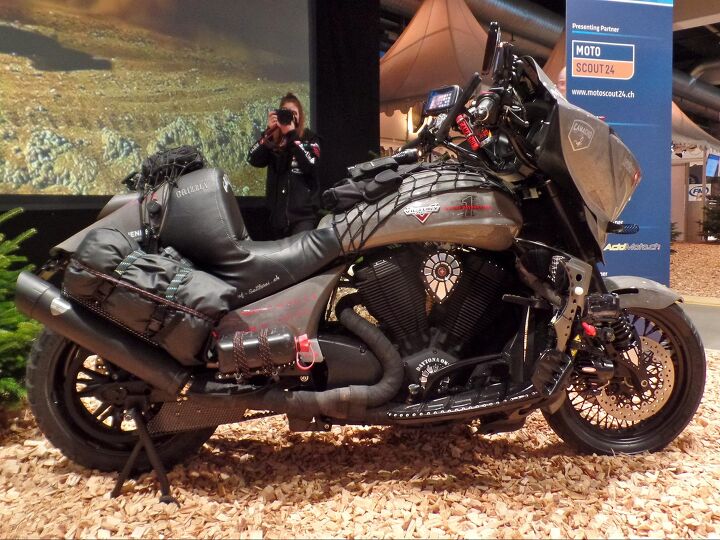
Grizzly’s first Cross Country, which he used to circumnavigate the globe in 2014 was pretty much stock. But the Cross Country Tour he is using for this attempt has been heavily modified. Dubbed Daytona1, the only aspects of the bike that have not been changed, according to Grizzly, are the frame and engine.

“I’ve increased the amount of air that gets to the engine,” he says. “But nothing else.”

Elsewhere, however, the list of changes runs long. Some of the ones that stand out are:
  • Increased ground clearance
  • Upward-angled exhaust (which sounds amazing)
  • Larger fuel tank
  • Custom seat
  • Passenger accommodation and luggage removed (which Grizzly says has reduced weight by 110 lbs.)
  • LED fog lights
  • A cockpit littered with GPS, tablet and phone units
  • Multiple cameras 

His personal preparation is a little less complicated: physical exercise, eating right. Grizzly drinks coffee as we speak but says he will cut it out of his diet in the week or so before he sets out.

“I don’t smoke,” Grizzly says. “And when I’m not on a race like this I only have coffee once in awhile. On the bike, the effect of that sort of thing – the up and down of your mood – messes with your mind over long distance. Energy drinks, too. Plus, they can be bad for your body. It’s better to just stop and have a power nap.

“In those final two or three days, when I know I’m so close to the end, and the psychological weight of this thing – two years of planning – is the heaviest, I might have a cup of coffee. We’ll see.”

Grizzly got his nickname in part because his real name, Urs, means “bear,” and grizzlies are apparently some of the more reclusive in the bear world. But he’s not as gruff as the name suggests. Although Grizzly claims to prefer his own company, he possesses an easy, welcoming nature. When people stop to say hello, he offers a two-handed handshake. He laughs easily, with the full of himself, and when he tells a joke he slaps me on the knee. He is instantly likeable.

As we speak, a translator sits with us. This despite the fact Grizzly’s English is strong enough that we are able to communicate directly – strong enough, in fact, that he playfully makes fun of the translator when she incorrectly translates the concept of torque as “high power” – but when I ask about the challenge of staying focused on such a long ride, he drops into his mother tongue.

On this subject he speaks passionately. I can tell that he’s speaking eloquently. I’m enraptured, despite the fact I can only pick out a few words. His translator is also clearly captivated and allows Grizzly to say far more than any translator would ever remember.


“He, uh, he connects with the universe,” she says, offering more a summary than direct translation. “All the animals, the birds, flora and fauna – he connects with everything. He’s there completely in that moment, aware of everything around him but not needing to think about it.”

Grizzly tells a story of riding in Siberia, on a tediously straight road where he has seen no one for hours. Far ahead of him, he spots a Eurasian eagle-owl gliding just a few feet above the ground. An enormous animal with a wingspan of more than 6 feet, it is flying directly at him. Grizzly doesn’t steer away, doesn’t duck. Somehow he is connected with the eagle-owl, knows the creature sees him and will move when it feels inclined to do so. And, at the very last moment, the bird angles up and soars over Grizzly’s head.

I get it. Probably every motorcyclist does. For him, motorcycling is a means of connection. While others find their place through mindfulness courses or Buddhist chanting, Grizzly finds it amid the drone of a 1731cc V-Twin. After all, a motorcycle, despite its mechanical parts, is the most human of things.

And yet, on this trip there will be more than just connection with the universe. He will, of course, be connected to his team – a close-knit crew that behaves like family – who will be helping him keep on top of things like weather and road conditions. But also, thanks to the bike’s extensive satellite and mobile communications gear, he is hoping to stay in touch with, well, everybody.

During the course of our conversation, Grizzly mentions several times the fact that people can track his progress via his website, www.grizzlyraceteam.ch (Incidentally, if you’re like me and are confused as to why the Swiss domain extension is CH rather than, say, SWZ, it’s because the country tends to refer to itself by its latin name “Confoederatio Helvetica”). He encourages me to download a mobile-friendly version of the site, called GrizzlyTracker, that functions as a sort of app, allowing you to see his most recent location, as well as send messages of encouragement.


You can connect, also, via Facebook, Twitter and Instagram. And once the trip gets under way, there will be daily uploads of video taken from the four cameras mounted to the Daytona1 bike. All that sounds a bit cheesy and over the top when I write it. But when Grizzly tells me about it, I get the real sense of a person who wants to be able to take everyone on the journey with him. He wants every person he meets to be able to hop on the back of the bike with him and experience the same feelings of connection and clarity that he has when riding.

His enthusiasm is infectious. At the end of our conversation I tell him I’m half-inclined to just hop on my bike and join him on his trip.

“Sure,” he laughs. “But you’ll have to keep up.”

(Originally published on Motorcycle.com)
ADSENSE HERE

Thoughts on customer service

ADSENSE HERE

Recently I had to take my Suzuki V-Strom 1000 in for some unexpected service due to a recall related to three separate electrical issues. It's an experience that's annoyed me on many levels, not least of which being the fact I can no longer hold reliability as an advantage over competitors.

Up until January, if you had asked me about the 'Strom I would have told you that it was at least as good as (if not in some cases better than) the Triumph Tiger 800 XRx or KTM 1050 Adventure or Honda Africa Twin, whilst being more reliable than the first two and cheaper than all three. Indeed, Triumph's proclivity for recalls has always been my primary reason for shying away from the brand, despite my fondness for the aesthetics of many of its models.

I am also particularly annoyed with Suzuki UK for waiting more than a month after the recall was issued in the United States to act in Britain, despite the fact one of the problems was first identified on a UK owner's bike. (Though, admittedly, I have no idea how these things work and perhaps Suzuki UK is not to blame for the slowness)

There is a theory that the myriad recalls Harley-Davidson has issued over the years is something that actually works to the company's advantage, but I can't imagine the same could be said for Suzuki. Not a premium brand and lacking many (if any) manufacturer-exclusive dealerships, a recall of Suzuki products only creates opportunity and incentive for the customer to investigate other brands.

Which is what I found myself doing on the day I took my bike in to be inspected. I was at Fowlers of Bristol, a large multi-brand dealership, and started by heading upstairs to investigate the KTM 1050 Adventure. KTM has apparently realized that its initial pricing of the model was too ambitious (conveniently it realized this after MCN, the UK's largest moto publication pointed out that "(t)he KTM is a corking bike, but it doesn't deliver enough to demand 11 grand") and is now offering a £1,500 trade-in bonus and free panniers to help bring it closer to the 'Strom in value.

Unfortunately, Fowlers didn't have any 1050s on display, so I went down to the next floor to check out the Yamaha Super Ténéré. The bike's shaft drive appeals to me, as does cruise control on the high-spec version. There is word that the bike hasn't been selling terribly well and, as such, is also the sort of machine that can be had for considerably less than its list price.

Before I had a chance to investigate these rumors, however, I was called back to the service department to be informed that the problem that Suzuki's recall had been issued to remedy had already affected my bike. The insulation on my bike's wiring harness had burned through. I was told that my bike was unsafe to ride and that Fowlers would order a new wiring harness, but that it would take several days.

"OK, that's fine..." I said, waiting for the service desk person to identify the problem that the person in front of her –– dressed in motorcycle gear –– might have with this plan.

"So, we'll call you in a few days when your bike is ready," she said.

"And how shall I get home?" I asked.

A millisecond pause as she read the look on my face that said : You have no idea how quickly this situation can turn sour.

"I'll be happy to issue you with a courtesy bike," she said. "It's a Triumph Tiger 800."

And just as quickly as that, I was reminded of why I go to the trouble to ride past one Suzuki dealership to get to Fowlers. The Tiger 800, meanwhile, has been a lot of fun and helped to alter my previously negative perception of the model.

My attitude hasn't changed necessarily –– I still think it is ugly, I still have issues with its gearbox, I still don't trust it, and I still wouldn't choose it over the V-Strom 1000 –– but I'm no longer as critical. There is a lot of fun to be had with that triple. A lot of fun. So much, in fact, that if it were possible to do a straight trade of my 'Strom for a Tiger 800 XRx I might –– might –– be willing to overcome my complaints about the bike.

It isn't possible, though. I've looked into the numbers. The KTM, however, I'm still debating. And if I could find a Super Ténéré at the right price...
ADSENSE HERE

Ride Review: Indian Scout

ADSENSE HERE

"It reminds me of bikes from the 70s," says a leather-vested balding man also test-riding the new Indian Scout. "I mean, it just feels like those bikes, you know?"

I don't know. But from his enthusiasm I take this comparison to be positive. You can see it in his eyes; some part of him is back in another place, another time. The Scout is transporting him to that wonderful period of a man's life when girls were so easy to get that you didn't even care.

Some of us have never actually experienced that period in our lives, but as time puts more distance between the present and the past we start to think we did. Or that we could have. Especially if we had been riding around on a Scout.

I will credit the Scout that much. Deep within my soul I feel that if I had been riding this bike in my early 20s I would have had to fight girls off with a stick. The bike is nothing short of amazing. And that's an important thing to note in this review: I think the Scout is amazing. Really. Genuinely.

I'm not the only one saying that. Motorcyclist recently named it Best Cruiser in its 2015 Motorcycle of the Year Awards. It earned the same accolade in Motorcycle.com's Best of the Year awards. And in Cycle World's Ten Best Bikes of 2015 it came runner-up in the Best Cruiser category (losing out to the incomparable Indian Chief Classic).

But despite that, I feel the Indian Scout is not as good as it could be. Because it is being hemmed in by the category in which it won the above accolades. The Scout is just too good to be a cruiser.


The Good

Let's start with that engine. To describe it as a sportbike engine is pushing things just a little. Although if you're particularly clever in terms of mechanics you could easily turn it into a sportbike engine. Polaris won't say either way, but it's generally believed that the engine used in Victory's Project 156 was a modified version of the Scout's.

The liquid-cooled V-twin engine is more rev-happy than something found in an old-school cruiser. Pushing the bike toward 8,000 rpm will reward you with catapult-like acceleration. Heading onto the motorway, I found myself in excess of 90 mph before I was even halfway down the entrance ramp.

Although the performance of the Scout is kind of Japanese (in a good way) its gearbox remains solidly American. Shifts are noted with a THUNK that I initially found to be a little annoying in light of the engine's performance, but one that I quickly grew to appreciate. I'm not sure, though, that clutchless upshifts would be possible with such an agrarian set up.

The brakes are solid. I'd still prefer to have two discs up front, but I have to admit the bike had no problem coming to a stop, even when squeezing the front brake lever with just two fingers. ABS comes standard in the United Kingdom and the rest of Europe. In the United States it'll cost an extra $1,000, because, uhm, freedom?


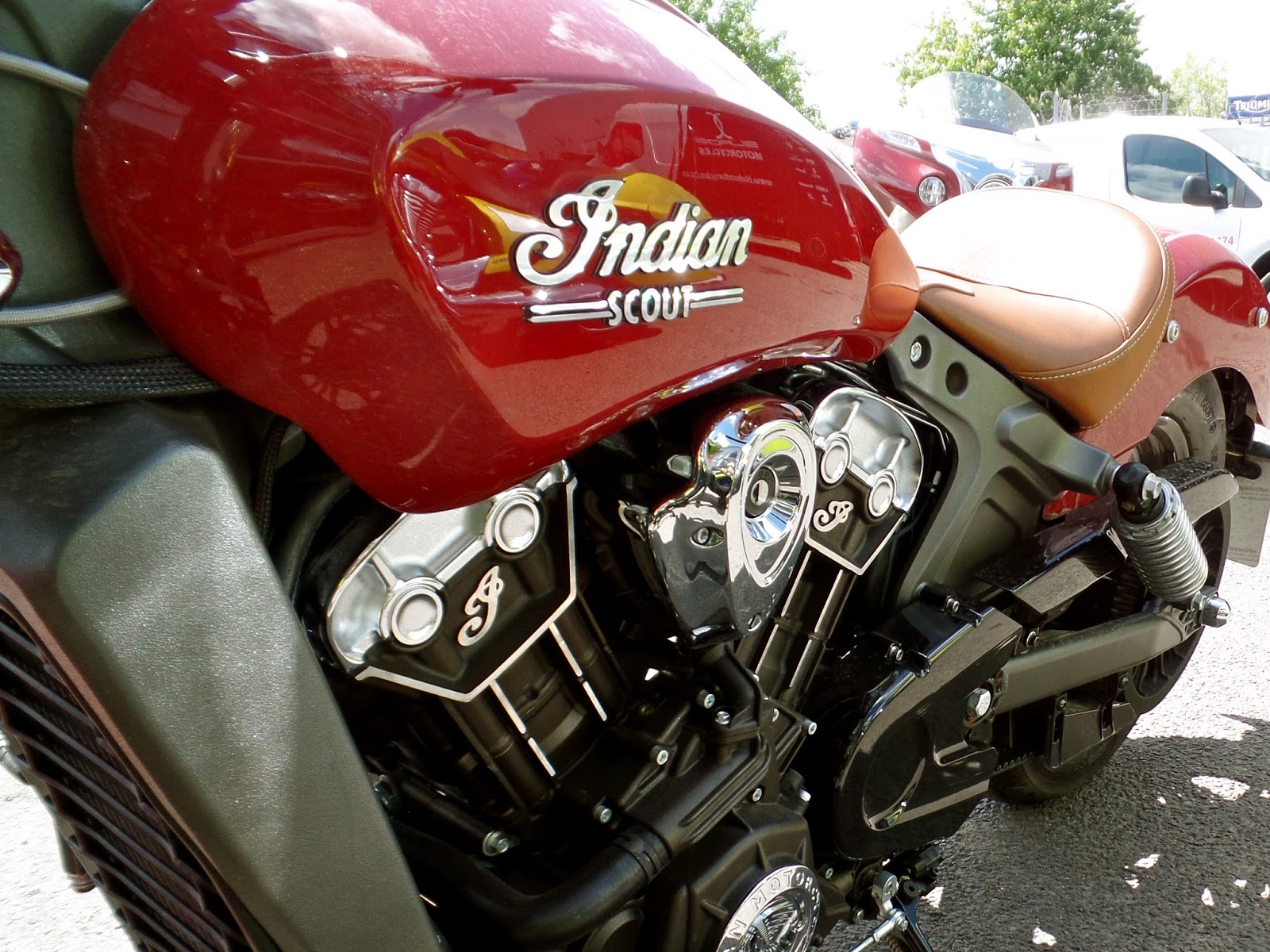
By and large, fit and finish are what you would expect from Indian. This is a motorcycle you will enjoy staring at. It's beautifully simple from a distance but come close and you'll spot all kinds of fantastic little details that let you know Indian put a lot of effort into this machine. This is something worth holding on to, something worth treasuring. The leather seat is certain to be an aspect that only improves with age (and care). If I had kids, I'd probably buy a Scout despite my reservations about it, just for the sake of being able to pass this piece of American history down to my children.

Instrumentation is pretty basic. The dash consists of an analogue dial speedometer, with a digital tachometer contained within. I'd prefer it the other way around, making it easier to switch from mph to kph when you ride across borders. You can switch the tachometer display to also show a trip meter or engine temperature. You'll get no fuel gauge or gear indicator, however.


The Bad

One comment that comes up in a number of reviews for the Scout is that it's small.

It's not small. Take a look at official specs and you'll see the Scout is longer, wider and heavier than my Suzuki V-Strom 1000. It is "small" only if you are using motorcycles to compensate for your personal inadequacies. What leads people to say it's small is the fact that its ergonomics are quite compact. And the seat is particularly low to the ground.

If you are long in the leg (I'm 6 foot 1), these factors lead to your feeling a bit cramped. Indian offer different pegs and seat to help stretch things out somewhat, but I personally can't see those fixes being to my taste. I don't want to ride a motorcycle with my legs splayed out as if I were in an obstetrician's stirrups. And for me, the Scout's 25-inch seat height is just too low.

The vast majority of my criticisms of the Scout could be fixed if Indian were to answer the plea I made in RideApart for a Scout Scrambler. It doesn't have to be a scrambler per se, but the Scout deserves a platform that better allows a rider an opportunity to really enjoy its amazing engine. Something akin to the BMW RnineT, perhaps: a retro-influenced roadster.

The engine makes you want to play; it makes you want to go. But in going around corners I found myself consistently scraping the Scout's pegs. The awesomeness of the bike is diluted by the category of the bike.


I understand why Indian did this: it operates first and foremost in the United States, where the cruiser is the unquestioned king of motorcycling, and it wanted the Scout to succeed. But considering Indian had already delivered the Best Cruiser Ever in the form of the Chief Classic (and, if you like fringe, the Chief Vintage), you'd have hoped the company would be a little more willing to take a risk.

Make something that hasn't existed within the American context for a very, very long time: a standard. My hope (and it seems a reasonable one, to be fair) is that the Scout is the first step toward a whole range of machines, similar to Triumph's Bonneville platform.

If so, this first step is a very good one, but it still leaves you with a motorcycle on which you're going to end up dragging pegs. You'll probably also be rubbing your back after a long ride, because the suspension suffers from all the inadequacies inherent to a bike with only 5 inches of ground clearance. And the seat tends to lock you into a single position.

As good as the brakes are, I did find them to be just a tad off/on. Subtle braking was a challenge. Slow-speed manoeuvres were particularly awkward because the seating position makes it difficult to operate the rear brake with a great deal of finesse.

The lack of a passenger seat means you'll have to risk damaging your marriage to ride a Scout, or you'll need to fork out the extra cash to dig into Indian's accessories catalogue. You'll generally need to do the same if you want to carry any luggage (although, the Scout's sturdy metal fender allows for the judicious use of bungee cords).

The gas tank is a bit small, but considering the Scout's ergonomics you'll probably be eager to stop before the bike demands it. Especially if you're travelling at motorway speeds without a screen. The wind blast is pretty intense and will have you looking like a bobble-head doll when trying to make good time.


The Ugly

The Scout's indicator lights are quite flimsy. At idle you can see them jiggling around. In RevZilla's review of the Scout Lemmy points out that this is so they'll give way, rather than break, should a rider accidentally drop the bike. When I heard that, I immediately thought: "Ooooohhh! Indian, you are so clever!"

But without knowing that I just thought they looked cheap.

Related to that, how much does a gear indicator and fuel gauge cost? The Scout doesn't have these things and I think that's silly. You get gear indicators and fuel gauges on Japanese 125s these days. Surely the presence of such simple, useful features wouldn't have bumped up the asking price that much. If at all. Whereas the absence of them gives the bike a sting of cheapness. It feels like savings for the sake of savings.

This negates the quality inherent in the rest of the bike. I'd be happy to forgo the seat's genuine leather (which will only soak up rain, anyway) in exchange for a gear indicator, fuel gauge, and better looking turn signals.


The three questions

Overall, the Scout is one of the best motorcycles to come out of the United States in the last decade. My frustration remains, however, because it really could have been so much more. I feel Indian was playing not to fail here, rather than playing to win.

Timidity seems to be a family trait amongst Polaris brands. Hopefully, though, the Scout's success will convince Indian it's on the right track and encourage it to step out of the cruiser box before too long.

So, that leaves the three questions I ask of every motorcycle I test ride:

1) Does it fit my current lifestyle/needs?
Not really. However, forking over great quantities of cash could equip the Scout with a screen, passenger seat and panniers, which would bring it more in line with what I want out of a bike. I'm not sure it would fit in my shed, though.

2) Does it put a grin on my face?
Yes. As much as I complain about the Scout not being exactly the bike I want there's no getting away from the fact that I loved riding it. It is so much fun that I think it creates a slight flaw in Indian's positioning it as an entry-level machine. A person who gets used to the fun of this engine may be disappointed by the relative sluggishness of a larger air-cooled V-twin. Thrill-wise, the Chief Classic might actually be a step down from the Scout.

3) Is it better than my current bike?
In terms of price, features, handling, usability and engine, no, the Scout is not better than a Suzuki V-Strom 1000 (some people would be surprised to find out what a hoot the V-Strom's engine can be). But the V-Strom is not something I would ever consider holding on to for a really long time. I'm already daydreaming of what I'll replace it with in two or three years.
Whereas the Scout possesses an intangible that you want to keep with you. There's something in the Scout that speaks to the soul, that makes a person want to sink the time, money and effort into fixing its little flaws and making it one's own. The Scout makes me think of the pickup truck I had when I was in college –– the GMC Sonoma I drove all over the United States. I can remember often thinking that all I needed in the world was that truck. And I can imagine a person feeling that same sort of thing toward his or her Scout.

For me, right now, at this time and this place in my life, the Scout isn't THE motorcycle, but I can understand how it could be for someone else. I have to admit I'm just a little bit jealous of that person. And when Indian finally makes the Scout roadster I want, I'll be joining them.

ADSENSE HERE
 

Advertisiment