Advertisiment

Showing posts with label road trip. Show all posts

Exploring the Scout Sixty's Irish Heritage

ADSENSE HERE

When several weeks of gentle pleading recently resulted in Indian Motorcycle handing me the keys to a Scout Sixty, I knew exactly where I wanted to go: Ireland.

That's probably not what you were thinking. After all, the Sixty is a motorcycle imbued with more than a century of American heritage, seemingly designed first and foremost for the American road. But, as with so many American things, if you trace its history back far enough you'll find an Irish beginning.

In this case, that beginning is Charles B. Franklin, an engineer and motorcycle racer born in Dublin in 1880. There's a plaque commemorating Franklin's achievements outside the house where he was born. And, because among those achievements are the designs of both the original Indian Scout and Scout 101, it makes sense to ride the Sixty there.

My adventure starts, though, in Cardiff, Wales –– separated from Dublin by about 300 miles, roughly 80 of which are across the Irish Sea. I schedule a night ferry and set out to cross the breadth of Wales, which –– you probably didn't know –– is the birthplace of St. Patrick (yes, that St. Patrick). For me, the whole trip will be like this: tiny connections within tiny connections.

I learn of Prince's death just as I'm putting on my jacket to leave. Pointing the Sixty westward, I take certain pride in the fact its modern liquid-cooled V-twin engine was designed in Minnesota.

The roads are empty; the best time to travel across Wales, it seems, is after 9pm on a Thursday. This means I can relax and keep the bike below 65 mph. With no screen, that's where I'm happiest. The engine is capable of more (on another day I'll hit 105 mph) but going slow means not having to lean hard into the wind, not having to fight to hold on.
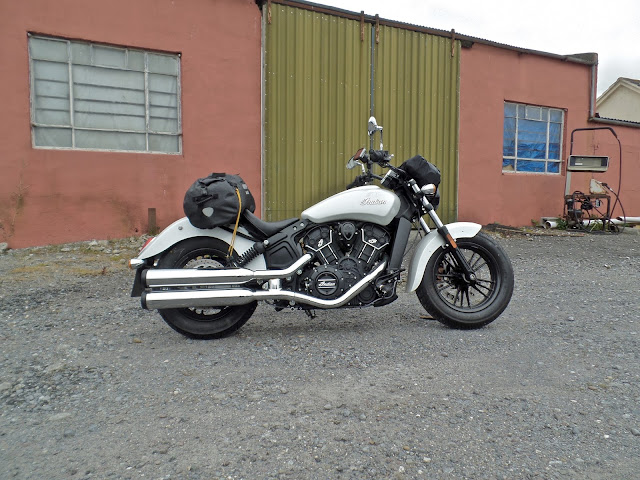

I've strapped a Kriega US10 bag to the triple tree and managed to secure an Oxford T50 Aqua rollbag to the fender, despite the lack of any bungee points. It's back-to-basics traveling. You know those hipster videos where some sexy tattooed person in a shirt that costs more than your monthly income straps a rolled Mexican blanket to the 'bars of a Sportster and takes six days to ride from San Diego to San Luis Obispo? That's how I feel: like someone cool.

No, that's not quite right. I feel legitimately cool. I like this vision of me. Everything feels right.

The Sixty's engine is smooth and drones into the darkness. To my surprise, despite the fact I am 6 feet 1 inch tall and the Sixty is mega-low, I am happy-comfortable. I arrive at the port too early, pull a Thermos of tea from my bag and wait.

After a while another motorcyclist shows up. He's just bought a BMW K1600GT in England and is taking it back to Ireland. Apparently he's saved a lot of money by buying it in the UK. We pass the time together trying to figure out what all the buttons and wheels and switches on his bike do. He delights in playing with the electronic suspension.

"Watch this, Chris," he says, making the bike go up and down. "Watch what she does."

I'm a big fan of techno whizzbangery, but the excessive amount of it on the K1600GT makes me appreciate the relative simplicity of the Sixty. Just turn the key and go.

Eventually, the handful of overnight travelers are allowed to board just before 2am. Four and a half hours later I roll off the boat at Rosslare with a lot more time to kill. Dublin is less than 100 miles away and the friend I'm staying with won't get home from work until 5 that evening. The best course of action is to try to get lost.


I adopt a tactic of approaching people and saying: "I'm trying to get to Dublin, but want to go by a really scenic route."

The Irish, though, know their country –– no wildly inaccurate suggestions are made. Not only do people give good directions, but offer suggestions of interesting things to see along the way. Even with tourist stops, though, I'm within The Pale by lunchtime, so I divert down into the Wicklow Mountains, the area that provides water for the Guinness brewery.

The narrow mountain roads here are of abysmal quality and too much for the Sixty's suspension. Fortunately, no one else is around. I slow to 10 mph and bounce along imagining I'm crossing the Himalayas. Every few miles I have to stop to re-secure the Oxford bag. There's something strangely fun about all this, but in hindsight I probably should have asked Indian to equip the bike with a rack.

This road was built by British soldiers in the early 1800s to allow them to hunt down Irish rebels. These days it connects a handful of charming towns, dotted by the odd pub or cafe in between. I stop to have tea and cake, and find myself in conversation with a 90-year-old woman who is baffled by Donald Trump. The Irish love to talk politics but her issue with him is a little less ideological.

"I can't understand how the hell any woman could go to bed with him," she says.

A little more than a century ago, the British would have still been patrolling these mountains. Charles Franklin would have been selling Indian motorcycles in Dublin and racing the bikes at the Isle of Man. He competed in the famous road race every year from 1908 to 1914. When World War I hit, a 33.3-percent tax on foreign luxury goods (such as motorcycles from America), designed to raise money for the British war effort, put him out of work.


Franklin landed on his feet, though, earning a position within Indian's design team and setting sail for Massachusetts in late 1916.

On my second morning, I have a severe hangover and have lost my voice from shout-talking with friends in the pub. This happens every time I come to Dublin, but today it's a little worse because I hadn't realized that the lager of which I consumed seven pints was 7 percent. I'm less resilient than I used to be...

I don't get moving until mid-afternoon. Eventually, though, I am steady enough to ride into the heart of Dublin. Almost exactly 100 years after Franklin left the city I find his house and park the Sixty in front of it to take pictures. Perhaps things were quieter when he lived here, but these days the road is busy, so I'm drawing a crowd.

"Jaysus! I never knew," exclaims one man after I explain what I'm doing. "I walk by this house every day, an' I never knew dat. She's a beautiful machine, man. An' yer man who's responsible was from right here. Dat's amazin'!"

As I take pictures he takes it upon himself to tell every passerby the story of Charles Franklin, which grows more elaborate with each telling. At one point, an open-top tourist bus is stopped in traffic and he's shouts up at them: "Do ye see diss gorgeous machine here? Diss amazin' American motorcycle here? It's the best motorcycle in the world, and the man who designed it was born an' raised right here in diss house!"


Franklin never returned to the house after 1916. He brought his family to Springfield, Massachusetts, in 1920 –– the same year he designed the first Scout. Two years later, he was responsible for the first Indian Chief. Then the lesser-known single-cylinder Prince in 1924, and the Scout 101 in 1928. The latter, of course, is the bike everyone remembers, the bike still favored by Wall of Death riders.

On this weekend the country is commemorating 100 years since the Easter Rising. Irish history is anything but clear cut, but some see that event as the beginning of the Irish revolutionary period –– the spark that helped lead to a free Ireland. Riding around on these streets, I wonder what Franklin must have thought about all that.

Of course, you can get too lost in thinking about these things. That night, my friend and I go to see an independent wrestling show and one of the bad guys is from Northern Ireland. The crowd chants "Sitch-yee ay-shun" ("situation" in a Northern Ireland accent) and he eggs them on in faux protest.

On my final day in Dublin, I pack up the bike under weak spring sunshine as my friend bounces his son on the Sixty's seat.

"Where to now?" he asks.

"I'm going to wander for a few days before catching the ferry back," I say. "I'm aiming for Tipperary today, then west to follow the coast."

"It's a long way to Tipperary," he says.

"So I've heard."


Sticking to smaller roads, I make leisurely progress south. The secondary roads, known as N roads, are gentle and undulating. The speed limit on them is 100 kph (62 mph), and Irish drivers are surprisingly respectful of the law. It all makes for an environment that leaves me imagining something more than looks has been carried forward from the Scout models of yore.

The Irish spirit is in there, too. The Sixty fits this place well. And the country's citizens somehow sense the connection. When I'm stopped, or even just moving slowly through villages, people walk out into the road to talk to me about the bike. Parents ask to have their children be photographed on it.

With the exception of mountain passes, most of the roads are good and I manage to avoid heavy rain. Even going slow, though, the smallness of Ireland reveals itself. I get from point A to point B far too quickly, so I loop back and ride the same roads again.

In this way I suppose the bike reveals its American nature; it makes me long for roads that never end.


–––––––––––––––––––––––––
–––––––––––––––––––––––––

This June I'll be taking part in the Royal British Legion Riders 1000 ride, helping to raise money for the Poppy Appeal. Please check out this page to learn more and donate in support of British veterans, currently serving military personnel, and their families.

––––––––––––––––––––––––
––––––––––––––––––––––––
ADSENSE HERE

This will probably end in tears

ADSENSE HERE

Last week, Jason Fogelson published an article on RideApart about the infamous Iron Butt Association, the worldwide motorcycle "club" where membership is earned by riding a stupidly long distance in a short period of time.

Jason finished his article by stating: "I'd love to be counted among the world's toughest riders. Wouldn't you?"

Yes, I would. And coincidentally, just before I read that article I had signed up to take part in an event that will see me tackling my first-ever Iron Butt ride. If I pull it off, I'll get to claim membership in the Iron Butt Association and, presumably, get a spiffy patch that I can have sewn into an Aerostich Roadcrafter or some such thing.

If I don't pull it off, though, that'll be OK because this will be an Iron Butt attempt with a difference. Unlike most attempts this won't be a lonely affair. I'll be on the road with more than 200 other riders, all helping to raise money for British military personnel as part of the Royal British Legion Riders' 1000 ride.

The Royal British Legion is an organization that helps provide support to current and former military personnel, as well as their families. It's an incredibly active organization and one of its most famous fundraising initiatives is the Poppy Appeal. Folks from the UK will know what that is, but if you're unfamiliar with British culture it's an integral part of life here.

Almost all performers on Strictly Come Dancing incorporate a poppy into their costume in November.

The initiative reaches its peak in the month leading up to Remembrance Sunday (the Sunday closest to Armistice Day). In those weeks, paper representations of poppies are sold in every shop, train station, and main street in the country. And just about everyone pins one to his or her lapel. Turn on the television during that time of year and poppies are omnipresent, worn by everyone from politicians and newscasters to reality show contestants.

Although most visible in the autumn, the Poppy Appeal raises money year round. And it's in support of that initiative that the RBLR 1000 ride has taken place each June since 2009. When I first heard about the event I knew I wanted to take part, if not simply because it's partly organized by the Royal British Legion Riders Branch, a group of motorcyclists — the vast majority of them veterans — helping to support the work of the Legion. And those dudes are awesome.

One of my favorite motorcycling experiences happened when I was amid a throng of Branch riders. Like a lot of people in riding organizations, many Branch riders wear leather cuts bedecked with patches that, if you didn't know better, might make them look somewhat nefarious. I was riding amid a pack of about 10 of these guys when we pulled up at a stoplight and one of them decided to crank up the stereo on the Indian Chieftain he was piloting.


It took approximately half a second before the entire group was dancing along to Taytay's sick beat. Within another half second we had managed to coordinate our moves, a few of the particularly celebratory riders dismounting their bikes and beckoning to people to get out of their cars and join us.


So, yeah, this June I'll be riding with those guys.

As well as members of the UK's Iron Butt Association, who are equally nuts.

Earning an Iron Butt badge in the UK isn't easy—if not simply because the country is less than 1,000 miles from top to bottom. And there are close to 70 million people crammed into it at any given time. Which means you can't just point yourself down a lonely highway and click on cruise control. There are no lonely highways; you have to navigate congested roads through heavily populated cities.

And more often than not you have to do it in the face of British weather. It never gets hot in Blighty and the odds of your riding 1,000 miles without hitting rain are extremely low. Nonetheless, I'm looking forward to it. Which is to say that ever since I sent in my entry fee I've been jittery with fear.

I worry I've made a terrible mistake and this whole thing will only end in tears. Or, perhaps snores. I mean, 1,000 miles in 24 hours; I'm the sort of fella who likes his sleep. Still, I feel I'm capable of accomplishing the feat. In part because of a marathon ride I managed last year on a Victory Vision, speeding 685 miles from Milan, Italy, to Rotterdam, Netherlands, in just shy of 15 hours.

The weather on that ride was horrendous — nonstop rain for about 6 hours — but apart from wet boots and gloves I came out of it OK. Admittedly, the Vision is a more comfortable bike than my own Suzuki V-Strom 1000, equipped with heated seats, cruise control and a radio to help fight boredom. 

So, perhaps one of the main things I'll be doing between now and June 11th is working to increase my Strom's levels of comfort. The seat is famously large, but maybe I should do that sheepskin thing. Anyone know if that actually works? Any other tips you want to throw at me, feel free.


I think my main fear in all this is that I'll hit the physical wall in the middle of nowhere. That I'll be riding along in Scotland at 2 a.m. and suddenly realize, "Nope. No more of this. Gotta sleep," and end up trying to grab some shuteye in a rest area that turns out to be a popular spot for dogging.

(If you don't know what dogging is, look it up. Do not look it up if you are at work. Hint: it has nothing to do with dogs.)

As I say, though, it's OK if I don't finish because either way I'll be raising money for a good cause. I've had the pleasure of meeting a number of veterans and current military men and women in my 10 years of living in the UK, and I'm always struck by how friendly and good humored they are. Perhaps, too, I feel a fondness for them because the UK has been such a staunch ally of the United States for more than a century.

And this is the part where I transition into an awkward pitch for donations. As part of my participation in the RBLR 1000, I'm being asked to raise at least £50 (US $70) for the Poppy Appeal. My plan is to simply contribute that amount myself, but I have set up a GoFundMe page to collect additional funds.

Yeah, I know. GoFundMe. It's the site used by Gixxer brahs when they crash wearing no gear and need money to pay medical bills. But, of the crowdfunding sites I'm aware of, it's also the one with the lowest fees. And I want the most money possible going to the Poppy Appeal. Additionally, the site allows donations in different currencies. 

So, if you're reading this in the United States, or Australia or Spain, you can still help out. That is, if you want to. If you don't want to, that's OK. I'm hoping though that the reach of the interwebs can be used to help out some very cool people. All of the money collected will go to the Poppy Appeal. To donate, visit: www.gofundme.com/ironbuttchris


(Originally published on RideApart)
ADSENSE HERE

Wind, rain, and terrorism on a Victory Vision

ADSENSE HERE

The original plan was to ride to EICMA on a Victory Gunner. I had come up with the idea in summer, imagining French back roads and Alpine passes.

When I get in touch with Victory's PR team in the UK, however, they gently point out the flaws in my thinking: EICMA takes place in mid November and I've given myself very little time to get there. Which means spending time on the motorway (aka freeway/interstate).

"You can do what you want, mate," says Victory UK's PR man, Steve. "I can get you a Gunner, no problem. But, well, have you ridden here in November?"

I have. Britain is terrible this time of year. Incessant rain and gale-force winds. The sun disappears until March. When Steve offers a Victory Vision as an alternative, I say yes before he finishes the suggestion.

The Vision is Victory's top-of-the-line tourer, happy to be brought up against the likes of the Indian Roadmaster, or Harley-Davidson Electra Glide. Relatively unchanged since being introduced in 2008, it maintains a contemporary look that puts it on the same aesthetic stage as the Honda Goldwing.

Twenty-nine gallons (132 liters) of storage space, full fairing, electronically adjustable screen, heated grips, heated seats, cruise control and stereo. All powered by a ginormous 1731 cc (106 cu. in.) V-twin. Yeah, that's the way to travel to Milan.

I pick up the bike in London and ride it back to Cardiff (where I live) to load its panniers and top box before heading out the next day. At first glance, the sheer enormity of the Vision intimidates me. Everything is big on this bike. Fairing the size of a Smart car, handlebars like the horns of a Texas steer, a seat large enough to accommodate an adult male polar bear.

Everything is big except the handlebar-mounted radio and cruise control buttons. They are too tiny for gloved hands. With the stereo, at least, there are additional controls on the bike's acre-sized tank. But those controls are out of my line of sight. So, there is a lot of haphazard mashing of buttons. Eventually, the radio comes to life and –– this really happened –– blares Steppenwolf's "Born to Be Wild"...

ADSENSE HERE

Europe 2015 pt. VI: Penarth to the Black Forest

ADSENSE HERE

I have visions of one day going back and writing up an extended version of the whole trip, but, honestly that sort of thing might bore you to tears. There are times when the editorial confines of professional writing are of benefit to the reader.

I'm working on a second part at the moment and that will be published on RideApart soon. As is always the case when I link to stories I've written on RideApart, if you have any comments please make them there. That way the site editors will be duped into thinking I'm brilliant and that I'm worth what they pay me.
ADSENSE HERE

Scooter Bob and I go to Aberystwyth

ADSENSE HERE
Recently I've had the privilege of hosting Scooter Bob, who you can read about here. We went on two little adventures together before he carried on with his world travelling. Here's the first of those:


Hey, Chris, I've been thinking...

Yeah, Scooter Bob? What about?

Well, you know, I don't want to sound ungrateful... I mean, I appreciate your letting me stay at your place for so long and keeping the fridge stocked in beer and everything... but, well, since I'm a wooden scooter I don't really drink beer. Or anything else for that matter. And I'm not really a homebody, either. I'm a travelling sort, Chris, and I'd really like to do something.

Like what, SB?

Like go somewhere. We're here in Wales, aren't there any interesting places to go?

Sure. Loads. Arguably, Wales is home to the best motorcycling roads south of Hadrian's Wall.

OK, that sounds like my sort of thing. Let's explore some of those roads!

Good idea, SB. We'll head up to Aberystwyth, about 100 miles north and west of Cardiff. Hop on the back of my V-Strom. The road to Aberystwyth takes us first through the post-industrial towns that line the Welsh Valleys. Coal, steel and all other sorts of useful things used to pour from these valleys. To a certain extent, it could be said that the Industrial Revolution started here. Certainly it could be claimed that the labour movement got its start in Wales. Legend says that the reason socialists choose to be represented by the color red comes from a blood-soaked flag that was waved during a workers' riot in Merthyr Tydfil many centuries ago.

Wow. Interesting! Why aren't we stopping to take any pictures?

Because it's depressing. There are many warm-hearted people in the Valleys, but I honestly can't understand why they stay here. I'd rather be dead than wake up every morning to find myself "living" in some of these Valleys towns.

That's pretty extreme. Ooh, where are we now?


This is Brecon Beacons National Park, one of Wales' three national parks. Not too long ago it was awarded Dark Sky status, which means it's a place to try to escape the light pollution that blights so much of the UK. Even out of the park, though, Mid and West Wales offer good stargazing. My wife and I were up here for my birthday back in March. The temperature fell below freezing but I stayed out, staring into the night sky, until I couldn't feel my toes.

The roads that curve and roll over these hills are pretty fun.

They are. Well, they are when the sun is shining, at least. Unfortunately, that doesn't happen nearly enough.

I have roots in Vancouver. Don't talk to me about rain! So tell me about Aber... uhm... What was it called?

Aberystwyth. The name means "Mouth of the River Ystwyth." Its claim to fame is that it was a popular seaside town during the Victorian age. When the weather's good it'll still draw a decent number of day visitors. As you'll see when we get there. But in modern times it has also transformed itself into being the cultural capital of the Welsh language. The bulk of Welsh-language artists and writers and such went to university here. To the extent that it's sort of a cliché.

Didn't you get a degree in Welsh, Chris?

I did. Two of them –– a bachelors and a masters. But I went to Cardiff University. I figured a big city and a big university would offer more chances to fit in. I was wrong. I didn't know at the time how much of Welsh culture is centered in Aberystwyth. I often wonder how things could have gone for me. Anyway, look, here we are. The town lets motorcycles park for free, right on the promenade.


Ha! Wow! This is so cool. There are some pretty nice bikes here. 

Yeah, it's definitely THE thing. Riders from all over the place like to make a trip here, then they'll make their way back to wherever they started by following the roads that hug the coast. It's a pretty nice way to spend a Saturday. Or you can just lounge around and talk to people about their bikes; all the riders are friendly. And because many are Welsh they will never run out of things to say.

What are all these different flags along the promenade?

Well, those are the flags of various nations that are seeking independence or, at least, some form of greater recognition from their governments. There's Brittany's flag, the Catalan flag...

The Quebec flag...

Yup. There's a fair amount of separatist sentiment here. As I say, Aberystwyth is the capital of Welsh culture and a lot of people within that culture are, or at least purport to be, in favour of leaving the United Kingdom. Further along the seafront you'll see a mural dedicated to Owain Glyndwr, who rebelled against the English crown in the 1400s. 

And what does this say?


"I ble gei di dy gludo pan fo'r haul yn suddo?" The fact that it rhymes should clue you into the fact it's a verse from a poem –– I don't know which one –– and as such, translating it is somewhat tricky because of the issue of interpretation. Roughly, I'd say it means: "Whence shall you be carried when the sun sets?"

What does that mean?

No clue. It's poetry, SB. You can interpret it to mean whatever you want it to. Welsh-language culture is stupid for poetry. They even have their own wholly unique form of it, known as cynghanedd, which manages to turn poetry into some kind of mathematical equation. I can't stand it. 


You certainly have a lot of negative things to say about Wales.

Yeah, I guess I'm pretty jaded. A lot of bad things have happened since I moved here and I guess I can't really let go of how angry and hurt I am about them.

Bad things. Like meeting your wife, Jenn?

No. That was a good thing, obviously.


Oh, so you must mean something bad like getting your motorcycle license?

Well, no, but...

Or maybe it's the free healthcare that upsets you about Wales? Or those incredible roads we took to get here? Or those dark skies you mentioned? Or this seafront? Or those mountains I can see in the distance?

OK. I get your point, SB. Want to hit the road? We can take a different route back to Cardiff.


I hate to go. It's so pretty here. The sea looks so nice. I'll bet it would have been a lot of fun to attend university here.

Maybe. Maybe. It's pretty isolated from the rest of the world; that might get lonely. But, see these houses along the seafront? A lot of that is student accommodation. Imagine being a student with that view.

Wow.

Indeed. OK, let's get rolling. If there's enough time we can stop for chocolates at a place I know in Llandeilo.

Sounds good. Hey, what's that by the roadside?


Ah, this is the "Cofiwch Dryweryn" wall. In Welsh that means "Remember Tryweryn." It's something of a rallying cry for the separatist movement. Tryweryn was a little village that the government cleared in the 1960s, then flooded the surrounding valley to create a reservoir for water to serve Liverpool. Needless to say, flooding a Welsh village to provide water for English people fuelled the separatist fire. The wall itself has earned its own kind of iconic status. Activists make sure it's repainted regularly.

You live in a place with so much beauty and unique history, Chris. You're very lucky. You really need to remember that, rather than holding onto whatever negative experiences might have happened here. 

I'm trying, Scooter Bob. I'm trying. Now hold on tight, this next section of road is pretty curvy...
ADSENSE HERE

Europe 2015 pt. V: Final checks

ADSENSE HERE

The Topeak Morph hand pump I use for my bicycle can also be used for motorcycle tires. That's where I'll start this update, because, really, that's what the last few weeks have been all about: making sure I have the right gear and that it works.

It's a strange world, motorcycling, that it can induce long internal discussions on air pumps. I suppose that is a reflection of just how much this upcoming trip spins in my head. I deliberate over everything. Yet I feel strangely unready. Either way, the adventure begins on Friday. Or, if you're reading this at some point after 3 July 2015, the trip began Friday.

Up until that point I'll be doing last-minute preparations. The early part of the week, for example, is dedicated to giving my riding gear the full waterproofing treatment: TechWash, TX Direct and Fabrisil for my jacket and trousers, a good clean and two applications of NikWax for my boots and gloves.

I changed the oil on the bike over the weekend. I'll be carrying tools to clean, oil and adjust the chain as necessary. And, of course, with the hand pump I'll be able to ensure I'm keeping the tires properly inflated as I ride through various altitudes. For any issues beyond those simple things I've got RAC coverage.

I've downloaded a free German-English dictionary for my phone. So, you know, that will totally make up for the fact that I never got around to listening to the Coffee Break German podcasts I had downloaded several months ago.

My tent works. Jenn and I rode down to a campsite in Devon about a week ago to give my gear a test run. The tent's poles needed new cord but apart from that it's in surprisingly good condition. REI stuff costs a lot but it's worth it in the long run; I've had that tent for roughly a decade.

Hell yeah I have a Leatherman attached to my belt. Like a boss.

Also perfectly functional are my sleeping bag, bed roll, mini stove, frying pan, enamelware mug, Leatherman, wind-up flashlight and various other camping items. All that gear fits easily into the Oxford Aqua 50 bag that Cam sent me, with still enough space for groceries I'll pick up along the way.

Cam's a fellow rider who lives in Scotland. He got in touch not too long ago to let me know he had the bag sitting around being unused and asked if I'd want it for my trip. Cam, I can't thank you enough for that thing. It will be a huge help.

One of the things I love about motorcycling is the generosity that seems to come from everywhere. In addition to Cam's kindness, fellow moto-blogger Sonja has offered up a place to sleep when I'm passing through Germany. And the advice I've gotten off Nikos has been incredibly useful.

Also showing the love have been the good folks at Suzuki. They've sent along an awesome tank bag for me to use on the trip and review. Designed specifically for use with the V-Strom, the bag attaches via a clever tankring lock. Expect the full review when I get back from my trip; the early signs are that it will be a positive review. I had a chance to try out the bag on the trip to Devon last week and was quite pleased.

Meanwhile, in true adventurer style, I've jerryrigged (a) my own GPS mount. The GPS had been clamped to the Strom's handlebars, but adding the tank bag made it impossible to see. That's fine. To be honest, I'd never been terribly happy with the GPS being that low, anyway.


Those of you with a good memory might be asking at this point: "GPS? What GPS? I thought you were doing this trip the old-fashioned way."

It's true that was my intent. Back in May, heading to a funeral in Texas put a huge dent in my finances. So, I had planned to make my way to Italy using some good ol' fashioned paper maps. But then I happened to notice that two of my intended destinations are not on said maps, and, more influentially, a conversation with Nikos convinced me I should find a way to make use of modern technology.

I know that plenty of people have had successful European adventures using the old-school methods of paper maps, wits, friendliness and patience, but I'll be honest that the thought of being completely lost in some "faraway" land where I don't speak the language causes deep ripples of panic in my mind. So, I shot myself lightly in the foot financially and bought a TomTom Rider (b).

Inevitably, fate will punish me by having the thing break somewhere in the Alps and I'll still end up navigating the old-school way. But for now I'm able to sleep a little better.

In breaking down for that purchase I opened the floodgates and allowed myself also to get a Lonely Planet guide and an additional pair of padded cycling shorts. I already have one pair that I use for long rides but it suddenly occurred to me that one pair of shorts over the space of several days might be unpleasant.

I'll be missing this lady while I'm on the road.

Spending money makes me unhappy, though, because it is money I won't have on the road. A part of me worries not just a little bit about having enough cash to even pay for petrol. But, hey, I guess that's part of the adventure.

I feel so unprepared at the moment. The more I think about it, the more apprehensive I get. There are times when I work myself into a state of thinking: "I don't even want to go."

The fact that I do this is no doubt indicative of some larger aspect of my personality, some self-defeating I-don't-know-what that stands between my ambitions and my realities.

But Friday will come and I will be on that overnight boat from Harwich to Rotterdam, and from that point there's really no turning back. It will be fine, regardless of what all my anxieties scream at me.

Meanwhile, my apologies if things on the site run a little slow for a while; I'm unsure what my internet access will be like. This will manifest itself most in my ability to approve comments. I'll do my best to stay on top of it.

Anyway, bânt a fi.


––––––––––––––––––––

(a) Yes, I know the correct spelling is "jury-rig" but that is not the way I've ever pronounced it. In Texas we say "jerryrig."

(b) Not too badly. Thanks to promotional offers and an additional discount I get at Fowlers for having bought my bike there, I was able to get my GPS for considerably less. 
ADSENSE HERE

Europe 2015 pt. II

ADSENSE HERE

My ferry tickets have been purchased; it's actually happening. 

"It," of course, is my ridiculously grand adventure to Italy –– a motorcycle journey through seven countries, covering at least 3,000 miles. On my own.

I have more than 4 months to prepare for this epic ride, but already I can't sleep. At least I've taken the first and most important step: committing to it. On 3 July 2015, I will ride to the other side of the UK and board a night ferry to the Netherlands. Then, I'll spend the next few days making my way south to the Tuscany region of Italy.

I am planning to visit a friend in Saarbrücken, Germany, on the way, which explains the slightly odd route I've chosen. The Google machine insists I should get to the continent via ferries or trains that run from Dover, England, to Calais, France. But what Google doesn't take into account is the fact that taking the ferry to the Netherlands costs less, all things considered.

I'll be taking an overnight ferry and have booked a cabin for the journey. That in and of itself feels exciting and exotic. Far more so than just staying in a hotel in Calais, which was my original idea. And, as I say, it's cheaper –– even with breakfast thrown in. Not to mention the fact that the ferry inherently provides strong incentive to stick to a schedule. On the second day of the trip I should be on the road and riding to Germany by 8 a.m.

A nifty side-effect of this new route is that it means I'll be spending the bulk of my time in German-speaking countries (Luxembourg, Germany and Switzerland), which makes things easier in terms of language learning.

Just about everyone I've spoken to and everything I've read (thank you, Gary France, for your very useful European touring guide) has insisted I need not worry about learning the local lingo. The majority of Europeans are fluent in English, they say. And certainly that was true 20 years ago when I was hitchhiking across France. I have no reason to believe things are different now, but my years of living in Wales and knowing just how much people appreciate that I can speak Welsh makes me want to put in the effort.

Not too long ago I downloaded some German learning podcasts and have been listening to them on a daily basis. Obviously, I won't be able to discuss the meaning of life with Germans and the Swiss, but hopefully I will have enough of the language to at least show respect and get directions to good restaurants.

I've had someone suggest that when in Germany I take the time to ride the famous Schwarzwaldhochstraße, a particularly popular route for motorcyclists that conveniently leads to the Weltgrößte Kuckucksuhr, aka the World's Largest Cuckoo Clock. Because, dude, that is exactly the sort of thing to be checking out on a road trip. How could you even consider passing that up?

Weltgrößte Kuckucksuhr

I'm planning to go to Bern, Switzerland, at some point, as well, for the sake of swimming in the River
Aare, though I'll probably save that as something fun to do during the trip back from Italy. As my route slowly materialises, I can't help but also turn my attention to other facets of planning –– what to bring, how to bring it, etc. Those of you with a keen eye will notice something different about my bike in the picture at the top of this post. I've finally broken down and bought some hard panniers.

Frustratingly, I will probably need to get a new set of tires before I go, as well. At the moment, the Michelin Pilot Road 4s that I have on the bike are in really good condition, but they've already got nigh 4,000 miles on them and I know I'll be racking up at least 2,000 more miles before the trip. Considering that my European adventure could see me clocking as many as 4,000 miles (not to mention I'll be loaded down with gear) and I don't know how long PR4s are supposed to last, I'm thinking it will be wise to just get a new set shortly before I head out.

That's not a financially pleasant thought, but it makes more sense than pushing my luck and then finding myself having to get a new set put on in Düsseldorf. Similarly, I'm thinking it will be wise to invest in a quality sat-nav. I'll have to get one regardless, because my existing hand-me-down device only has maps for the UK and Ireland. I'm considering getting the new TomTom Rider, although it's stupidly expensive.

I'll need some physical maps, an emergency tire repair kit, perhaps a new visor for my helmet (the existing one is starting to get pretty scratched up), maybe a CrampBuster, and so on. Lots of little things. So many little things, in fact, that I'm not sure of what all I'll need. And I'm not sure what I won't need. The tendency when looking at such a daunting task is to over-prepare, to bring too many things.

I remember when I took my 3-month road trip across the United States back in 2009; I ended up hauling around a whole load of crap I didn't need –– too many sweaters and a pair of boots I never wore. In that case, I was in a car. So, it didn't matter too much. But everything I carry to Italy will be a thing I can feel the burden of: when I'm trying to accelerate, when I'm at a stop and balancing the bike. Logic says I should try to be as minimalist as possible but emotionally I feel a need to pack all the things.

As always, any advice you may have is greatly appreciated.
ADSENSE HERE

Andiamo in Italia

ADSENSE HERE

I don't know if you've ever noticed the little sidebar box on the right-hand side of this blog that says "Lifetime miles." It's not totally accurate. It doesn't account for any of the miles I've done on test rides, nor the miles I covered during the arduous and expensive European training process, nor even the roughly 130 miles I racked up when the lovely people at Michelin gave me a bike to play on for a day. But I figure it's close enough. 

Considering that I only earned my European license about 18 months ago, I suppose it's a decent number. Elspeth Beard clocked up roughly 10,000 miles in her first two years of motorcycle ownership and I'm on track to keep pace with her (a), but still I find the number sometimes taunts me. It's not large enough; I haven't been nearly enough places; I haven't seen nearly enough things.

The Great Welsh Tea Towel Adventure is, in part, an attempt to rectify that, but it looks as if this summer I'll get a chance to really get some miles under my belt. The family of my wife's best friend has invited us to spend a week in Italy with them in July. They have a villa in Volterra, in the Tuscany region, and Jenn suggested I take the opportunity to ride my bike there (b).

She didn't need to make the suggestion twice. Within seconds of her mentioning it I was researching possible routes on Google Maps. In doing so, I discovered that one possible route runs past the German city of Saarbrücken, where my friend, the mighty Chris James, lives these days. So, I've tentatively invited myself out to visit him as part of this trip. I really should drop him a line and let him know I'm coming...

Roundtrip, this adventure will see me riding some 2,500 miles and visiting at least six countries: France, Belgium, Luxembourg, Germany, Switzerland and Italy. If I choose to avoid the notoriously expensive French toll roads on the way down, I may also venture into Austria, though that would mean missing out on the opportunity to ride through the 10-mile-long Gotthard Tunnel. Either way, my route will take me through three completely different eco zones and terrain ranging from flat coastal plain to the Alps. Great googly moogly, y'all: the Alps. My breath stutters just at the thought of it (c).

More rides through the Welsh mountains will be called for.

And that's the thing. This trip is so big, so grand in vision, that I struggle to properly grasp it in my mind. And with that comes the difficulty of figuring out how in the world I'm supposed to prepare for such a thing. I mean, where do you even start? I guess it might be handy to know how to say a few things in French, German, and Italian. And I suppose I might want to invest in a good-quality map, but where after that?

I am very seriously considering forking out the cash to equip my bike with hard, lockable luggage. I am also inclined to believe it might be a good idea to get myself an up to date and more reliable sat-nav programmed with full European maps (my current not-always-functioning sat-nav covers just the UK and Ireland). I'll be sure to have the bike checked out by a mechanic before I go, of course. And I'll pack an emergency tire repair kit, my Haynes manual, necessary tools, and will spend the next few months trying to teach myself how to do roadside fixes of the most likely issues one might face (cables, levers, chain, etc.).

Additionally, I'll spend these next few months seeking out the more challenging nearby roads (thankfully, we have plenty of those in Wales) to build up my skill level, and I may do a few runs criss-crossing the width of the UK in a day to help me improve stamina for long days. I'll make sure I'm familiar with the Iron Butt Association's Archive of Wisdom. I'll try to figure out how the hell to secure a bike when it's on a ferry. And so on.

But even with all of this, I get a twinge of fear –– a feeling that when it comes time to point the Honda toward Italia, I will be woefully unready.

So, I'm keen to hear what advice you can offer. If you've got experience covering massive distances, I'd love to hear what tips you might have for making it enjoyable. If you've ridden through multiple countries whose languages you do not speak, I'd definitely like to get your input.

I've got about seven months to prepare. Already I'm finding it difficult to sleep.

Stelvio mountain pass in the Alps.

––––––––––––––––––––

(a) If you haven't guessed, I have something of a crush on Elspeth Beard.

(b) She's planning to go in a car with her friend. My bike is simply not passenger-friendly enough to be stuck on the back of it over such a long distance.

(c) If I can build up the guts to do so, I may even tackle the infamous Stelvio Pass.
ADSENSE HERE

GWTTA: Newport, South Wales (Casnewydd)

ADSENSE HERE
It seems appropriate for Newport to be the first place visited on the Great Welsh Tea Towel Adventure. It is here, after all, that I finally passed my Mod 2 exam, thereby earning my motorcycle license.

It is appropriate, too, because Newport exemplifies how utterly random is my tea towel map. I can think of very few scenarios in which I would suggest Newport as a place to visit. I doubt many Welsh people –– including and especially those from Newport –– would tell you to visit, either. Newport is not a place to go to of your own free will; it is a place to ridicule.

Literally translated, the town's Welsh name, Casnewydd, means "new hate," but, of course, this name is almost certainly a mishearing of whatever people were calling it centuries ago. That happens a lot in South Wales. Cardiff's Welsh name, for example, is Caerdydd, which literally translates to "Day Fortress" (a). The name of the town I live in, Penarth, translates to "Bear's Head" (b).

According to the ever-reliable Wikipedia, Newport's original Welsh name was Castell Newydd ar Wysg, meaning "New Castle on the River Usk." The castle being referred to there hasn't been new since about 1087. Get used to this sort of thing as the Great Welsh Tea Towel Adventure rolls on: stuff is really old here. Sadly, this particular really old stuff is no longer visible, its crumbled remains having been buried under rubble created by railway work in the 1840s.

That's not to say Newport is sans castle. After all, Wales is home to more castles and fortresses than any other country in the world –– for a city to be without one would be gauche, darling. A new, new castle was built around 1327. Within two centuries, it had fallen into disrepair but it was used by various invading forces off and on right through the inaccurately named English Civil War (c).

These days the castle is little more than a miserable pile of rocks, occupied primarily by dodgy-looking teenagers. "Dodgy-looking" is a descriptor that can be used for almost everything in Newport: buildings, people, cars, rail-road tracks, even the River Usk as it churns wide and muddy through the middle of the city.
In case you're wondering, Newport smells as bad as it looks.
Still, for some reason I can't quite fathom, I have a little soft spot in my heart for Newport. That is to say, I don't outright hate it. I guess the fact I passed my motorcycle test there plays a part in this. Along with the correlating days I spent riding all around the city in training for the test.

Located less than 15 miles from Penarth, it is a place to which I will often ride when I want to refresh certain skills. The almost-always-empty car park for Newport Stadium is a good place to work on slow-speed manoeuvres. The width of the roads through city centre make them ideal for practicing the art of filtering. And overall, the city's roads are pretty quiet, except for certain roundabouts connecting the major arteries of the Sirhowy, Ebbw, Ebbw Fach, Llwyd and Usk valleys.

All of these road junctions are in the north of the city, where the M4 runs past, exporting goods and talent to Cardiff and the more profitable towns and cities of Southwest England. And therein lies the only thing that Newport has ever had going for it: it's conveniently located near better stuff.

During the Roman occupation it was conveniently located near the legionary fortress of Caerleon. During the Industrial Revolution it was conveniently located between Wales' ore-rich valleys and the sea. These days it's conveniently located between the major cultural centres of Cardiff and Bristol. However, its interminable ugliness and notoriously drunken and drugged-up residents mean it hasn't really been able to shape itself into a commuter town.

Newport's most famous residents, comedy rap group Goldie Lookin' Chain (who achieved their greatest fame with the songs "Your Mother's Got A Penis" and "Guns Don't Kill People, Rappers Do"), are a mocking but equally accurate portrayal of the sort of person you're likely to encounter in the city: dirty, bedecked in discount leisurewear, under the influence of at least one kind of substance, but ultimately convivial and open to conversation. Newport, in other words, is one of those places that apologists like to describe as "having a lot of character."

And, indeed it does. Or, rather, it should. If you look at Newport, it seems to have all the elements necessary to be a cool, quirky, artist haven like London's Camden neighbourhood, or Brooklyn's Williamsburg. But it isn't. The artists aren't here; they won't come. It's just an ugly place full of scary people that, because of its general desolation, happens to be a good spot to practice riding one's motorcycle.

I rode into the city taking the old Newport Road out of Cardiff, a route that was long ago superseded by the adjacent A48, and thereafter the M4. As such, Newport Road is relatively quiet. It is one of the few places in Britain where you can cheerfully putt along at the speed limit without having other road users aggressively trying to force you to go faster. At St Mellons, it joins up with the A48 for a few miles but this section, too, is almost always quiet.

Reaching the city boundaries I began looking for something to take a picture of. Anything. This was something of a challenge because the look of Newport is generally one of two things: 1) crumbling post-industrial decay; or 2) a flat space where crumbling post-industrial decay has been levelled and replaced by a McDonalds or KFC.

Eventually I settled on the Transporter Bridge.

Built in 1906 as a unique answer to the problem of getting people across a river that is also used for shipping, the Transporter Bridge features a sort of platform gondola that hangs from wires. Within a few years it was being used as a setting in the film Tiger Bay, which highlighted how utterly shit life in South Wales was in the 1950s. A few decades later, the bridge ceased operation because it had fallen into disrepair and there was no need for it; industry was dead.

These days it is just a tourist destination that struggles to stay open because there are no tourists. When I stopped to take pictures, a woman at the bridge's shed-sized visitor centre asked me if I was lost.

She explained to me the bridge was closed for the winter. Should I be keen to return in summer there are specific open days during which I can ride the bridge's gondola back and forth to my heart's content and climb to the top of the structure all for the low price of £2.75. It's an unmitigated bargain, to be sure, but the problem is that it requires you spend time in Newport.

After finishing the cup of tea the woman had kindly offered, I decided I had spent enough time here and packed up to move on. If the goal of this whole adventure is to improve my opinion of Wales, it was probably best to get Newport out of the way as soon as possible.

____________________

(a) Most people agree that Caerdydd is a bastardisation of "Caer Daf," which would mean "Taff Fortress." That name makes sense, considering Cardiff began life nigh 2,000 years ago as a Roman fortress on the banks of the River Taff.

(b) Although Penarth Town Council have embraced the bear's head theme, even going so far as to incorporate several images of bears into the town crest, Penarth's name is probably a mishearing of "Pen y Garth," which means "top of the hill." And surprise, surprise, Penarth is located at the top of a hill.

(c) Which took place in the 1640s. If you're unfamiliar with the English Civil War, here it is explained in two and half minutes through the medium of song.
ADSENSE HERE

The Great Welsh Tea Towel Adventure

ADSENSE HERE
My first year in Wales was awful. Ranked among my thus far 38.5 years on this planet, I would say it was the second worst of my life -- edged out of the top spot by my fourth year in Wales. I am willing to bet that the third worst year of my life also took place in Wales, which sort of begs the question as to why the hell I am still living here. But I'll get to that in a moment.

Despite it being so generally awful, there were in that first year some highlights. One of which being the day Mormons showed up at the door with a TV.

My ex-wife was (and presumably still is) a member of the Church of Jesus Christ Latter-day Saints, and had found a welcome in the nearby Rhiwbina ward soon after our arrival in Cardiff. I am thankful she did. I doubt very much that we would have survived that first year on our own.

For those of you playing along at home, if you are considering a move to the Old World, be prepared to suffer at least 8 months of unemployment. Jobs are a hell of a lot harder to find in Europe than in the United States. Hitherto our moving to the United Kingdom, the longest my ex-wife or I had ever gone without work was just two weeks. Having arrived Cardiff in early July, we were by late October in dire straits.

Most of the money we had saved up before moving was now gone. Primarily we were living off my student loans and her minimum wage earnings from a part-time gig at Starbucks. We ate a lot of rice; I can't now remember a meal that didn't pad the stomach with rice. We didn't have a car. Getting groceries meant walking 2 miles to the Tesco and stuffing everything into backpacking rucksacks.

We couldn't afford to go out; we couldn't even afford a television. Meanwhile, I had learned that I was in way over my head in university, so my life became one of attending lectures and thereafter coming home to lock myself away in the study. At night I would surface just long enough to wolf down a rice-heavy meal, then disappear again until well after midnight -- collapsing into bed with eyes hurting from staring at Welsh dictionaries. My ex-wife would spend the evenings reading in silence.

Her respite was attending church. Or "chapel," as they call it here in Wales. Going to "church" usually implies attending Church of England services. Not that many people here do either these days. And to that end, LDS meetinghouses are few and far between. Cardiff, being the largest city in Wales, has two but neither were particularly close to us. So, members of my ex-wife's ward would give her a lift.

Stoic almost to a fault, I doubt very much that she ever complained of her condition -- thousands of miles away from family, poor, highly qualified but reduced to serving coffee (a substance barred by her religion), effectively ignored by her academically swamped husband, left to spend her free time alone and reading in silence -- but no doubt the members of her ward were able to pick up on her unhappiness. So, one night, amid the rainy creeping darkness of October, a group of them showed up unannounced and armed with gifts.

There was the TV, of course -- a 27-inch-screen beast that one of the congregation had had lying around spare. He insisted upon giving it to us because, he joked, he didn't want us to miss seeing Wales playing in the international rugby matches that take place each November. More touching, though, was the huge care package the group had brought with them. It was full of foodstuffs like canned goods, pasta, rice (more rice!), and a few jars of Caro, which is what British Mormons drink instead of tea (which is also against the LDS Word of Wisdom). But also there were a number of Welsh items: local jam, honey and chocolates, a little stuffed dragon, and a tea towel featuring a map of Wales.

A few years later came that aforementioned fourth year in this country. That was the year that put the "ex" in ex-wife. Our lives had gotten better, but they hadn't gotten good. And all the years of struggle had worn us down and made us miserable. In particular, both of us had developed a very deep, angry bitterness toward Wales. My ex-wife wisely responded to this by leaving the country. I still don't really understand why I stayed.

Ultimately, we are both much better off these days, and staying here was the right decision for me. But if you've read this blog for very long you will almost certainly have picked up that much of my old bitterness remains. I don't want to make myself angry by trying to express just how deep that well goes, but suffice to say it is a motherhugger. And it is so intense as to be a hindrance. 

I mean, uhm, I'm a pretty lonely dude; I don't have a lot of Welsh friends. You could count them all on one hand and still have enough fingers to hold a cup of tea and a Kit-Kat. There's a reason for that: my attitude doesn't make me easy to befriend. If I knew someone who was anywhere near as critical of the United States as I am of Wales I sure as hell wouldn't be his pal. I understand this logically, as well as the fact that it is utterly ridiculous to be so emotionally hurt by a place, but I struggle to overcome it.

Quite some time ago I learned through the grapevine that my ex-wife had actually returned to the UK after our divorce, for a visit. Apparently she had come expressly to "make peace with Wales," keen to bury and move on from her own negative emotions toward this little wet nation. It's a good idea, and something I have tried to do myself, though without much success.

I think that is partially because of how I've gone about it. I haven't left. You can't really "move on" if you don't move. Instead, it occurs to me that if you're going to stay in a place, it's probably better to try to rekindle the affection that brought you there in the first place.

Meanwhile, I have noticed that my overall level of rage toward all things Welsh has decreased considerably ever since I got a motorcycle. (You were wondering when a motorcycle was going to fit into this, weren't you?) And I have thought that perhaps one way of getting over my bitterness toward Wales is to get to know it better, to invest some time trying to remind myself why I wanted to live here, why I was desperate to call this place my home.

And here's where we get to the point of all this. I still have that tea towel given to me by Mormons back in 2006. As I say, it's primary image is a map of Wales. Though there are also a few drawings of notable buildings, such as Harlech Castle and the Swansea Guildhall...

"Wait. The Swansea Guildhall? What the hell is so special about that? It's just an office building used by the council. Who would list that as a tourist attraction?" 

That was the thought that came to me recently as I found myself actually looking at the tea towel for the first time in a number of years (rather than simply using it to dry dishes, or watching Jenn accidentally set it on fire whilst cooking, as she does with most of our tea towels). And upon further examination I saw that little of this representation of Wales made sense. The map lists some 66 cities, towns and villages in Wales, along with one national park –– those being:
  • Aberaeron 
  • Aberdaron 
  • Aberdovey 
  • Aberporth 
  • Abersoch 
  • Aberystwyth 
  • Amlwch 
  • Ammanford 
  • Bala 
  • Bangor 
  • Barmouth 
  • Barry 
  • Beaumaris 
  • Borth 
  • Brecon 
  • Bridgend 
  • Builth Wells 
  • Caerleon 
  • Caernarfon 
  • Cardiff 
  • Cardigan 
  • Carmarthen 
  • Conwy 
  • Corwen 
  • Criccieth 
  • Dolgellau 
  • Fishguard 
  • Flint 
  • Harlech 
  • Haverfordwest 
  • Holyhead 
  • Kidwelly 
  • Knighton 
  • Lampeter 
  • Llanberis 
  • Llandudno 
  • Llanelli 
  • Llangollen 
  • Llanrhystyd 
  • Machynlleth 
  • Merthyr Tydfil 
  • Milfordhaven 
  • Monmouth 
  • Montgomery 
  • Neath 
  • Nefyn 
  • New Quay 
  • Newcastle Emlyn 
  • Newport (South Wales)
  • Newport (Pembrokeshire) 
  • Newtown 
  • Pembroke 
  • Pontypridd 
  • Port Talbot 
  • Porthcawl 
  • Porthmadog 
  • Pwllheli 
  • Rhyl 
  • Ruthin 
  • Saint David's 
  • Saudersfoot
  • Snowdonia 
  • Swansea 
  • Tenby 
  • Tywyn 
  • Welshpool
Effectively this is just a random collection of places. There is no rhyme or reason here. This is certainly not a map of places that you should or necessarily would want to visit. I mean, Borth –– a city that Morrissey described as a "seaside town that they forgot to bomb" –– makes the list, but Hay-on-Wye, home to one of the world's best known literature festivals, does not. The thoroughly unspectacular town of Barry is listed, but tourist honey pot Abergavenny isn't. The map mentions Port Talbot for Pete's sake. The thinking behind the selection process here is impossible for me to grasp.

But, see, in its randomness, its that-doesn't-make-a-damned-bit-of-sense-ness, this tea towel map is so very, very Welsh. That is such a Welsh thing to do. Welsh people are often clueless about what might make Wales appealing; its part of their charm.

So, from this ridiculous tea-towel-based map I came up with a ridiculous idea: to visit every single one of these places. Because why not? Any excuse to ride a motorcycle is a good one, and maybe this excuse can help change the way I think of Wales. Maybe riding to pointless corners like Ammanford and Knighton, and, more importantly all the spaces in between, can cure me of my Welsh hate.

It shouldn't be too hard. Wales is a tiny place; in the case of all the locations on the map, I can ride there and back within a day. The only trick is hitting these places in good weather. After all, if your stated goal is one of improving your impression of Wales, definitely don't go visiting places in the rain.

So, that's the plan. I'm aiming to visit all 67 spots within the next year or so. Maybe longer. We'll see what happens. I'll be keeping an eye on the weather and seizing whatever riding opportunities I can. Expect my first report soon.
ADSENSE HERE
 

Advertisiment