Advertisiment

Showing posts with label USA. Show all posts

Does it matter where stuff is made?

ADSENSE HERE
(Originally published on RideApart)

I've become obsessed with the idea of getting an Aerostich Roadcrafter, the famously unsexy safety onesie favored by adventurers and moto-journalists. I mean, just about every two-wheel-loving scribbler out there seems to wear one: John Burns, Jamie Elvidge, Marc Cook, Gabe Ets-Hokin, that guy who goes camping with dogs... 

And since I've been known to describe myself as a moto-journalist –– primarily just to annoy my father –– I feel I should look the part. But also, 'Murica y'all.

Roadcrafter suits are made in the God-blessed United States of USA Land –– specifically Minnesota, where I spent many of my formative years –– and the idea of being able to represent my home country every time I ride hits the semi-illogical pleasure center of my brain where patriotic thoughts are most often stored. Indeed, I think that may be the main reason I want an Aerostich: patriotism.

But I'll admit to being a man of fickle allegiances. I've lived in Her Majesty's United Kingdom of Great Britain and Northern Ireland for almost 10 years now, and I've developed some affection for it. As such, there may be an argument for my buying one of the textile suits made by Hideout, a company based in the English county of Hertfordshire.

I've met some of the women who run and work at the business, and that humanizes the product for me. It makes the idea of Hideout gear feel more important, more special.

Hideout Hi-Pro Adventure suit

In both cases –– Aerostich and Hideout –– the goods are said to be of extraordinary quality. And with that, comes an extraordinary price tag. In the case of the 'Stich, you're looking at shelling out upward of $1,700 for a suit with additional bells and whistles and some tailoring. Meanwhile, a two-piece from Hideout easily heads north of $2,300.

That's eyewatering, but keep in mind a two-piece from Rukka can put an equally large hole in your wallet: about $2,200. Buy the best two-piece suit Klim has to offer, and you could end up paying more than $2,500.

In my mind, I've dismissed those last two. Rukka gear comes from China, and asking the origin of Klim stuff results in a murky, apologetic admission that it comes from a lot of places, none of which are the United States.

All of this is academic, of course. I have nothing close to the money needed for even the least-expensive of these options. But I tell myself that if I did I would want my gear to be "local" (local either to where I'm from or where I am presently).

This speaks to an idea of goods origin that I've been developing recently. I want my stuff to come first and foremost from 'Murica, but if that's not possible, I'd like it to be from the UK or Ireland. After that, Canada and Mexico, then the European Union, and finally, any one of the other 75 countries at the top of the Democracy Index.

But, of course, that's hard to do. I'm writing to you on a device that was assembled in China: a country listed well below those top 75. And in inspecting the labels on the clothing I'm wearing right now, I'm only scoring 1 out of 5 in the conscientious buying game.

Aerostich Roadcrafter Classic

Meanwhile, perhaps simply to assuage feelings of guilt, I can't help asking myself if it really matters.

I mean, let's say I had the money for one of Hideout's fancy, made-to-measure get-ups. I don't know their gear to be demonstrably superior to, say, Rukka or Klim. Hideout suggests as much, but you'd expect it to say that. Finding independent reviews to back up that claim is a challenge (equally, I can find no negative reviews).

Still, I'd choose the UK brand because it's a UK brand. Because I've met some of the people who make it, but more broadly because I like the UK.

Effectively then, I'm deciding that something is "good" because its staff and manufacturing facilities are located in a place that is familiar to me. I assume they are people "like me" –– people who share the same Western values as myself, whose ideals align with my own. Is this silly? Is it jingoistic?

And more importantly, does it matter? The Vietnamese guy or gal who made the Triumph-branded riding suit that I wear at the moment is probably a cool person. But if he or she isn't, who cares? And what does it matter if he or she agrees with my world view? I bought the suit because it was the best thing I could afford at the time, and it's held up pretty well over the 21,000 miles I've worn it thus far. Shouldn't that be what matters?

Maybe. I clearly haven't gotten my undies in a twist over the fact that I don't ride a motorcycle that was made in the US or UK. For all my pro-Minnesota blustering I don't (yet) have a Victory or Indian in my shed. (Though, I will point out that the Suzuki V-Strom 1000 is made in Japan –– no. 20 on the Democracy Index)

Japanese bike in Luxembourg

I honestly can't decide which is the correct position to hold. I can't decide if "local" is actually important or if I just feel that way. I will say though, that none of this pondering has stopped me from setting aside money each month for an Aerostich.

And when I finally do get one, you can bet I'll be paying the extra $15 to have them sew on an American flag. If they can scrounge up a Minnesota flag, I might have them sew on one of those, too. Because who wouldn't want to be associated with the home of Prince, Dairy Queen, and Great Clips?
ADSENSE HERE

Good news, bad news: Moto predictions for 2016

ADSENSE HERE

(This post was originally published in another form on RideApart)

Prediction 1: THE AMERICAN MOTORCYCLING RENAISSANCE

The good news: We're hitting a renaissance of American motorcycling. There are strong rumors of Indian delivering a bike this year called the Chief Springfield, which will be based on the existing 1811cc V-twin platform. It also seems inevitable that the Scout and Scout Sixty will head in different aesthetic directions.

Meanwhile, Victory has promised a 1200cc liquid-cooled V-twin for 2016. Based on the Combustion and Ignition concepts of last year, the final product will likely disappoint those hoping for the super naked, of which Victory is totally capable—but you know, baby steps. And remember that last year the company also trademarked the name "Victory Charger" for use on an electric bike, which will almost certainly be more than just a rebranded Brammo.

Elsewhere, it seems Harley-Davidson is (slowly) phasing out the Twin Cam 103, and its Street models will need updates (brakes, emissions) by the end of the year if they're going to continue to be legally sold in their target European markets. And Motus has finally (really, no for real this time—we mean it) started production of its MST and MSTR sport-touring motorcycles. Yes, in terms of electronics, the bikes are roughly 15 years behind every other sport tourer on the market (while still costing more), but they are a huge step forward within the American arena.

And therein will be the story of 2016: All of the above will combine to make it year one of a renaissance that will eventually see American motorcycle companies leading in more than just intangibles. 


The bad news: EBR and, by extension, Erik Buell will play no part. Maybe one day, many decades from now—in a spirit similar to the modern affection for Nikola Tesla—crowdfunding campaigns will ensure statues of Buell are erected at all of Wisconsin's major border points. But in the meantime, he's damaged goods. From a corporate perspective, the sum of Buell's career is that he has unintentionally proven there is no interest in American sportbikes. Even companies willing to push against that assertion will steer clear of Buell's bad mojo. 

Prediction 2: THE RISE OF ELECTRIC MOTORCYCLES 

The good news: Thanks to Polaris' acquisition of Brammo last year, Victory can awkwardly lay claim to the title of "First Major Manufacturer with a Production Electric Motorcycle." It's a title that will be held more securely if the company delivers the aforementioned Victory Charger in 2016. But it will have to do so quickly because Yamaha, Honda, BMW, Kawasaki, Suzuki and Harley-Davidson have all flirted with the genre.

And it seems a few of those are quite close to committing. I suspect we'll have a better idea of who's really willing to take the plunge this summer, when the Isle of Man TT Zero takes place.

Meanwhile, established e-bike manufacturer Zero will benefit from tax breaks in the United States, as well as its return to certain European markets from which it retreated a few years ago. And Italian firm Energica is in the process of expanding both its business and its lineup.

This all suggests that the long-predicted "Future of Motorcycling" may have finally have arrived.


The bad news: If the "Future of Motorcycling" has arrived, I think it will still take some cajoling to get motorcycle buyers to the same point. Motorcyclists are notoriously conservative and susceptible to hoodoo beliefs. A company may be able to deliver an electric motorcycle that will 100 percent satisfy a given rider's needs, but that's no guarantee that said rider will buy it, especially if oil prices stay low.

Depressingly, if the two sides can't meet soon it will probably result in the concept of e-bikes being shelved for a while.

Prediction 3: FORCED INDUCTION AWAKENS

The good news: Suzuki, Kawasaki and Honda are all known to be working on some form of forced-induction (turbocharged or supercharged) engine. Forced induction essentially means you can get liter-bike power from a 600cc machine while retaining the fuel efficiency of the latter.

All four of Japan's big manufacturers toyed with the concept in the 70s and 80s, but eventually gave up due to issues with turbo lag, heat, cost and reliability. However, the nearing implementation of strict Euro 4 emissions regulation has revived the concept. Most recently, we've seen it used in the Kawasaki H2 and H2R, but 2016 may be the year in which we see forced induction used in slightly more real-world applications (i.e., bikes that won't rip your arms off).

Suzuki seems most likely to get there first, having revealed its Recursion concept a few years ago, and a production-ready turbocharged engine at last year's Tokyo Motor Show.


The bad news: Without a doubt, Suzuki will pull the most Suzuki thing ever and put its new, fantastico engine in an all-rounder that possesses the visual excitement of a half-eaten bowl of Cheerios. Some time later, Kawasaki will deliver a bike that is less comfortable, less useful, and sickeningly green; and moto journalists from Santa Monica to Sidney will soil their pants in giving it praise.

Last to the party will be Honda, which will place its forced-induction engine in an automatic-transmission and airbag-equipped motorcycle that delivers just 40 hp and looks like a manatee, but has fuel economy of roughly 700 mpg. Some weird Austrian guy will buy one, and thereafter, spend 20 years traveling the world without ever needing to replace a part.
ADSENSE HERE

Is Belfer for real? Thoughts on the future of EBR

ADSENSE HERE

I watched a lot of professional wrestling when I was a kid. This was during the dying of the light for wrestling territories. Down in Texas it was all about World Class Championship Wrestling. I remember, too, watching Mid-South and a fledgling World Championship Wrestling. When my family moved to Minnesota I got to see the American Wrestling Association in its final two years. I never watched WWF; I didn't like it.

The common thread in the wrestling I liked was that it was based in the Southern or Central parts of the United States. In those wrestling promotions (and in my wider Texas-born world), people from the East Coast were always bad guys. They were condescending, arrogant, unethical, smarmy –– always trying to trick you. These themes still run as subtext in American country music, but in the unfettered days before cable TV dominance (and, later, the internet), they were rife in the South. 

As a result, oh my goodness did I hate the East Coast. I hated it in the pure and unquestioning way only a child can. Although I've grown up and now have the ability to override childhood prejudices, some intrinsic distrust remains.

I tell you all this to explain my illogical and totally unfair gut reaction to Bruce Belfer.

Belfer is the owner of Atlantic Metals Group LLC, the company that recently purchased Erik Buell Racing from receivership. And one of the first things Belfer seems to want people to know is that he is from New Jersey. Or, rather, "Jersey." 

Which is something I find infuriating. He is not from Jersey. That's an island in the English Channel. Belfer is from New Jersey. How arrogant is it for a person to think that where he or she is from is so significant they don't have to correctly identify the name of that place?


Ugh. Sorry. Breathe. See what I mean? It runs deep. And, as I say, it's totally unfair. 

It is also silly and personally frustrating. Because on the strength of his words Belfer is someone I really like. He's recently given interviews with both Motorcycle.com and the Milwaukee Business Journal, and in them he's said things I not only agree with but that cause me to pump my fist in celebration.

For example: "America needs another cruiser manufacturer like it needs a hole in its head."

Yes! Yes to this a thousand times.

I also think Belfer is spot-on when he says the main reason EBR failed was that it got "distracted from its primary business of manufacturing motorcycles... [it] did not focus its energies well. So, what was missing from the equation was service to the customer base, in the form of parts and warranty service and new models. At base, the core business was being ignored."

Belfer talks a lot about "the core" in his interviews, which I think is, again, spot-on. A few months ago, Cycle World ran a three-part interview with Harley-Davidson CEO Matt Levatich in which he used the word "core" 14 times.


"Core is critical," Levatich told Cycle World. "Clarity of direction is critical... We are not going to confuse ourselves with... other things because that would take us away from being great at motorcycles."

Considering Harley-Davidson controls more than 50 percent of the U.S. market for motorcycles with engines of greater than 600 cc, I think Belfer is wise to follow the same strategy. There seems to be a consensus amongst the keyboard quarterbacks that too much focus on racing is the thing in particular that "distracted" EBR into failure.

Erik Buell has always loved racing, considerably more than the overwhelming majority of American motorcyclists. The feeling is that his dedication to the former resulted in his being unable to deliver a desirable product to the latter.

In a July interview with the Milwaukee Journal Sentinel, Buell effectively denies this, saying that racing "didn't cut too deeply" into EBR's revenue. Which, of course, means that it did. If it was cutting into EBR's revenue at all, and EBR's revenue was such that the company found itself being walloped more by than $20 million in liabilities, it was inherently cutting too deep.

Read between the lines and it would appear that Belfer agrees with this assessment. Tactfully, he told Motorcycle.com: "you can't really separate the EB from the R. They've cut their teeth in racing. Having said that, applying those skill sets to a broader range of products makes a lot of sense to me... we have to hold onto the Erik Buell Racing definition of EBR, and we have to expand it to Engineered By Riders."


Lest there be too much grey for you in that statement, Belfer clarifies his position by saying: "A racing program is one of the most expensive things a company can undertake, and I will not sacrifice the core business for a racing program... [Racing] is a huge part of the brand. But for me it has to be about business. For EBR and its employees, it has to be about business."

Superbike racing is pretty niche in the United States. By extension, so, too, are supersport motorcycles. EBR's opening shots at the motorcycling market were via the supersport 1190RS and 1190RX. In their very existence, these bikes asked the question: Is there room in the market for another expensive supersport that is as good but not significantly better than existing supersports?

In the United States the answer to that question was (and, I suspect, always will be) "no." Arguably, you'll get the same answer on a global scale. Name one company on the planet that is successfully staying afloat selling only sport bikes. EBR eventually produced the 1190SX but I think that came too late.

So, Belfer's strategy of focusing on the core is, in my opinion, a good one. The question from there is: who is the core?

If Belfer (rightly) believes there is no need for another cruiser company, if he believes, as Victory Motorcycles Head of External Relations Robert Pandya told me in an interview a few months ago, that "there are spaces where American bikes are not currently present," and that some of these spaces can be successfully filled, who does Belfer think he'll be selling to?


It won't be the same "core" that Harley-Davidson are chasing. It won't be the too-small-to-be-relevant core of American superbike enthusiasts. Look to interviews Belfer has given and he's admittedly somewhat vague on defining the core, but he offers a few hints on who he thinks it is.

At one point in his Motorcycle.com interview he says the reborn EBR's first order of business will be "to reward the faithful." At another point in the interview he lets slip this fact: "I originally tried to reach out to Erik Buell when the Harley situation came apart for him, being a lifetime fan."

Belfer is the faithful.

So, who is the core? People like Belfer. And from what I can pick up, Belfer is one of those folks who didn't so much love EBR as admire it because of what it had come from: Buell Motorcycle Company. Indeed, check out the EBR Facebook page or pay close attention to internet comments from EBR fans and you'll note that a whole lot of them don't actually own EBR bikes. They have Buell machines.

So, I sense that the EBR that Belfer wants to build is the Buell Motorcycle Co. that he believes could have been had Harley-Davidson not derailed the whole thing with its lack of faith. Buell Motorcycle Co. made sportbikes, yes, but it also produced naked/standard motorcycles, the infamous Buell Blast, and the ahead-of-its-time adventure-sport Ulysses model.

In a broader sense, then, the core that Belfer is hoping to reach is also someone like me: someone who wants an American-made motorcycle that isn't a cruiser and that isn't hyper-niche/hyper-expensive. I want a motorcycle that isn't painful to sit on for more than 45 minutes, a motorcycle that isn't ridiculously low to the ground, and a motorcycle that can be put to use in a number of different scenarios. I want an American motorcycle that is like so many other motorcycles made by BMW, Ducati, Honda, Kawasaki, KTM, Moto Guzzi, Suzuki, Triumph, and Yamaha.


Cynics might say that this core rider doesn't exist in great enough numbers. If it did, why did Buell Motorcycle Co. tank? Why did Harley-Davidson lose faith in it and drop it like a burrito filled with pubic hair?

Well, firstly, I think Harley-Davidson was too focused on its own core to be able to see any other kind of rider. But, I also go back to a post I wrote a while back that everyone totally misinterpreted, in which I suggested that for many years Harley-Davidson skewed the motorcycling landscape. They defined what an American motorcycle was and, by extension, what it was supposed to be.

But you will notice that in the last few years Harley-Davidson has been changing far more rapidly than it had in the decades before. Why? Why are they changing and why would Buell Motorcycle Co. now succeed?

Simplifying things somewhat, the answer comes in the pervasiveness of the internet. Specifically the fact that social media is everywhere. In the short time since Buell Motorcycle Co. was scrapped social media has spread beyond the phones of college kids into everyone's lives everywhere. And in so doing, it has given everyone a voice.

Meanwhile, motorcycle publications have all but left store shelves and now reside primarily on the internet. There is no hardcopy version of RideApart or Bike EXIF, for example. And by existing in such a fluid and vocal space these publications have discovered that there are a lot more motorcyclists –– and potential motorcyclists –– out there than we thought who want something other than a cruiser, who don't think certain technologies (e.g., anti-lock brakes) are an affront to their manhood, or who, indeed, are not even men.


The Harley-Davidson vision of motorcycling no longer suppresses other interpretations. If this environment had existed 10 years ago, Harley-Davidson might never have pulled the plug on Buell Motorcycle Co. Now that the environment does exist, I think Belfer's EBR might have a chance.

Well, in theory it might.

In an article I wrote for RideApart recently I identified a number of issues that make me cynical about EBR's future. My biggest concern is how EBR handles its old debt. If I understand the rules of receivership, Belfer's EBR doesn't have to pay its old debts. But it seems to me it will want to make some sort of peace with the holders of those liabilities if it wants to be able to move forward. I mean, the motorcycling world can't be so big that you can go around burning bridges with suppliers and dealerships.

For his part, Belfer is again saying all the right things.

"Our first order of business at EBR is to reconnect with our dealerships to figure out who's still on board," he told Motorcycle.com. "There may be some attrition, it wouldn't surprise me, but I'm hoping it will be minimal, and that the best players stay in the game.

"I can't speak for them. I can speak to what we're going to do, and we're going to do right by our dealers. And we're going to do right by our clients. The first thing we have to do is step up."


I also like how Belfer plans to "step up." He says he's a strong believer in American manufacturing, in creating American jobs for American workers.

"I feel very strongly that the only way for this country to return to its glory is to make things," he said. "The only way for the U.S. to get back on its feet... is by being productive."

Which brings us back to my illogical and totally unfair gut reaction to Belfer. On paper, based on what he's saying, I love this guy.

I want to believe that he has a genuine grasp of the challenges EBR faces and that he equally possesses the skills, drive and business acumen to overcome them. I want to believe that the 1190AX adventure sport that was rumored to be just around the corner will be resurrected and that I'll be riding one within three years. I want to believe that EBR will slowly, steadily grow and that its success will force America's other manufacturers to diversify their models, and in some glorious future people will be talking about the dominance of motorcycling's Big Four and they will be talking about American machines. I want to believe. I want so much to believe.

But I don't. I don't believe it at all. I expect EBR to flounder for a while, promise things it can't deliver, maybe take the Motus route of offering an out-of-date motorcycle with Givi luggage and an astronomical price, then collapse before 2020.

Maybe the reason I don't believe it is because the 8-year-old in me sees a man who is just trying to connive his way into winning the heavyweight title. Or maybe it's worse than that. Maybe I've lost faith in the American Dream.

I don't believe Bruce Belfer. But I hope I'm wrong. I very sincerely hope that Belfer will make me eat my words.

ADSENSE HERE

EBR we hardly knew ye

ADSENSE HERE

By now you will have heard the news that EBR is no more. Out of the blue this week, the company announced it was shutting its doors, laying off all 126 employees and selling off assets to try to cover a $20 million debt.

That's a damned shame. And it's really surprising. OK, when I was at Motorcycle Live last November I did note a certain dearth of interest in the bikes (as I wrote at the time: "I probably could have wheeled one out of the hall without being noticed"), but overall I felt things were moving in a positive direction for the company. I really imagined that within 5 years or so, Erik Buell Racing could be a legitimate player and that it could be a source of pride for motorcyclists in the United States.

There were all sorts of reasons to believe such a thing. The 1190RX (introduced in 2013) and the 1190SX (introduced in 2014) had both received critical acclaim. Sure, there were some first-effort quibbles but no one really held that against EBR. A lot of motorcycle publications chose to pit the 1190RX against the Ducati 1199 Panigale in comparisons and found it to be a solid, viable contender. Cycle World said: "If you have one molecule of national pride, now is the time to be proud that we finally produce a motorcycle like the 1190RX."

In competitive racing, EBR was holding its own against far larger, better-funded and more-experienced teams. Last year, it had established a base in Europe. And in 2013 it had partnered with India-based Hero MotoCorp, giving it access to better funding and distribution.

People like me were starting to look forward to seeing what EBR could do. True fact: The day before I learned of EBR's collapse, I was planning to write a post about how eager I was to see EBR produce the adventure-styled 1190AX. I was planning to declare: "When they make it I will buy it."

Now I won't get that chance. The bottom has fallen out.

We don't really know why. One gets the sense that it has something to do with the fact that being good at designing motorcycles doesn't inherently mean you are good at selling them. EBR bikes still needed a little bit of work -- they hadn't truly arrived in terms of aesthetics and features -- and it's difficult to get someone to fork over $20,000 for a bike that isn't perfect.


Add to this the fact the brand had not had any time to develop a personality. I mean, not too long ago I was lamenting that 17-year-old Victory lacks a true identity. EBR had been producing street bikes for less than two years.

Then there was the partnership with Hero. I think a lot of people might have misinterpreted it to think that EBR had effectively become a foreign company, or that EBR bikes were being manufactured in India. That perception wouldn't have helped. But also there's the fact that Hero is a gigantic corporation and Erik Buell doesn't seem to know how to protect himself from getting screwed over by gigantic corporations.

Americans hate a failure and a lot of the reaction I've seen to EBR's shutting its doors has been, in my opinion, unnecessarily mean-spirited. I guess some American riders would prefer we not try, rather than look silly trying to catch up. For me, I take the news with a feeling of sadness.

EBR seemed like America's best hope of producing a bike that isn't a cruiser. This is a common lament for me. I like cruisers -- I like them a lot -- but it irks me that cruisers are the only thing American businesses seem willing to manufacture. See, because I am one of those people who likes to say that America is awesome. But I'm also one of those people who doesn't like to be full of shit. And where motorcycles are concerned it is presently impossible for me to be both things at once.

Cruisers we've nailed. Harley-Davidson, Indian and Victory are unquestionably better at making a gigantic rumbling torque beast than anyone else. The fellas at Triumph definitely get it, but the Yanks are still better. Everything else, though? We don't even try. We should be kicking ass in every genre, because that's how you earn the right to go around telling everyone you're the best -- you be the best -- but we won't even throw our hat in the ring (a).

I had thought that with big corporate funding EBR was going to change things. They were able to compete in the rarefied air of supersport machines. I really believed that with a little time they'd be able to stand on top. Equally, I pictured the 1190AX as one day being good enough that Japanese manufacturers would start trying to copy it, in the way they're currently chasing after the Ducati Multistrada. Or, at least good enough to encourage Polaris to live up to its potential and produce the best adventure bike in the world.

Indeed, that was my main hope for EBR: that it would encourage America's other manufacturers to come out of their cruiser caves. Harley-Davidson isn't staffed by idiots; it could produce a standard or a sport or an ADV bike if it wanted to (Ever heard of the Nova Project?). Polaris definitely could. Hell, the Indian Scout is almost there already.

But for the time being it seems unlikely that American manufacturers will try to do such a thing. Especially when there's no home-grown competition to spur them on. And I find that upsetting.

Meanwhile, I wonder about the fate of Erik Buell. He's 65 years old now. Perhaps it's time to call it a day and retire. A few comments I've seen insist he'll bounce back, and that's certainly the suggestion made in the statement he released about EBR's closure.

"While this is a sad ending, I personally hope for a new and better beginning," he said.

But who's going to believe in Buell now? If in a year or two there were a bike with some new permutation  of Buell's name on the tank, would you have any faith in it? I wouldn't. I'd think: "No thanks. Any parts/dealer support for this bike will disappear within a few years."

So, another motorcycle manufacturers disappears in a poof of disappointment and thoughts of what might have been...


____________________

(a) Some of you may respond to this by saying: "Chris, what about Motus?" Yeah, I've given up on them. They still haven't actually put a bike out and the bike they plan to release costs thousands and thousands of dollars more than any competitor whilst being decades behind in certain technical aspects (e.g., no ABS, traction control, electronic suspension or other features that are increasingly standard on other sport tourers). To me, they've become an embarrassing joke. Though, having said that, I would absolutely love for Motus to make me eat my words. If anyone at Motus is reading this, please, please, please make me look like an ass for criticising you and put out a truly awesome bike. If it costs what a sport tourer actually should cost, I will find a way to buy one and I will say a little apology to each and every one of you every time I press the starter.
ADSENSE HERE

Where are the Americans?

ADSENSE HERE

Just a quick addendum to my previous post. One thing I noticed in the Honda video featuring world explorers was a lack of American accents. And that got me thinking: Off the top of my head, I can think of no world-travelling American motorcyclists.

I can't remember ever reading about even one. I've read about riders from Canada, France, Germany, Israel, New Zealand and Ireland. I've read about loads of Aussies and loads more Brits. But I'm not aware of the story of one American who has travelled the globe on two wheels.

I realise there are plenty of Iron Butted Americans who have criss-crossed the United States and perhaps even sojourned in Canada or Mexico. I take great pride in counting as friends two people who effectively live on the American highways and byways. But why has my country produced no world travellers? 

Have I just missed hearing about them, or is there something about Americans that keeps them from straying too far from home? 

Full disclosure: I (currently) have little interest in riding around the world on a motorcycle. Sure, I'm fomenting plans to explore Europe, and I dream always of  wandering the great expanse of North America, but I'll admit that the thought of possibly breaking down on the Trans-Siberian Highway or having to bribe customs officials in Bali puts me off wanting to ride in areas that would force me too far from my Western sensibilities. I'm not entirely sure why I am this way (Am I afraid? Am I too comfortable?), but perhaps it speaks to the reason that other Americans aren't doing such a thing either.

What do you think? Why aren't there more American accents in far-flung places?

__________

(The picture above, by the way, is of American Sash Johnson riding near the Mexican border. I wouldn't put it past her to take up world travelling soon)
ADSENSE HERE

Love for the Can-Am Spyder

ADSENSE HERE
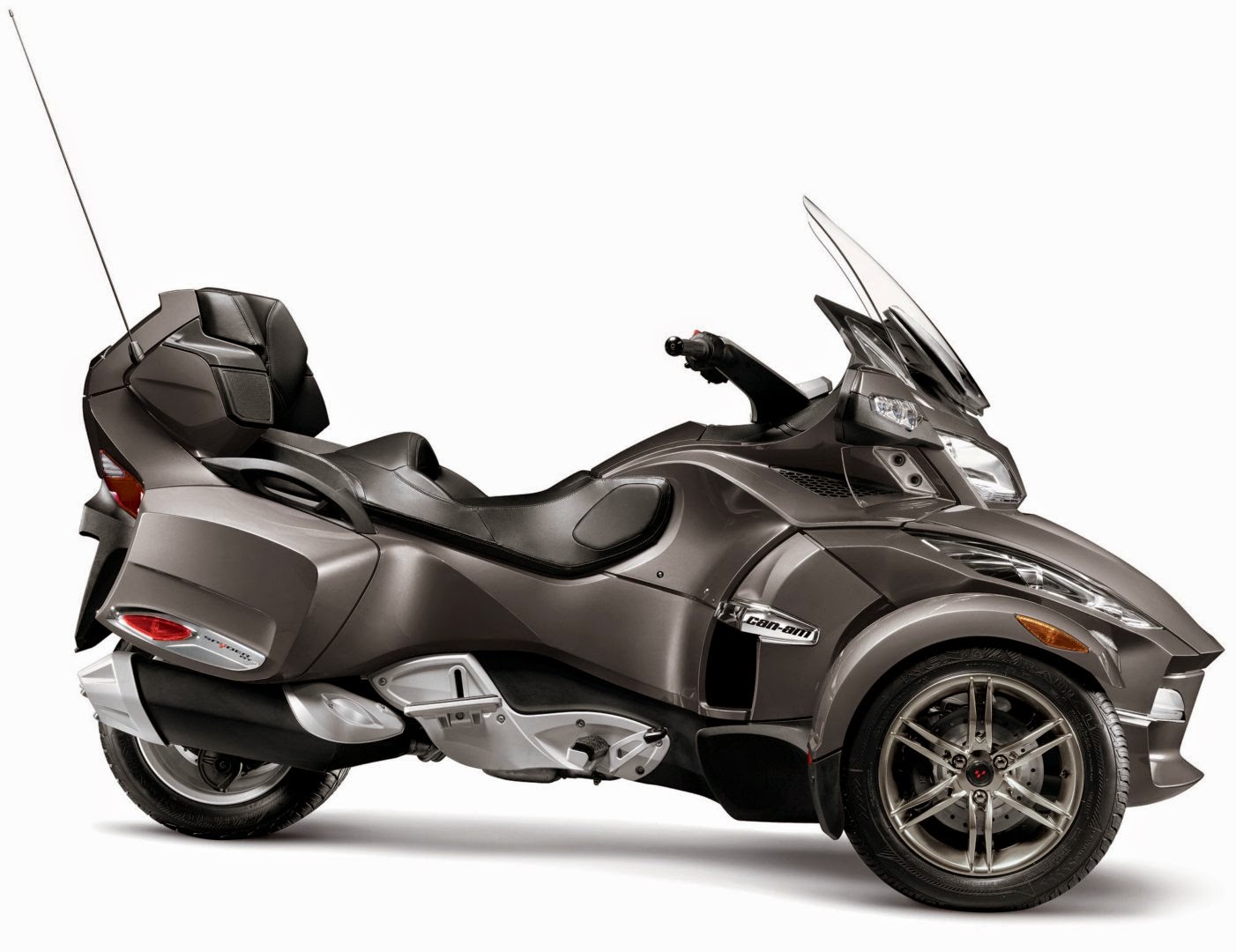
Can-Am Spyder F3

The UK motorcycling community hates trikes. Actually, that scorn extends beyond motorcycling circles. I once heard someone who doesn't ride describe trikes as "belonging to that section of motoring marked: 'Only For Men With Ponytails.'"

This colours my own attitude toward trikes, of course; we are affected by our surroundings, regardless of whether we want to be. And I will admit my own opinion of traditional two-wheels-in-the-back trikes is particularly negative. I think this is because they remind me of Big Wheels: transport of choice for discerning 4-year-olds. And when I see an adult on a Harley-Davidson Tri-Glide or converted Honda Gold Wing I can't help but imagine them to have the same traits as a 4-year-old: blindly self-focused, incapable of intelligent conversation, not terribly coordinated and inclined to wet the bed.

For some reason, though, my opinion changes if you switch things around and put the two wheels at the front, creating the Can-Am Spyder. Does this make sense? No. It's just how I think.

I'm not sure Brits share my view. According to official government statistics, Can-Am sold just 31 Spyder vehicles here last year. That's not a lot. Admittedly, a lack of dealerships may also be part of the problem. Can-Am has just four in the whole of the country. But then, MV-Agusta also has just four dealerships and managed to sell 184 models last year.

Maybe low sales are more to do with the fact that a Spyder is so utterly pointless in a UK context. With its 5-foot-wide stance, it is too broad to filter and as such serves effectively as a compact car. It's a Vauxhall Corsa with three wheels. But for the fact that the cheapest Spyder costs roughly £6,000 more than a standard Corsa, lacks the weather protection of a Corsa, can't haul nearly the amount of stuff or people as a Corsa, and gets just half the mpg of a Corsa. Top Gear described the Spyder as having "none of the benefits of a car and all the disadvantages of a bike."

Can-Am Spyder RS

The vehicle apparently sells pretty well in North America and Southern Europe, though -- places that have more sun and more open roads. And when I ponder what it would be like to own a Spyder I always picture myself back home.

I alluded to this in my post about the Ducati Scrambler: the idea of heading off on some epic, meandering journey a la Steve and Sash. One of the variants of this fantasy is the idea of Jenn and I trundling across the North American continent on a ridiculous behemoth of a machine that could hold all the things two people need to live on the road indefinitely, and with the sort of weight to resist the toppling winds that rip across the great flat spaces of the Plains States, Manitoba, Saskatchewan, et. al. Something like an Indian Roadmaster or BMW K1600GTL usually comes to mind.

But this past summer, Jenn and I were in the United States visiting family and two things happened in relatively quick succession that got me thinking about such big bikes. Both happened at the Minneapolis Farmers Market (another of the quadrillion things about the Twin Cities that makes it better than wherever you live).

First, I spotted a woman riding a Can-Am Spyder RS. I had yet to see one of these in person and was taken by the fact that: a) it is massive; and b) it is a lot less stupid-looking than I had thought. I mean, a lot. To the point that it looks strangely... cool? I'm pretty sure that's not the word I want to use, but I can't think of one that it is more appropriate. The woman steering that dry-land snowmobile through the heavy farmers market traffic looked... cool.

The second thing happened a few minutes later, as my dad, Jenn, and I were walking from one row of stalls to the next. Misjudging a curb slightly, my dad caught his foot and performed a spectacular Dolph Ziggler-esque fall onto the pavement. It wasn't just a stumble; it was as if he had launched himself to the ground.

It has to be said that Dad has never been athletic. He tells a story of himself as a chubby boy at a swimming pool wearing an inner tube that fit rather snugly. At one point he got turned upside down in the water, and lacked the physical wherewithal to right himself. A lifeguard had to jump in to save him from drowning. Now almost 65 years old, he suffers the same low-level clumsiness as always but increasingly lacks the agility and reflexes to correct such missteps. So, when he caught his foot and started to fall, he wasn't quick enough to bring the other foot forward and catch himself; he just went crashing down.

He ended up with a massive gash down his right forearm, another down his left knee and shin, and a few minor cuts on his hands. Fortunately, a paramedic team was stationed at the market and they were able to patch him up with a stack of bandages and some gentle humour.

Can-Am Spyder RT

You see where I'm going with this, right? If I want to keep riding past retirement, and especially if I want to live out that "Jenn And I Ride Across North America" fantasy, I need to accept that at some point in the future my balance, agility and reflexes might not be up to the task of manoeuvring a massive two-wheeled machine without incident. And at that point I will be left with just three options: give up riding, have expensive and morally questionable surgery to transplant my brain into the body of a 20-year-old, or get a three-wheeled bike.

The third option is the most viable. And because I find the aesthetics of a Spyder to be strangely appealing I'm OK with that. In some small way I look forward to it. I can see us now: wearing matching Roadcrafters and modular helmets with intercom systems, happily cruising across the plains of Kansas or badlands of the Dakotas on a Spyder RT -- a Wall Drug bumper sticker affixed to the top box.

But why wait until my autumn years? Jenn and I are still hoping to move to Minnesota in 2019 and I often ponder how I will deal with the fact it is a place that can see snow for 7 months out of the year. Do I just fall in with the fairweather majority, or do I become a motorcycling legend like Chris Luhman of Everyday Riding? He lives in the Twin Cities and rides through the winter on a Ural Patrol.

There's no denying the ready-for--a-zombie-apocalypse coolness of a Ural, but for me I'd prefer a Spyder as the tool for riding through the months of King Boreas' reign. It has traction control and apparently (because people in Canada have done it) it's possible to put winter car tires on the thing. So riding in winter kind of makes sense. After all, the Spyder is, as I said, a dry-land snowmobile; it is made by a snowmobile company.

So, ride on all your Spyder riders. You look ridiculous but who cares? Maybe one day I'll join you.

Can-Am Spyder snowplow. Because why not?
____________________

On a related note, it's been reported that quite a large percentage of the people buying Can-Am Spyders are women and individuals who have never ridden a motorcycle before (in many countries -- the UK included -- you do not need motorcycle qualifications to ride one, just a driver's license). I think this is great. Generally, I think that anything putting more motorcyclists or quasi-motorcyclists on the road is a good thing because it leads to normalisation, greater overall awareness by other road users and, ultimately more and better choices for consumers.
ADSENSE HERE

Are American motorcyclists retarded because of Harley-Davidson?

ADSENSE HERE
Man, if that headline isn't link bait I don't know what is. But let me explain: I love Harley-Davidson bikes, but I have a theory that motorcycling in the United States has suffered retardation, i.e., stunted development, as a result of Harley-Davidson's dominance over the past 30-odd years.

When I use the word "retard" I mean it in the technical sense –– not as a schoolyard taunt or politically incorrect description of someone who is mentally disabled. To retard is to "slow down the development or progress of something," according to Merriam-Webster. And that's what I'm asking: Has Harley-Davidson's overwhelming success in the U.S. market slowed down the development or progress of motorcycling in that country?

But, you know, obviously I could have chosen other words when asking that. "Impede" would work just as well, or "hinder," and so on. The word "retard" comes with a negative-value meta-narrative and its use implies a bias in the person asking the question. Guilty as charged, mis amigos. As someone who carries a latent pro-America stance I can't help but feel a little annoyed when I am forced to admit that my native land is not The Best at a given thing. 

And the painful truth is that Americans are not the best when it comes to making unique and different motorcycles. Not at the moment, at least. I think there is potential within the American landscape for rapid and dramatic change, but right now we are decades behind the curve. And I feel that much of the blame for that falls on the shoulders of Harley-Davidson. Well, no. Not Harley-Davidson, but the fact that there has for so long been no one but Harley-Davidson for a patriotic rider. 

In the United States, Harley-Davidson dramatically outsells all other brands. In 2013, Milwaukee's most-famous company was responsible for more than 51 percent of the street motorcycles sold in the country. And of the street bikes sold last year that were not Harley-Davidsons, quite a large percentage had been designed to look and ride like them. Los americanos les gustan las Harleys. 

That's not terribly surprising. People everywhere tend to cheer for the home team. Triumphs sell better than all else in Britain, BMWs sell better in Germany, and so on. However, Harley-Davidson's situation is unique because its sales dominance is so much greater compared to the successes of other manufacturers on their home turf. For example, BMW carves out just 17 percent of its local market.

My theory is that Harley-Davidson performs so much better at home because the United States was one of the few countries not to suffer an existential crisis after World War II. In other motorcycle-producing nations like Germany, Japan, Italy and even England the post war years forced serious re-evaluations of national identity. After all, it was nationalism and its ugly sides of xenophobia and racism that had fuelled the war. As such, patriotism isn't always an effective selling tool.

Whereas in the United States, the simple fact of a product being American is often reason in itself for people to choose it. Yes, I realise this is less true now than it used to be, but trust me, flag waving still delivers infinitely more marketing success in the United States than here in Europe. 

Through wit, hard work and good ol' fashioned dumb luck, Harley-Davidson found itself pretty much the only American motorcycle brand as it began its resurrection in 1981. Through the 1970s it had bumbled almost to the point of bankruptcy, unable to focus and therefore unable to compete against cheaper, superior foreign brands. Perhaps not so coincidentally, this rough patch had come during the Vietnam War and its aftermath, when the American psyche was suffering the closest it would ever come to existential crisis. It was a time when a product's simply being American wasn't enough.

But then, you know, "Morning in America" and all that stuff, and suddenly my grandfather was teaching me to check the labels of my T-shirts to see where they were made. And at the same time, Harley-Davidson lasered its focus to the types of model that had performed well in the past: "traditional" motorcycles. Bikes like those ridden by the modern cowboys who had captured popular imagination in the decades before.

And, of course, the American experience is always one of amalgamation. It is the melting pot. So, the society-degrading outcasts of one generation became the iconic symbols of American spirit for the next. Harley-Davidson brilliantly tapped into this and soon established itself in Americans' minds as not only as being the quintessence of America but the quintessence of motorcycling.

Growing up in the U.S. Central Time Zone –– in Texas and Minnesota –– there was only one kind of motorcycle. Well, maybe two: Harley-Davidsons (or foreign copies), and bikes for people who wore neon socks. Within my cultural understanding, it was Harley or nothing else. If you've followed this blog for a while, you'll know that, after getting my motorcycle license at age 18, I spent almost two decades choosing the "nothing else" option.

I know that the mindset of my younger self is not unique. Take a look at motorcycle blogs, websites and forums and you will see it everywhere, every day. Take a look at the motorcycles on American roads. Lots and lots of Americans struggle to comprehend a world beyond the Harley bubble.

Again, I'm not complaining about an American company being successful, nor am I complaining about the kind of bikes that Harley-Davidson chooses to make (hell, I want one myself). What irks me is that Harley's tremendous success seems to have resulted in so many people being blind to everything else. And as a result, motorcycling in the United States has not moved forward at the same pace as the rest of the world.

Do you see what I'm getting at? Perhaps it would help to take it out of a motorcycling context. Imagine if Chili's were the only place you ever ate. Ever. I'm a big fan of Chili's, personally. Free refills on ice tea, good burgers, decent wings, awesome chili-cheese nacho dip, and the Southwestern eggrolls are the bomb. That molten chocolate cake, too, yo. When I was in college I got a job as a waiter at Chili's solely because it meant getting a discount at Chili's. I could and can stand to eat at Chili's a lot. But if it was the only restaurant I ever went to? After a few decades of that I would be suffering from culinary retardation. I wouldn't really know what food could be.

In that scenario, should Chili's change what it's doing? Nope. Not necessarily. Should people begrudge its success? Definitely not. But that doesn't make me any less stunted in my understanding and philosophy of food.

I feel Harley-Davidson's success has retarded American motorcycling both technologically and philosophically. It is not just that American motorcyclists don't care about things like liquid-cooling or traction control, etc., but that they can't see why they should care. Because to them (a) motorcycles are toys. Hobbies. Trinkets that –– like an NFL jersey or Tom Petty box set –– are reflections of the personality/character a person wants to portray outwardly, but which are ultimately not terribly relevant nor deserving of analysis and progression.

The end result of that is three American brands that lack any model diversity and an American motorcycling landscape where filtering is allowed in only one state and very few people ever ride unless it's hot and sunny. A motorcycling landscape where too many riders settle for an inferior situation and too many potential riders choose nothing.

UPDATE: On the same day I published this post, Wes Siler published this article on Jalopnik, which captures the same frustrated sentiment you see in my post but more detail. It's a good piece (I wish I had written it) and will get you feeling upset at the state of motorcycling in America.

––––––––––––––––––––

(a) I'm talking in generalities here, speaking of the majority. Obviously, I know there are exceptions.

ADSENSE HERE
 

Advertisiment