Advertisiment

Showing posts with label cool stuff. Show all posts

Victory's NM-4: Remembering the Vision 800

ADSENSE HERE

A little more than 10 years ago, Victory Motorcycles revealed a concept bike that featured an 800cc liquid-cooled parallel twin engine, automatic transmission, and storage in the space where a tank would traditionally be. Dubbed the Vision 800, it was a dramatic departure from the sort of thing Americans had come to expect from their motorcycle manufacturers, and it offered a glimpse of Victory's true potential.

If you've never heard of the Vision 800, you're not alone. I only learned about it last year, as I was doing research for my review of the much larger V-twin tourer that shares part of the Vision 800's name, as well as its futuristic look. To my eye, Victory had created the Honda NM-4 several years before Honda, and I was surprised such a unique concept could seemingly have come and gone without more fanfare.

When Victory released its new liquid-cooled Octane model earlier this year, one of the narratives of the bike was that it represented a kind of opening of the doors for the Minnesota-based company. Finally, with its Polaris sibling, Indian, shoring up the traditional/heritage side of motorcycling, Victory could begin pushing in new directions.

All of which got me thinking again about the Vision 800. I decided to get in touch with the folks at Victory to ask a little more about the bike, starting with the most obvious question: Why wasn't there a production version?

"The Vision 800 was designed to be a concept motorcycle and introduce design elements that eventually showed up in the Victory Vision," explained Victory/Indian External Relations Manager Robert Pandya. "It was not intended to be a production bike, [but] then 'backed off' from production. The point of concept bikes is to introduce a series of design ideas and explore the product possibilities for the brand."


For more information about the Vision 800, Pandya directed me to Tiger Bracy (pictured above), the designer behind the project.

"The history of the Vision 800 began with my summer '04 internship," he said. "I was a Transportation Design student at the Art Center College of Design, in Pasadena, California. My boss (Greg Brew) handed me a design brief to work on something rather unique. We had a few conversations surrounding what an automatic motorcycle might be like for Victory. It needed to utilize a motor from our existing portfolio, and it needed to tie in with the Victory Vision touring bike."

The motor Bracy used was from a Polaris Sportsman 800 ATV. Equipped with a cast aluminum alloy frame, linked brakes and low-seat cruiser ergonomics, the Vision 800 was aimed at expanding Victory's customer base beyond its current buyer.

"I decided to... aim it towards new riders with very little or no experience," Bracy told me. "It was a statement on how a new motorcycle brand could develop its customers from the ground up. Notice I say motorcycle brand and not 'cruiser' brand. I wanted to challenge the status quo of what the 'New American Motorcycle' could become in the future."

To do this, Bracy spent a long time thinking about the sort of person that would ride the Vision 800 — someone he hoped could grow with the brand after choosing his concept as their first bike.

"Most inexperienced riders aspire to have a more powerful bike right away, even though they lack the riding skill to safely ride it," he said. "There is nothing intuitive about riding a traditional [large, air-cooled V-twin cruiser] motorcycle when you’re a beginner. They’re dangerous and difficult to master. In an absurd way, I guess that’s a part of the appeal.


"So, the styling of the Vision 800 needed to say American Muscle, and, most importantly, it needed to be unique. Think trendsetter, not a follower."

For the styling, Bracy said he couldn't help but look to the Vision tourer.

"The Vision touring bike was in the beginning stages of development," he explained. "I had this prototype sitting right in my face every day. The Vision 800 was designed to flaunt the new look of the Vision touring bike, but they could not share any actual components. I decided to borrow the touring bike's architecture of having twin fuel tanks mounted on either side of the motor, and that’s it.

"I rotated the parallel twin cylinders toward the front wheel to give more room on top of the motor. The radiator was moved out in front of the forks so the motor itself could be pushed even further forward to give room for the CVT. That architecture aided the Vision 800 to open up a massive storage space where the fuel tank and air-box would normally reside."

Bracy isn't exaggerating when he says "massive." The Vision 800's "trunk" was large enough to hold two full-face helmets, plus a little more. Bracy felt that having that much storage would help encourage new riders.

"When you’re a newbie, what’s the best way to get more experience? Simple: more seat time,” he said. "You could use the 800 as a daily commuter. It could haul a bag of groceries and your gym bag, no problem... The low seat height would make the bike less intimidating for smaller people or the less experienced."

In discussing his desire to create a bike to draw in new riders, Bracy offered a lot of insight into the challenges that any motorcycle manufacturer faces, especially in the modern world.


"Grandpa is getting old, but he’s living longer than his parents did," Bracy said. "[However,] his great-grandchildren may not have any interest in the bikes he once enjoyed. If you want to sell more new bikes, then you probably need to find new riders. You want more riders, you’ve got to teach new people how to ride. In high school, I had a driver’s automotive education class at 15 years old. But what about early motorcycle education? Good luck with a two-day safety foundation course."

Bracy said that when he designed the Vision 800 he gave it an automatic transmission in hopes of partially answering those challenges. He said it makes a bike easier to ride, and therefore more "newbie" friendly. He's not the only one to think this. Again, the comparison to the Honda NM-4 comes to mind. And, indeed, Honda has been at the forefront of pushing automatic transmission bikes.

"Since the Vision 800, we’ve seen Honda’s DCT in many different models. This confirmed that I wasn’t alone in identifying a new segment that most manufacturers overlook," Bracy said. "You see attempts to make an automatic motorcycle look either like a traditional bike, sans the clutch lever, or like something out of Transformers. This to me is the dilemma. It’s very difficult to get rid of the manual clutch; it’s like a badge of honor. It’s proof that you earned your stripes."

But, Bracy said, that "badge of honor" may be something older generations are more concerned with than those who might be considering riding now.

"Future generations will grow up in a world where these new autonomous cars are common to them. Didn’t I just see a robot piloted a Yamaha R1 last year? I bet the phrase 'what the hell happened to the clutch lever' will seem old soon," he said. "Do I see a future for more automatic bikes in our lives? The answer is yes... That future will probably be dictated by the OEM that is smart enough to begin appealing to a much younger generation that may not see a benefit in a manual clutch."


Which leads to the obvious question of whether Victory will be that OEM. The official answer to the question is the company-wide response of, "We cannot speak to future product," but Robert Pandya did say that Victory— and to a broader extent, Polaris —is aware of the opportunity to head in a more unique directions.

"The possibilities for the brand are very wide indeed. Even moreso now than they were when the Vision 800 came out. Polaris brands have access to a wide array of engines and technologies, and would be able to build anything. But the real question is if customers will buy it," he said.

The bottom line has long been a guiding factor in Victory's decision-making process. The brand's prudish business sense has sometimes earned it criticism from those who would like to see more earth-shattering projects being put forward. But you have to admit that there's something to be said for a brand that isn't constantly hovering near bankruptcy. And that's not to say that Victory is dedicated to being stuck in its ways.

"As consumer demands change, there are few companies in a better position to leverage a variety of technologies and product design groups than can build whatever we design," Pandya said. "It’s an exciting time to be in the PowerSports industry — especially with the Victory brand."

Meanwhile, Bracy remains hard at work within the Polaris umbrella. Since the Vision 800, he's worked on several of Polaris' off-road and on-road vehicle programs. Most notably, he was responsible for the three-wheeled Slingshot. Looking back on the Vision 800, Bracy said he remains proud of the concept— which these days sits in his office —and feels Victory was particularly brave for putting it out there.


"It let us know that anything was possible and we weren’t going to get stuck in one segment, just building clone bikes," he said.

And contrary to my limited perception (the internet gives us all a short memory), the Vision 800 did make a fairly big splash at the time.

"It was featured in more than 20 magazines, and Puma used it in an international ad campaign," Bracy said. "Some random design studio did a total rip-off and butchering of the concept for the latest Judge Dredd film. A friend of mine reminded me that imitation is the best form of flattery. I chuckled and grinned because I didn’t know if I should be flattered or pissed."

_____

(Article originally published on RideApart. Huge thanks to Tiger for his time and for providing images of the bike)
ADSENSE HERE

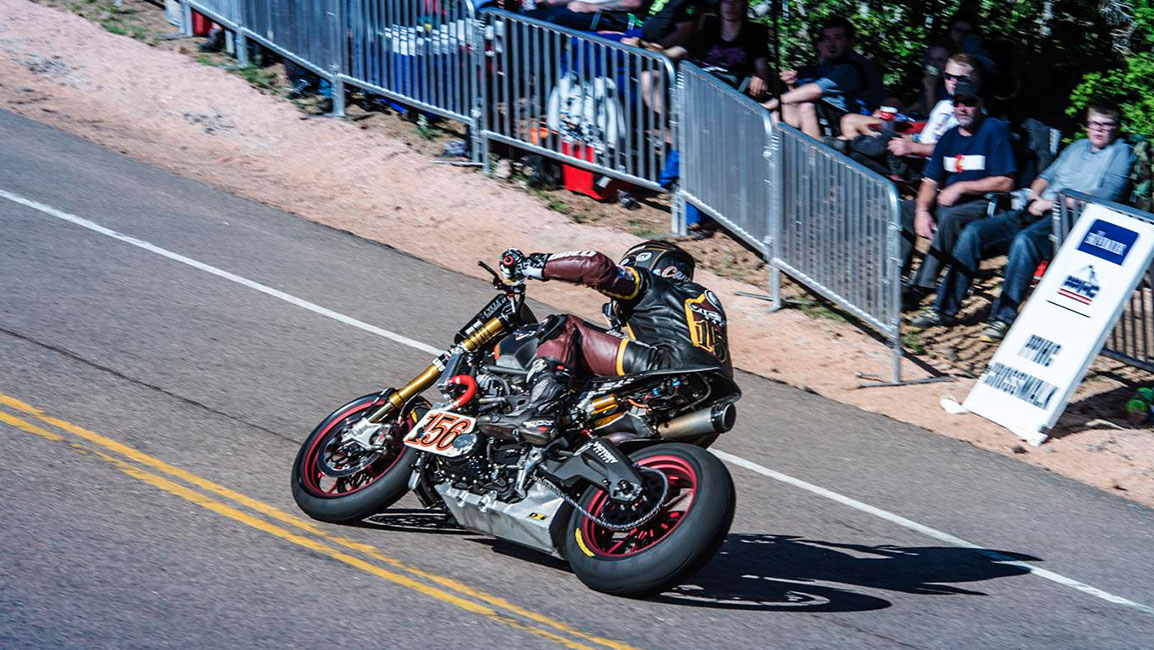
Please let this be true: Production version of Victory's Project 156 may still happen

ADSENSE HERE

There are fresh rumors that a road version of Victory's Project 156 bike is in the works and may arrive as soon as this year. And no, I don't mean another cruiser.

Project 156, of course, was the name for Victory's effort last year to conquer the Pike's Peak International Hill Climb. Powered by a rip-snorting prototype 1200cc liquid-cooled V-twin engine, the naked race bike was designed in part by Roland Sands and ridden by Cycle World editor Don Canet. Although the Project 156 attempt was ultimately unsuccessful, the bike Victory produced for the event drew a great deal of attention and raised many motorcyclists' hopes that a production version would soon become available.

Those hopes were raised even further in the weeks leading up to last month's unveiling of the Victory Octane, a 103 hp cruiser that some felt didn't quite live up to the Project 156 ethos. Many expressed disappointment that Victory had not delivered a model more faithful to the original Pike's Peak bike.

But now British motorcycling newspaper MCN is suggesting motorcyclists should not yet give up on the idea of a super naked from Victory. The paper claims a Polaris insider has told it: "The intention is still to create a production bike with similar levels of performance and looks for the road in the near future."

MCN says this bike "could be revealed later this year." The paper bolsters its claim by pointing out that Victory will again be racing at Pike's Peak this year. And, indeed, a quick glance at this year's competitor list shows Victory will actually be running two bikes up the notoriously difficult mountain course.


Don Canet will be back, this time astride a prototype electric motorcycle. And a 2016 version of Project 156 will be ridden by 2014 Pike's Peak Open Class winner Jeremy Toye, indicating that Victory are very serious about taking the prize this year.

Not surprisingly, Victory is saying nothing about all this. The company's standard response to any questions about what may or may not be in the works has always been: "We don't ever talk about future products."

And in this case, you can't blame Victory for keeping tight-lipped. An over-enthusiastic PR campaign for the Octane left some motorcyclists upset and may have convinced Victory that it's better to take a "less is more" approach when it comes to unveiling new models.

However, when I spoke last year to Victory/Indian external relations manager Robert Pandya about that year's Project 156 bike he did say: "Obviously we're doing this for a reason."

He also offered some hope to motorcyclists pining for an American bike that isn't a cruiser by pointing out that Victory was aware of the desire for such a thing.

"Certainly there's been interest from our existing customers" he said. "And our desire is to draw in new customers in different categories. We've got different venues we can play in, in terms of the overall opportunity on market. There are spaces where American bikes are not currently present, and maybe there's an opportunity for us."


That's an observation that feeds into a statement made earlier this month by Polaris President of Motorcycles Steve Menneto regarding the future of Victory and Indian. He told Minnesota's Star Tribune: "We project that [sales] volume will increase [and] we will double our market share over the next three years."

At present in the United States, roughly 50 percent of all street motorcycles larger than 600cc are sold by Harley-Davidson. It could be that Polaris has enough faith in the Indian brand that it thinks it can double its market share simply by cutting into Harley's piece of the pie.

Or, it may be eager to expand into other segments of the motorcycle market. Perhaps to naked motorcycles, which is the second most popular segment in the United States. And if that were the case, Victory has certainly made no secret of the fact that its aim is to focus on performance, cutting a distinct path away from the more traditional world of Indian. 

But all of these "what-ifs," "maybes" and "should-bes" are the sorts of things that led so many people to being underwhelmed by the Octane. So, personally, I'm a little skeptical of these new rumors. To build a road version of the Project 156 bike seems like too great a leap.

Victory has always been a forward-thinking company, blessed with engineers and designers capable of dreaming up ideas that are decades before their time. But it has also been pretty gun-shy when it comes to implementing those ideas.

If Victory wanted to fulfil riders' daydreams of a Project 156 bike for the masses, it obviously wouldn't be as simple as slapping an Octane engine into an upright chassis (which in itself isn't exactly "simple"). Riders would expect power north of 120 hp, as well as the bells and whistles found on many other super nakeds: ABS, traction control, rider modes, and so on. This bike would need to be at least as good as a Suzuki GSX-S1000, with many wishing it to be on par with a KTM 1290 Super Duke. That's a pretty tall order, and it's a hell of a lot to have to get right on your first try. It would, as I say, be a massive leap.


However, that doesn't mean I'm not eagerly looking forward to my first glimpse of the 2016 Project 156 bike. The look of that motorcycle may say a lot about whether production bike rumors are true. When building last year's bike, Roland Sands and his team were squeezed for time, so they used the swingarm and suspension of a Ducati 899 Panigale. Since Victory will presumably have had more time to prepare for this year's event it will be interesting to see if the chassis now has a more original "in house" look.

If it does, that may hint at production intentions. Or it may not. I guess we'll have to wait and see.

(Originally published on RideApart)
ADSENSE HERE

Indian's new Scout Sixty: Who is this for?

ADSENSE HERE

(This article was originally published on RideApart)

Less than two months have passed since Indian's new Scout Sixty was unveiled in Milan, and the classically styled modern cruiser has already racked up a fair amount of accolades.

I've yet to ride the bike myself (I'm working on changing that soon), but by the accounts of other motojournalists, the 999-cc Scout Sixty maintains all the positives of the 1131-cc Scout from which it is derived. The Scout Sixty loses a little bit of horsepower to its bigger sibling, as well as a sixth gear, but also sheds $2,300 from its US price tag.

That's no small amount. With the money saved you could spend a full two weeks staying at the Holiday Inn Express in Clute, Texas. Why you would want to do such a thing, I don't know; the point is that you could.

But is that enough? It seems the reason the Scout Sixty is winning so much praise is the simple fact it is, essentially, a Scout. It looks like a Scout, sounds like a Scout, rides like a Scout, and handles like a Scout. It weighs roughly the same as a Scout; it has the same seat height, the same ergonomics.

So, why not just buy a Scout?

I like the Scout Sixty, but ever since it was revealed I've struggled to understand who it's for. What segment of the motorcycling population does the Scout Sixty reach that the original Scout does not?

When you have two bikes that look almost exactly the same, it's obviously not a case of appealing to different tastes as might be the case with, say, Harley-Davidson's Iron 883 and Sportster 1200 Custom.


A common tack adopted by many motojournalists (including myself when I first wrote about the bike last November) is to suggest the Scout Sixty is aimed at new and returning riders. But, really, I don't think that explanation holds much water.

Ignoring the fact that buying a brand-new bike as your first is a terrible idea—there's nothing about the original Scout to scare off newbies. I've ridden it, and although it possesses a claimed 100 hp, it's far from being an untameable hell beast. Power delivery is smooth and manageable, especially if you adopt the traditional cruiser technique of short shifting.

Actually, perhaps I'm looking at this the wrong way. The major difference between the Scout and Scout Sixty is 22 horses: the Scout makes 100 hp, the Scout Sixty delivers 78 hp. That latter number is still plenty. More than plenty. It's more than you'll get from a Harley-Davidson Sportster 1200 (65 hp), and considerably more than the 54 hp offered by Triumph's new Bonneville Street Twin. It's more, even, than the 75 hp produced by the Ducati Scrambler, which is a bike everyone tells me isn't comparable to the Scout Sixty even though I think it is.

On paper, the Scout Sixty outmatches almost any bike you might choose to compare it against, and a fair few that you wouldn't. So, perhaps the real question is: Why would anyone buy a Scout instead of a Scout Sixty?


Has Indian shot itself in the foot by delivering a bike that is almost in every way as good as the Scout while costing $2,300 less? Probably not. But I'm stumped in trying to determine the sense of this situation.

My guess is that before long, possibly within the next eight months, we'll see the two models heading in different stylistic directions. Maybe the larger-engined Scout could be reworked into a kind of touring platform. After all, a liquid-cooled engine comes in handy when covering long distances in summer. Or maybe, as hinted by the Roland Sands flat trackers, Indian could use the Scout Sixty to finally fulfill my wish for a Scout Scrambler (or any sort of standard).

It's exciting to think of where the Scout and Scout Sixty could end up, but I'm still confused by where they are now.
ADSENSE HERE

Bryan Harley, I hope you're right

ADSENSE HERE

By now you will have figured out I'm a Victory mark; I get grumpy when they don't do exactly what I wish they would do, I swoon every time that they do something cool, and I will bite on just about every rumour I hear. 

So, it goes without saying that I've been going out of my mind ever since I read speculation by MotoUSA's (a) Bryan Harley that Victory may be planning to unveil a new liquid-cooled model at EICMA

The basis of his speculation comes from a save-the-date-type email sent out last week to members of the media, letting them know the time and place of a "world premiere" at this year's EICMA show in Milan.

"Victory Motorcycles has been showcasing American Muscle throughout its product line and in racing," the email says. "Our pathway to the latest evolution of the brand will be revealed (at EICMA)."

Also within the email is the above photo of a Victory-branded case cover unlike those seen on any of the manufacturer's existing models. In fact, it looks a whole lot like (and may, in fact, be) the cover seen in this photo:


That, of course, is a picture of the engine that was used in Victory's renown Project 156 bike, that CycleWorld editor Don Canet rode as part of an effort to conquer Pike's Peak earlier this year. Although the effort wasn't successful due to incredibly bad luck, the snarling beast of a bike was a huge hit, serving as one of the best examples of American know-how and ability since... uhm... a hell of a long time. It sounded amazing, it looked fantastic and it moved.

Drawing on these two bits of information -- the cover and the email's text -- Harley has come to the conclusion that a long-awaited liquid-cooled Victory is finally set to arrive. And when I say "long-awaited," I mean looong.

I was writing articles wildly hoping for speculating on such a thing almost a year ago. Harley himself had been expecting the news even further back. In July 2014, when Victory brought moto-journalists to Las Vegas for what turned out to be the launch of the world's most disappointing bike, the Magnum, he had been expecting to be presented with a liquid-cooled model. After all, he reasoned, why else would you launch a bike in Las Vegas in the dead of summer?

Of course, Victory didn't deliver in that instance and thus far hasn't since. Which is a fact that lies at the heart of my cynicism toward Harley's speculation. Additionally, why EICMA?

A huge part of Victory's ethos is the fact that it's from 'Murica, y'all. It talks about "American muscle" and prides itself on the fact its first model was produced on the 4th of July (in 1998). Meanwhile, when Victory finally does deliver a liquid-cooled bike, it will undoubtedly be seen as the first step in Victory's new direction, the new way forward that has been promised and hinted at ever since Polaris resurrected Indian. Why would this American-flag-waving company choose to launch something so crucially important in Italy?

Perhaps, though, that's the point. By and large, Europeans don't have the weird obsession for air-cooled V-twins that Americans seem to have. And it's a good bet that anyone bothering to turn up at EICMA, even American journalists, will agree with or be sympathetic to that line of thinking. So, launching a liquid-cooled bike at EICMA helps Victory avoid the inane "OMGWTFBBQ!!" response that the American old guard are certain to deliver.

Additionally, to launch something at EICMA would be something of a declaration for Victory, a means of asserting itself on a world stage. It would be a way of saying: "We're not some 'also-ran' company. We are important and worth paying attention to."

Personally, I am desperately hoping that Bryan Harley turns out to be right. As it happens, I will be there in person to find out if he is (b).

I will be covering EICMA for RideApart and, in fact, I will be riding to Milan on a Victory Cross Country that the good folks at Victory Motorcycles UK will be lending me. I was already looking forward to the trip, and now I have even more reason to be excited.

But what will it be?

So, if it turns out that Victory actually does unveil a liquid-cooled something less than a month from now what, exactly, will it be?

Remember these sketches?

As much as it pains me, I doubt the new model will be the Victory adventure-tourer that I've daydreamed about. And I think it's even less likely that the company will deliver a pure sport machine. But sticking to the cruiser genre seems to me a bad idea, since I'd think a big part of Victory's modus operandi at the moment would be a desire to clearly set itself apart from Indian (which already has a liquid-cooled cruiser in the form of the Scout).

The picture sent in the media email (which I also got, by the way; and I am kicking myself for not putting the pieces together as Bryan Harley did) doesn't offer any clues. Indeed, it appears that in that particular shot there is no bike, just engine.

To that end, perhaps that's all that would be revealed at EICMA: an engine. Similar to the way Indian first launched the Chief Classic, Chief Vintage and Chieftain a few years ago. They teased us with the engine first, then revealed the actual bikes later. So, perhaps the actual bike reveal would coincide with Daytona Bike Week. After all, that event, which is technically centred around an actual motorcycle race, celebrates its 75th year in March. And it was that venue which Victory chose as a platform when launching both the Judge and the Gunner.

But a four-month tease seems a little long. Especially considering the fact that the fabled new liquid-cooled engine is almost certainly nothing more than a modified version of Indian's liquid-cooled V-twin. You don't need four months to hype that.

Perhaps a clue in what will come can be found in those sketches that were leaked back in March 2014. One of them turned out to be the Indian Scout, but we've still not seen anything like the other three. Disappointingly, the sketches were of cruisers, but at least two of them had mid-set pegs, putting the rider in a chair-like seated position, which Harley-Davidson and Star Motorcycles would call "sporty." So, maybe Victory will go back to the well from whence the Judge originally came.

I'd hope not. I'd hope that Victory would push a little further and perhaps deliver something to rival the BMW RnineT in style and power and handling. I sense they have it in them to deliver such a thing and to do it well. And, as Victory's head of external relations, Robert Pandya, told me back in June, the company is aware that a demand for such a thing exists.

"Certainly there's been interest from our existing customers" he said. "And our desire is to draw in new customers in different categories. We've got different venues we can play in, in terms of the overall opportunity on market. There are spaces where American bikes are not currently present, and maybe there's an opportunity for us."

Whether Victory seizes that opportunity and in what form it chooses to do so... well, maybe those questions will be answered in mid-November.

_______________


(a) Is it MotoUSA now? When did it stop being Motorcycle USA? I missed the memo on that one.

(b) Bryan, if you happen to be reading this I have memory of once promising to buy you a beer. I hope I'll get the chance to do that at EICMA.

ADSENSE HERE

The joy of jerryrigging

ADSENSE HERE

There are all kinds of positive aspects to motorcycling –– I wrote about several of them not too long ago –– but one of the lesser-known positives is the incredible sense of satisfaction that you get from coming up with a solution to a problem.

Sometimes the solution can be purchased. My shed is an example of that; it's a solution to the problem of British weather. The Constands centre stand dolly I use is another example; allowing me to navigate the Strom through the tight corners of my courtyard so I can put it in the aforementioned shed.

Especially gratifying, however, are those instances when you come up with your own, homemade solution.

So, here was the problem I faced: there isn't any particularly good place to mount a GPS (aka sat-nav) on a Suzuki V-Strom 1000. Indeed, the only place available on your standard Strom is on the handlebar. And because much of the 'bar space is eaten up by switchgear, handguard mounts, mirror mounts, brake reservoir and heated grip controller, you have to attach the GPS low –– where the 'bar bends down to the clamps.

This is less than ideal at the best of times. Placing the GPS so low puts it out of your immediate line of sight when riding, forcing you to take your eyes off the road and look down to follow directions (a). Meanwhile, if you mount a tank bag view of your GPS will be blocked completely.

This is my old setup. It may not look like it from this angle but the GPS was mounted particularly low.

The solutions currently offered by the aftermarket aren't terribly good. Suzuki sells an installation bracket that bolts to the clamp. If you look at the bracket, however, it doesn't appear it would raise the GPS more than 2 inches –– just enough to peak out from behind a tank bag, maybe, but still low and out of your line of sight.

Touratech sells something similar, but it looks particularly difficult to install. They also, however, sell a handlebar crossbar that is cheaper, less fiddly, and looks like it would allow you to mount a GPS just that little bit higher (probably half an inch to an inch higher than the clamp-mounted system).

When I say "cheaper" I say that within the Touratech context. The crossbar, which is nothing more than a piece of metal with some bolts, has a list price of £26.09 (US $41.08). Nonetheless, I ordered one.

A month ago.

The confirmation email said it would arrive in 10 days. But to my knowledge, it still hasn't arrived. Thankfully, I did not pay for the crossbar and had simply scheduled for it to be sent to Touratech's Wales location. This instance included, I have only dealt with Touratech twice, and both times I've been disappointed (b).

But, as I say, even that solution wasn't terribly good. So, I'm happy fate ruled it out. What I really wanted was a bar that runs above the dashboard display, similar to what you see on the dashboards of the BMW R1200GS and Triumph Tiger Explorer. It is a ridiculously simple thing, but it makes a world of difference.

This is the view from astride a Triumph Tiger Explorer XC. Note the bar that runs above the clocks.

Then, last weekend, as I rode down to Devon, I had an epiphany: I could make a GPS mounting bar for the V-Strom 1000! I could do it myself, just like one of those old dudes that spends all his time on the ADVrider forums.

It occurs to me there might be, somewhere, another Strom owner out there who would also want to mount a GPS, so, this is how I did it:

First, I got a piece of plastic tube that Jenn's grandfather found in his shed. He keeps various bits of tubing around for gardening projects. The tube is roughly 25 mm in diameter. Then I went down to the local hardware store and bought some 22mm steel tubing of the sort you might use for building a shower rail.


The next step was to cut both pieces to 300 mm using a hacksaw. My idea was to create something to bolt onto the two metal brackets that hold the V-Strom's adjustable screen. There are several holes already drilled in said brackets, so I figured it would be easy enough to make use of them.

After that, I slid the metal tube inside the plastic tube, thereby creating a bar that's extra strong (I suspect that either of the tubes would have been good enough on their own, but, hey, why not use two?)


Then I simply needed to hold the bar up to the screen's brackets where I wanted to bolt it and mark my drill points with a Sharpie. With a 25mm bar, your only choice is to use the bracket holes for the screen's highest setting.

I took a deep breath (I always get anxious when cutting or putting holes into things), and drilled bolt holes on each side of the bar.


I used a 5mm drill bit to make the holes, then pushed through two 5mm x 40mm bolts (i.e., 5 mm wide and 40 mm in length). From there, it was a simple matter of attaching the whole thing to the Strom's screen mounts and reattaching the screen (on its lowest setting in this case, though I could probably also use the mid setting holes if I wanted).

And just like that I now have a bar that allows me to mount my GPS well within my line of sight.

I'll be honest that I was actually surprised to have it work so well. More often than not, anything I do falls into the "Measure Twice, Cut Thrice" school of DIY. I suppose that's an indication of just how easy this project was; if I can do it, so can you.


Odds are, if you do it, it'll look better. But I feel there's something beautifully redneck about that blue plastic. It is exemplary of the kind of ugly-ass fix that a true Texan would build. It's straight-up Gulf Coast jerryrigging (c). But the most important thing is that it works.

Besides, it won't stay that way for long. I have decided I will cover the bar with stickers from the countries I've ridden to. Before long, it'll be a prized part of the bike.

Including the cost of hacksaw blades and a drill bit capable of going through metal, this project cost me £8.59 (US $13.52).

Meanwhile, the feeling it gave me to come up with and implement this solution is invaluable. As I was putting it together, I started singing to myself, "I am a genius: a genius who is amazing," in the style of David Bowie.

How it looks with my GPS mounted


––––––––––––––––––––


(a) One means of alleviating this issue is hooking up a Bluetooth device in your helmet and syncing it to your GPS so you're receiving audio direction in addition to the visual direction offered by the map. Unfortunately, I do not have a Bluetooth device in my helmet, nor the money to buy one.  

(b) The other time was when I rode out to the Wales location to ask for advice on which was the best emergency tire repair kit to buy. The woman at the counter was baffled by this question and directed me to a guy whose only input was: "Well, I dunno, to be honest. I don't really use 'em. I s'pose I'd go for this one by here, 'cause it's cheapest." Right. Thanks for the expert advice.

(c) I know the correct spelling is "jury rigging" but that's not how you'd say it in Texas.
ADSENSE HERE

I am going to win this bike, so don't even bother entering the competition

ADSENSE HERE

Did you see David Beckham: Into the Unknown last summer? It was a one-off TV show that incongruously linked to the soccer World Cup, featuring David Beckham riding around Brazil in ridiculously fashionable gear astride a custom Triumph Scrambler.

A few people were critical of the show because it did very much feel like a long advert for Triumph motorcycles, Belstaff clothing and whatever skin and haircare products Beckham uses to keep himself so handsome. But I didn't really care.

Firstly, because I like Beckham. He is about as "normal" as you could possibly expect anyone with so abnormal a background to be. I mean, the man was effectively raised by a soccer team, for Pete's sake. He was shipped up to Manchester at the age of 14 and indoctrinated into the professional footballing machine. He was raised by a multinational corporation, for whom winning served as the moral backbone. 

This is the culture that produces rapists, drink-and-drive killers and wife beaters. That the most lamentable thing about Beckham is his extraordinary prettiness is a testament to the inherent goodness of the man.

And I respect his appreciation for motorcycles. Obviously his athletic ability helps him in this, but when you see the man ride it's clear he's not just fired up the bike because the cameras are rolling. He knows how to move a bike around. Even in the mud. In Into the Unknown he mentions that one of the things he loves about riding is the anonymity afforded to him by wearing a helmet. And that's something I can relate to. Not on his level, obviously; I'm not internationally famous (yet). But one of the many things I love about riding is the feeling of freedom that anonymity brings.

As I wrote not too long ago: "inside your helmet and gear there is freedom from judgement. If you're fully geared up, an onlooker may not be able to tell your age, race, or gender; they likely can't guess your religion or politics, probably not even your socio-economic status.. and in that you are free."

Secondly, the reason I liked Into the Unknown was the bike. Beckham and his pals all rode customized Triumph Scramblers. Or well, customized Bonneville T100s made to look like Scramblers, according to Triumph. I can't begin to guess what the difference would be.

Either way, they were really cool bikes. Totally inappropriate for riding through the rainforest, I'd think, but cool nonetheless. I am surprised Triumph didn't choose to issue a special-edition Beckham Bonneville off the back of the show.


Turns out I'm not the only one to think such a thing. The folks over at Motolegends felt so strongly it should exist that they built one themselves.

Motolegends is a motorcycle clothing/gear website run out of Guildford, England. Guildford, as you know, is the stop before Woking when taking the train from Portsmouth to London (a). And Woking, of course, is the stop before London Waterloo, which means you should get up and go use the toilet unless you want to be stuck paying to pee.

I have a tendency to salivate over the Motolegends catalogue, which is why I'm effectively giving them a free plug here. They sell all kinds of cool gear, including the Halvarssons and Rukka stuff that I daydream about owning.

Daydream is probably all I'll ever do; a Rukka Armas jacket will set you back £1,000 (roughly US $1,500). And that's just the jacket; the trousers cost another £700 (US $1,000). How on earth can a jacket cost that much? What does it do? For that kind of money, I'd expect it to... uhm... perform marital functions.

Anyhoo, inspired by the show, the Motolegends kids took a 2001 Bonneville and transformed it into their own Beckham machine. They used it as a display piece for a while but have recently decided to make it available to win in a prize draw.

They got in touch with me and asked that I tell you about the prize draw. Because they are nice people who read the blog and claim to be fans of the Minnesota Vikings, I decided I would do just that. So, click here if you want to win a really cool motorcycle.

Though, in all honesty, I'd prefer you didn't enter the competition. Because I want to win. And the fewer people I have to compete against, the better my chances.

Here, we'll make a deal, OK? If you really want the bike, I will sell it to you when I win. Then I'll have the money to buy one of those Rukka sex suits. That way, we'll both be happy. Especially me.


____________________


(a) I was a student at University of Portsmouth many moons ago.

ADSENSE HERE

Keyless start makes you a bad ass

ADSENSE HERE

I can remember when key fobs started showing up in cars, allowing keyless entry and keyless start. It baffled me. Why, I thought, would such a thing be necessary or even all that desirable? 

Is the world full of silent sufferers of repetitive stress injury whose lives are made hell by the act of taking keys out of their pocket and placing them in the steering column? Are we so short of problems that the greatest minds of our generation absolutely needed to remedy this problem?

Key fobs just struck me as stupid and inherently susceptible to issues that don't apply to the traditional old bits of metal that are keys. Water, for example. I have on very many occasions gone swimming with my keys in my pocket. Not by accident, but because it makes sense.

At Barton Springs, in Austin, Texas, for example. Leave my wallet in the car, tie my car keys into the waist tie of my swimming trunks. Boom. No worries. But if you've got a battery-powered key fob, you can't take it into the water with you. You can't keep it on your person. So, you can't relax and enjoy splashing around.

Instead, you have to wrap it up in the towel that you're leaving creekside and hope that no one saw you wrapping up said fob, hope that no one will want to steal a towel just for japes, hope that none of the half dozen dogs that are playing in the creek decide to unravel your towel. And you're left to always be craning your neck to make sure that the towel remains in sight, never willing to put your head underwater, never really venturing too far into the creek or having any fun.

Connected to this, a fob isn't the sort of thing you'd want to risk throwing to someone. Ever done that? I have. You're up on the third floor or some such thing and your wife says: "Hey, can you throw me the keys, I need to get something out of the car."

So, you toss them down to her and because she has the eye-hand coordination of a drunk and blind sloth, the keys never even touch her hand and go straight to the pavement. Do that with a fob and you'll end up with smashed bits of plastic and an urgent phone call to the dealership.

Even if you don't ever get the fob wet or drop it from great height, there's still the reality of a battery and its finite lifespan. A metal key that's been sitting in a drawer for 60 years will still function as it did when it was first cut. If you live in a place that gets ungodly cold, like Minnesota, that key will still get you into the shelter and safety of a car even if the car's battery is dead.

So, by and large, my opinion of key fobs has always been negative. They strike me as an unnecessary gimmick, answering a question no one asked and creating problems from a previously problem-free aspect of driving (a).

Needless to say, as the keyless-start trend has made its way to more and more motorcycles it has been met by more and more eye rolling on my part. I have definitely gone swimming with my motorcycle keys in my pocket (on those times when I've remembered to bring a swimming trunks and not just dived in completely naked). I have definitely dropped my keys.

True, I have also accidentally left my key in the ignition and walked away, only to realise my mistake upon returning to the bike half an hour later. And, yes, the other key on the key chain (the key to my U lock) has bounced around in the wind to the extent that it has scratched and chipped the metal of the steering column. But these issues still haven't really validated keyless bikes in my mind.

Generally, when I've seen keyless start listed as a feature, I've thought: "Give me heated grips instead. They're cheaper, more practical and less critical should they fail."

But then something happened that completely changed my mind

.
There's a dude in Cardiff who rides a Harley-Davidson Iron 883 and parks it wherever the hell he pleases. He works in the city centre, I assume, because that's where I always see his bike -- always in some place that motorcycles aren't really supposed to go (b). This in and of itself makes him cool. Cardiff city centre benefits from second-hand cool as a result. I feel this should be written into the city's improvement plans: if you have a cool bike you are allowed to park it anywhere you damn well please. There's something pretty awesome about seeing a Harley just cooling under a tree in the Hayes, or Royal-Enfield Continental GT serving as backdrop to some street performer.

This particular Iron 883 has aftermarket exhaust that can be heard from a fair distance, but up until recently I'd never seen the guy who owns it. Then, a few days ago, I was walking through city centre when I heard the bike approaching.

FAWOOM. I turned to see it rolling up a bus lane and onto the pedestrianised area outside Central Library. Next to the bicycle racks, where a few other motorcycles were parked, he stopped and performed the coolest manoeuvre I have ever seen.

In one single, fluid action, he kicked down the side stand, thereby cutting the engine, stepped off the bike and walked away, pulling off his helmet and never even glancing back at the bike as he strut into John Lewis.

Yeah, the story is ruined somewhat by the fact he was strutting into a John Lewis, but ignore that bit. The keyless fob in his jacket meant he was able to just get off the bike and walk away like a movie star. It was such a cool, beautiful move that I felt weak in the knees. It made me want to run out and get an Iron 883 just so I could ride around pulling the same trick.

And deep down in the recesses of my mind a thought formed: "Man, keyless bikes are bad ass."

____________________

(a) OK, not totally problem-free, as people from the Upper Midwest can attest. It is possible to have your lock freeze in severely cold weather and for the key to snap as you're trying to undo that lock. But that's a problem that can be overcome by the simple act of paying attention to what you're doing: if the lock feels frozen, don't try to force it.

(b) Though, there's nothing to say specifically that he shouldn't be parking his bike there. Peculiarly, if you look at the Vehicle Excise Duty certificate (often incorrectly referred to as "road tax") for a motorcycle in the UK, you will see that the government in its infinite wisdom has classed the machine as a bicycle. Running with this, many of the ballsier riders in the UK apply the same parking thinking to their motorcycles as one would a bicycle -- e.g, on the sidewalk, chained to a pole, etc. Only London has cottoned to this trick and outlawed it. Everywhere else, it is left to police discretion as to whether your bike is causing a problem.
ADSENSE HERE

Get a motorcycle

ADSENSE HERE
This, y'all. The only thing I would add, right at the very end of the video, are three simple words: get a motorcycle:

ADSENSE HERE

What I want: the new supercharged Honda NC750

ADSENSE HERE

I had a moment of excitement and glee this week when I spotted the following blurb on page 7 of the February 2015 (a) issue of Bike magazine:

"Kawasaki's supercharged H2 has caused proper rumpus, so now Honda plan their own blown bike. They've filed patents showing a supercharger on... yes, the humble NC750."

Wait. What?! 

I'll admit we're treading deep into the waters of Things Chris Doesn't Really Understand here, but from what I know of superchargers they are magical bits of machinery that when added to a motorcycle leave you wondering: why didn't they do that in the first place?

I mean, the Victory Hammer that set a land speed record at Bonneville, for example. Simply slapping a supercharger on that thing saw it delivering 200hp at the rear wheel. Compare those numbers with the roughly 83hp you'll get from a stock Hammer S and the stock bike seems like a bad investment.

I'm simplifying this so it makes sense to my tiny brain, but basically a supercharger is able to get increased performance by forcing more air into the engine. In the way I've visualised it in my head, this forced (compressed) air has an effect on the engine similar to blowing on the embers of a fire; suddenly the stuff being burned is being burned more efficiently. If you know about superchargers, please feel free to offer a clearer explanation in the comments. But remember to use small words and simple terms because I'm from Texas.


Even though they've existed for nigh 100 years, it's my understanding that superchargers haven't been placed on standard bikes because they are expensive, not just a little bit fiddly, and create a more urgent challenge in terms of engine cooling.

Also, hitherto, superchargers have really only been used to help a bike go insanely fast. And that's what so interesting about this Honda plan. Big Red intends to use the supercharger more for the sake of efficiency than speed.

According to an article in Motorcycle News, the supercharged NC750 will make use of the technology to deliver a vehicle that offers the same low emissions and enviable MPG while boosting performance to somewhere around 100 hp!

In other words, a supercharger will eliminate the single gripe I have about the NC750X. I have long been a fan of the bike, writing about it here, here, and here. Honestly, I don't think there's a week that goes by in which I don't find myself staring at the NC750X page on Honda's website, thinking: "Maybe. Maybe. Maybe that would be the bike for me."

I mean, the damned thing gets more than 80 mpg, for the love of Pete. That blows my mind. The pickup truck I owned in college got 14 mpg –– making the 240-mile drive from Bloomington to Moorhead on a single tank of gas was always a nerve-wracking experience. Meanwhile, the Honda CBF600SA I ride at the moment gets roughly 50 mpg and has spoiled me against many less-efficient machines. I love not having to pay for fuel (especially in the UK, where it costs so much).


But the thing –– and generally, the only thing, because I can overcome its ugly/bland looks –– that cools me on the NC750X is the fact it's so underpowered. It produces just 54hp. OK, uhm, true, that's the same amount of power as a Harley-Davidson Sportster 1200, and if I had the money I'd probably already be riding one of those around, but the Harley is so much cooler. My expectations exist on a sliding, often emotional scale. And because I ride a 600cc Honda that gets 76 hp, I expect at least that much from a 750cc Honda.

A supercharged NC750 would exceed my horsepower expectations while still offering a fuel-efficient and environmentally friendly machine. That last aspect is the driving force in developing a standard supercharged bike, it seems. More stringent environmental legislation is set to go into effect in Europe in 2016 and it's logical to assume that even tighter restrictions will be implemented later on.

To that end, Honda is not the only one looking to put out a supercharged middleweight bike. Just the other day I spotted a news article claiming that a supercharged 600cc Suzuki is very close to production. It's claimed the forthcoming Suzuki Recursion (which, to me, looks as if it has taken its styling cues from a sex toy) will put out 100 hp and a cruiser-like 74 ft.lb of torque.

It seems that for the sake of efficiency, the supercharger is the way forward. Indeed, not too long ago I read that Honda is developing a new VFR400 (not to be confused with the one that ceased production 20 years ago). No doubt it, too, will be supercharged. It's an exciting new world and I wouldn't mind being part of it.

Having said all that...

I've decided to add a new element to my What I Want posts, acknowledging the fact that all motorcycles have some flaws. In this case, one of the biggest problems will almost certainly be price. In the case of the Kawasaki Ninja H2, adding a supercharger means it costs 67 percent more than the Ninja ZX-10R. Jacking up the price of an NC750 by that much would dramatically decrease its appeal to me.

Add to this the fact that alleged patent drawings for this forthcoming bike show the supercharger eating up the space that currently exists for the NC750's signature tank-trunk thing.

So, now you're talking about an NC750 that costs a whole lot more and has a whole lot less storage space. Not to mention the inherently increased risk of mechanical problems that comes from adding technology that has taken more than a century to be perfected for standard use.

At that point it makes far more sense to spend your money on something like a good ol' Honda CB650F –– 86 hp and 60 mpg, plus better brakes, for only £100 more than the current NC750X.

Honda CB650F

–––––––––––––––––––––

(a) February 2015, lads? I bought the magazine in December 2014!
ADSENSE HERE

I'm a sucker for good marketing

ADSENSE HERE
"A life without dreams simply has no meaning."
–– Soichiro Honda
I'm a Honda rider; I'm never really sure, however, whether you could call me a Honda guy. My emotional relationship with the manufacturer of the bike I ride is often tenuous. You can see that in a number of posts I've written over the past few years: the time I compared Honda to professional wrestler Lance Storm,the time I lamented Honda's utter lack of coolness, the time I compared my bike to an ex-girlfriend, and so on.

Of course, the mind immediately jumps to the question of whether it's necessary to be an anything guy. Why not just buy/ride whatever bike it is that you like according to your needs and wants at the time, rather than trying to shoehorn yourself into the illusory lifestyle of any given motorcycle manufacturer? After all, motorcycle ownership is not religion.

But I suppose we could learn a little about motorcycling from at least one religion: Sikhism. To paraphrase Guru Nanak, there is no Harley Guy, there is no Honda Guy, but each of us must still choose a motorcycle.

I digress. The point is: I'm a Honda owner but I often feel something akin to embarrassment because of it. People will ask me what kind of bike I ride and too often I'll attenuate my answer with words like "only" or "just," e.g., "Oh, it's only a little 600cc Honda, but what I really want is..."

Nevermind that my "little 600cc Honda" delivers more horsepower than a 1200cc Harley-Davidson Sportster, is more fuel-efficient and everyday useful than an Indian Chief Classic, and has better brakes than every bike Victory has ever made. For some reason, I have in my head a silly, childish, aesthetic, and all too often financially-based (a) vision of what coolness is, and Honda doesn't really fit within that.

But then there are things like the picture above of world-travelling Stephanie Jeavons, or my own interaction with American nomad Steve Johnson, or the chance conversations I've had with people like the guy I met at Motorcycle Live who had put 87,000 miles on his ST1300 and said of it: "Be careful if you get one because the bloody thing won't die and you won't have any good reason to replace it when you decide you want something new."

These people are adventurers. Their gear is often makeshift and almost always worn out from use. They just go and go and go, in part because the bike they've chosen doesn't stop. And that's pretty cool. 

But because I'm a Gen X dude who can't think for himself, I sometimes need the capitalist machine to remind me that Hondas are cool. Which is why I have been really digging the marketing campaign for the forthcoming True Adventure motorcycle.


I kind of wonder how this hype will jive with the actual automatic transmission motorcycle that I saw displayed at Motorcycle Live, but, you know, Who cares, man?! These videos are awesome. Especially that second one (b); I've watched it about a dozen times thus far. And each time I do, it manages to set off a little voice in my head that yelps: "I need a Honda so I can explore all the things."

Hey, wait! I already have a Honda! Go me! I can explore all the things right now! Yay! Fire up Google Maps and let the dreaming begin!

And therein you have the power of good marketing. Harley-Davidson, of course, does it incredibly well, but this is the first time I can remember being struck by any sort of Honda campaign. Well done, Big Red: you've made me feel happy to be a Honda owner.

Though, I'm still not sure if I'm a Honda guy...

––––––––––––––––––––––––––––––––––––––––

(a) For example, Hondas have a reputation for durability and quality. BMWs also have a reputation for durability and quality. BMWs definitely don't look much better than Hondas, so why do I swoon over them more? The only logical answer is that I am somehow enchanted (and duped) by the fact that they are more expensive.

(b) One of the people featured in the video is Steph Jeavons, who is Welsh and is a partial inspiration for my own Great Welsh Tea Towel Adventure.
ADSENSE HERE

Ours is to scream against standardisation

ADSENSE HERE
I've mentioned before my love of El Solitario –– a custom-builder from Spain whose work is part of a movement in motorcycles that I love. Here's an interesting little film about him that talks, of course, about motorcycles but also about art and its relevance. 

Subversively, this little film also explains why I need to improve my Spanish and move to Spain.

 
ADSENSE HERE

Miscellaneous

ADSENSE HERE
The lads of El Soliario
Here are a some miscellaneous things that have been on my mind lately:

Farewell Bob Skoot
It would appear that Bob Skoot, author of Riding the Wet Coast and avowed Crocs lover has died. Within the tiny sub-culture within a sub-culture that is blogging about motorcycles Bob was well known as the guy who would actually read posts and leave thoughtful comments. I didn't interact with him as much as I now wish I had, but he was a definitely a good man. 

Victory's hard sell
Victory is offering some pretty hefty rebates on all of its models at the moment -- up to $2,000. This rebate applies to a huge swathe of models, going back to those from the 2012 model year. Any time a manufacturer has to slash prices it suggests all is not well, but what's particularly telling to me is that there are apparently so many unsold models from years past. Perhaps that's behind Victory scrapping so many models for its 2015 model year line up: it simply wasn't selling the models it was making. And that certainly makes one concerned for the company's future. However, if you're looking for a silver lining, maybe Victory is doing its best to sell old stock because it knows that something considerably better is just around the corner. Perhaps a higher-performance engine that would make older models considerably less desirable? And anti-lock brakes on all the models?

Someone at Yamaha is listening
I suggested in my review of the Yamaha MT-09 (aka the Yamaha FZ-09) that its engine would be better suited to a different format. Unlike the delightful MT-07, the larger MT-09 doesn't have the character and spirit to make you overlook the shortcomings of a naked hooligan-targeted bike (e.g. no viable passenger accommodation, no wind protection). Instead, the MT-09's triple strikes me as better suited to bike suited to motorway (freeway) commuting and light touring. It seems Yamaha has gotten the message. Not too long ago it registered a trademark for an adventure-style sport tourer -- something similar to a Suzuki V-Strom or Honda Crossrunner. Then, this week CARB documents revealed that Yamaha is working on yet another platform for the MT-09's triple. Motorcycle.com notes that both new bikes will be given an FJ designation (FJ09FCGY and FJ09FCR). I am really bad at divining stuff from motorcycle names but my hope is that all this means Yamaha will be developing a lighter (and cheaper) version of its venerable FJR1300. Something on par with the Honda VFR800F or BMW F800GT.

Keanu's bike costs three times as much as a house in Detroit
Many moons ago, I sang the praises of the Keanu-Reeves-backed Arch KRGT-1. My primary point in liking the bike was the fact that it was American and it was new. At the time, the Polaris Indians had yet to be revealed, so I was simply happy to see someone attempting to move the American motorcycle discussion forward. But then Chief and Chieftain showed up. Then Harley-Davidson introduced Project Rushmore, made improvements to all its models, introduced the Street line, and went all-in on developing the Livewire. Then Indian released the Scout. Now Arch has finally announced it is ready to sell the KRGT-1 and it is a chain-driven, no-ABS, disappointment that looks like something Roland Sands would do on a budget. And Arch is asking $78,000 for it. 

El Soliario has a big set
CycleWorld has called El Solitario's Impostor custom BMW RnineT "the world's most hated motorcycle." El Solitario is a builder based out of Spain that's on the forefront of the custom scene that I love so much -- the Wheels & Waves scene of grizzled Gringo-helmet-wearing Europeans speaking in viscidly poetic terms about motorcycles and souls. Well, them and Roland Sands. Anyhoo, a while ago, as part of its launch for the bike, BMW gave a number of these custom builders an RnineT with which to do as they please. Germany's Urban Motor turned it into a muscled flat tracker, Roland Sands decided to use the bike as an exercise in subtle beautification, Over in Japan, builders transformed the RnineT into sleek cafe, racing and new wave machines. But El Solitario, what did they do? They took a brand new high-performance machine and made it look like a Mad Max prop that had been kicked off a cliff and abandoned for several years. They went rock n' roll; they went punk. Whereas all the other builds effectively help BMW sell its bikes, the El Solitario Impostor is a big middle finger to that idea. Which inherently makes it a thing of particular beauty.
ADSENSE HERE
 

Advertisiment