Advertisiment

Long-term gear review: Corcoran Jump Boots

ADSENSE HERE

I wrote a post about Corcoran Jump Boots a few years ago, after about a year of use, but I thought it would be good to offer another review, now that I'm considering retiring my pair in favor of some Alt-Berg boots. Or, well, perhaps not retiring, but taking out of regular service.

I first bought a pair of Corcoran Jump Boots about three years ago, based on the recommendation of the dog camping guy. Since then, I've put roughly 24,000 miles on them, using them in all weathers. 

In Wes Siler's article he suggests these Corcoran boots as a good middle ground between fashion, usefulness, and safety.

"[A] little more normal to walk to do normal things in," he wrote. "I can even dance in these."

Since I grew up in Texas, where dancing consists of spinning on your cowboy boot heel while trying not to spill your Lone Star, that's not really an impressive claim. I can "dance" in ski boots.

So, yes, these are dancing boots; perfect for those of you riding stereo-laden baggers and tourers, eager to bust out a boogie at stop lights. But that's not why I bought them. I chose these boots because they are: 1) cheaper than any equivalent-quality boot I could find; 2) made in the God-blessed United States of America. Specifically, they are made in Martinsburg, Pennsylvania — a community so full-on Americana that its police department offers to check up on your house for free while you're on vacation.

The story of Corcoran Jump Boots stretches back to World War II, when US paratroopers wore them on the battlefields of Europe. Made of thick, insanely durable leather, they offer a decent amount of protection for motorcycle use in the sense that internal ankle support, a steel shank, and high lacing all help to keep the foot firmly in place.


I had to look up what a shank is: it's the bit of a shoe's supportive structure that runs down the middle of your foot, between the heel and ball of your foot. I can't feel said shank when wearing the boot, but the firmness it offers possibly explains why I have found the boot to be a good substitute for a hammer when trying to put tent pegs into hard ground. Obviously these boots don't offer the sort of protection you'd get in something specifically made for high-speed track riding or ankle-snapping off-roading, but for everyday all-the-time use I've found them to be pretty good.

They've become immensely comfortable over the years, to the extent that I've been known to walk several miles in them. They are unlined, so they were about as tolerable as any boot could be when riding in 102ºF Italian heat last summer. In Britain, where warm weather is extremely rare, I find that more often than not a good, thick pair of wool socks is necessary. When temperatures drop below 40ºF, two pairs of socks are required if I'm going to be riding for more than 30 minutes.

The boots are not waterproof, but a dedicated regimen of slathering them with Nikwax helps keep them fairly water-resistant... within reason. When I spent several hours riding through constant downpour in Luxembourg, Belgium and the Netherlands last autumn, puddles formed inside the boots and things took roughly a week to dry out. But I'm not sure many boots would have faired a whole lot better in the same situation.

Meanwhile, failure to religiously clean and re-wax the boots has occasionally left me with soggy feet.
One of the things I like is the fact the boots lace up and, as such, can be brought tight against the calves. Because I live in a place where it rains all the time, I prefer to wear my trousers over my boots, rather than tuck them in and risk having water run inside. Having the boots tight against my leg means they'll fit beneath pretty much any riding pant.


Additionally, I prefer the secure feeling of boots that can be laced tight. Many motorcycle boots are made for the pant-tuckers of the world and leave my leg feeling too loose and unprotected. The most extreme example of this came when I was able to kick off a fully strapped pair of Forma Adventure boots.

Corcoran Jump Boots come with a set of smooth, hard rubber soles that Wes suggested are "good for making them last," but my experience was that they wore away pretty quickly. But maybe I am just really hard on boots; I have had these resoled three times.

Which speaks to another advantage of the Jump Boots: they're easy to get repaired. High-end boot manufacturers like Daytona will sometimes repair worn soles if you take them to an official dealer and have them shipped off to the factory. But that's incredibly expensive and time consuming. Meanwhile, Jump Boots can be resoled at your local strip mall shoe repair store in a day or two for considerably less money.

The boots take a while to break in, and when I first bought them they were so stupidly shiny as to make me feel foolish. But over time they've proved themselves so comfortable and versatile that finding replacements has been challenging.

Ultimately, I decided these aren't quite suited to all-the-time British use and bought a pair of truly waterproof boots that meet European safety standards. I'll still hold on to my Jump Boots for summer rides — especially those that see me traveling somewhere and doing a fair bit of walking. I've treated these boots pretty rough, but I'm confident they've got several years of life left in them.
ADSENSE HERE

Living the Dream

ADSENSE HERE

I'm sitting in a hotel in Yorkshire as I write this — about 300 miles north of my home in Cardiff. Known as "God's own country" by locals, this region of England is rich in hills, curving roads, quaint villages and (when it's not raining) staggeringly beautiful sunsets.

I'm here to visit the factory where Alt-Berg boots are made. Primarily the maker of hiking boots, Alt-Berg also offers a handful of rigorously tested motorcycle boots popular among the Iron Butt/BMW-owning crowd.

Partially my visit is personal, seeking out a set of riding boots that meet my ambition to buy local. The factory is the only place to see/touch Alt-Berg's motorcycle offerings in person, and I'm the sort of old-school dude who thinks that's important. And partially my visit is professional, trying to determine whether there's a story to be had here and whether that story would fit on RideApart.

To the first purpose, the trip was a success. I ended up buying a set of Hogg All Weather boots, which will be made to order and shipped in the next few weeks. I got to wander around the factory where my boots will be made (amid a scrum of frightening machinery), and I got to meet Debbie, the woman who will be making my boots.

But to the latter purpose I question whether the fit would be a good one. The above paragraph is pretty much the meat of any story I might write about Alt-Berg — nice people making nice boots in a nice place — and it strikes me as perhaps a little too local for an international (often USA-focused) site like RideApart.

Riding back from the factory to my hotel, I got stuck behind one of Yorkshire's surprisingly numerous slow drivers (30 in a 60? For the love of Pete!) on a road where passing was not allowed. It started raining heavily and within a few minutes the not-Alt-Berg, not-waterproof boots I was wearing were soaked through. Wet, cold, frustrated and hangry (the factory visit had taken longer than expected and I'd not had lunch), I proceeded to throw a little tantrum in my helmet.

Harrogate, Yorkshire

For some reason I had decided to twist in my mind the whole purpose of this trip. I cursed the fact I had come here and that my story idea had met a dead end.

"What a waste of time this whole trip has been," said me.

Actually, I just thought that; it was an idea that flashed through my brain. But it was an idea well enough formed to have intonation — an intonation I did not like. There was arrogance in the thought, a sort of "I'm better than this" quality.

And instantly I felt stupid. I found a place to pull off the road, killed the engine, stepped off the bike and took a few deep breaths as the rain faded to light drizzle. In the distance, I could see the clouds breaking and radiant sun pushing through.

"You're riding a motorcycle, Chris...on a Wednesday afternoon," I reminded myself. "And, more or less, this is your job. Why are you bitching?"

This month marks the one-year anniversary of my joining the RideApart team, and moto-journalism became my full-time gig earlier this year. Although I have plenty of experience in other journalistic fields, I think it's fair to say I'm still something of a newbie on the moto side of things.

Though, from my past lives in television newsrooms and long-dead news websites, I know that one of the curses of a newbie is the fact that arrogance sometimes builds faster than experience. Which, I guess is more or less what happened to me on that ride. I had somehow managed to convince myself that I was an Important Person who did Important Things, and when faced with minor inconvenience I went all Stone Phillips on the road (a mentor of mine was a runner for NBC many moons ago and tells a story of the broadcaster losing his sh*t when she brought him a 7-Up, rather than the Sprite he had asked for).


But I'm not an important person, and I'm definitely not doing important things. I write about motorcycles, y'all. This is quite possibly the most ridiculous career a person could have. And although the pay's not great (I'd struggle to purchase any of the bikes I write about), I really have nothing to complain about. Even when a story idea comes to naught, even when I'm stuck behind someone's overly cautious grandmother, even when I'm hungry, even when it's raining.

Back in my hotel— fed, warm and dry —I felt stupid and embarrassed about the whole thing. But rather than keep it to myself, I've decided to write about it to perpetuate the embarrassment, to better crystallize the experience in my mind and hopefully hold it as something to keep me from pulling the same sort of nonsense again.

I'm living the dream here, and if I forget that fact I risk losing the sense of excitement that comes from getting to spend so much of my time astride a fire-driven dandyhorse. Which would be very sad from a personal point of view, and also negates my ability to do my job well.

So, yeah. I let myself temporarily forget how good things are. No one saw it, no one but me was affected by it, but I'm putting it out there on the internet so that, hopefully, it won't happen again.
ADSENSE HERE

Victory's NM-4: Remembering the Vision 800

ADSENSE HERE

A little more than 10 years ago, Victory Motorcycles revealed a concept bike that featured an 800cc liquid-cooled parallel twin engine, automatic transmission, and storage in the space where a tank would traditionally be. Dubbed the Vision 800, it was a dramatic departure from the sort of thing Americans had come to expect from their motorcycle manufacturers, and it offered a glimpse of Victory's true potential.

If you've never heard of the Vision 800, you're not alone. I only learned about it last year, as I was doing research for my review of the much larger V-twin tourer that shares part of the Vision 800's name, as well as its futuristic look. To my eye, Victory had created the Honda NM-4 several years before Honda, and I was surprised such a unique concept could seemingly have come and gone without more fanfare.

When Victory released its new liquid-cooled Octane model earlier this year, one of the narratives of the bike was that it represented a kind of opening of the doors for the Minnesota-based company. Finally, with its Polaris sibling, Indian, shoring up the traditional/heritage side of motorcycling, Victory could begin pushing in new directions.

All of which got me thinking again about the Vision 800. I decided to get in touch with the folks at Victory to ask a little more about the bike, starting with the most obvious question: Why wasn't there a production version?

"The Vision 800 was designed to be a concept motorcycle and introduce design elements that eventually showed up in the Victory Vision," explained Victory/Indian External Relations Manager Robert Pandya. "It was not intended to be a production bike, [but] then 'backed off' from production. The point of concept bikes is to introduce a series of design ideas and explore the product possibilities for the brand."


For more information about the Vision 800, Pandya directed me to Tiger Bracy (pictured above), the designer behind the project.

"The history of the Vision 800 began with my summer '04 internship," he said. "I was a Transportation Design student at the Art Center College of Design, in Pasadena, California. My boss (Greg Brew) handed me a design brief to work on something rather unique. We had a few conversations surrounding what an automatic motorcycle might be like for Victory. It needed to utilize a motor from our existing portfolio, and it needed to tie in with the Victory Vision touring bike."

The motor Bracy used was from a Polaris Sportsman 800 ATV. Equipped with a cast aluminum alloy frame, linked brakes and low-seat cruiser ergonomics, the Vision 800 was aimed at expanding Victory's customer base beyond its current buyer.

"I decided to... aim it towards new riders with very little or no experience," Bracy told me. "It was a statement on how a new motorcycle brand could develop its customers from the ground up. Notice I say motorcycle brand and not 'cruiser' brand. I wanted to challenge the status quo of what the 'New American Motorcycle' could become in the future."

To do this, Bracy spent a long time thinking about the sort of person that would ride the Vision 800 — someone he hoped could grow with the brand after choosing his concept as their first bike.

"Most inexperienced riders aspire to have a more powerful bike right away, even though they lack the riding skill to safely ride it," he said. "There is nothing intuitive about riding a traditional [large, air-cooled V-twin cruiser] motorcycle when you’re a beginner. They’re dangerous and difficult to master. In an absurd way, I guess that’s a part of the appeal.


"So, the styling of the Vision 800 needed to say American Muscle, and, most importantly, it needed to be unique. Think trendsetter, not a follower."

For the styling, Bracy said he couldn't help but look to the Vision tourer.

"The Vision touring bike was in the beginning stages of development," he explained. "I had this prototype sitting right in my face every day. The Vision 800 was designed to flaunt the new look of the Vision touring bike, but they could not share any actual components. I decided to borrow the touring bike's architecture of having twin fuel tanks mounted on either side of the motor, and that’s it.

"I rotated the parallel twin cylinders toward the front wheel to give more room on top of the motor. The radiator was moved out in front of the forks so the motor itself could be pushed even further forward to give room for the CVT. That architecture aided the Vision 800 to open up a massive storage space where the fuel tank and air-box would normally reside."

Bracy isn't exaggerating when he says "massive." The Vision 800's "trunk" was large enough to hold two full-face helmets, plus a little more. Bracy felt that having that much storage would help encourage new riders.

"When you’re a newbie, what’s the best way to get more experience? Simple: more seat time,” he said. "You could use the 800 as a daily commuter. It could haul a bag of groceries and your gym bag, no problem... The low seat height would make the bike less intimidating for smaller people or the less experienced."

In discussing his desire to create a bike to draw in new riders, Bracy offered a lot of insight into the challenges that any motorcycle manufacturer faces, especially in the modern world.


"Grandpa is getting old, but he’s living longer than his parents did," Bracy said. "[However,] his great-grandchildren may not have any interest in the bikes he once enjoyed. If you want to sell more new bikes, then you probably need to find new riders. You want more riders, you’ve got to teach new people how to ride. In high school, I had a driver’s automotive education class at 15 years old. But what about early motorcycle education? Good luck with a two-day safety foundation course."

Bracy said that when he designed the Vision 800 he gave it an automatic transmission in hopes of partially answering those challenges. He said it makes a bike easier to ride, and therefore more "newbie" friendly. He's not the only one to think this. Again, the comparison to the Honda NM-4 comes to mind. And, indeed, Honda has been at the forefront of pushing automatic transmission bikes.

"Since the Vision 800, we’ve seen Honda’s DCT in many different models. This confirmed that I wasn’t alone in identifying a new segment that most manufacturers overlook," Bracy said. "You see attempts to make an automatic motorcycle look either like a traditional bike, sans the clutch lever, or like something out of Transformers. This to me is the dilemma. It’s very difficult to get rid of the manual clutch; it’s like a badge of honor. It’s proof that you earned your stripes."

But, Bracy said, that "badge of honor" may be something older generations are more concerned with than those who might be considering riding now.

"Future generations will grow up in a world where these new autonomous cars are common to them. Didn’t I just see a robot piloted a Yamaha R1 last year? I bet the phrase 'what the hell happened to the clutch lever' will seem old soon," he said. "Do I see a future for more automatic bikes in our lives? The answer is yes... That future will probably be dictated by the OEM that is smart enough to begin appealing to a much younger generation that may not see a benefit in a manual clutch."


Which leads to the obvious question of whether Victory will be that OEM. The official answer to the question is the company-wide response of, "We cannot speak to future product," but Robert Pandya did say that Victory— and to a broader extent, Polaris —is aware of the opportunity to head in a more unique directions.

"The possibilities for the brand are very wide indeed. Even moreso now than they were when the Vision 800 came out. Polaris brands have access to a wide array of engines and technologies, and would be able to build anything. But the real question is if customers will buy it," he said.

The bottom line has long been a guiding factor in Victory's decision-making process. The brand's prudish business sense has sometimes earned it criticism from those who would like to see more earth-shattering projects being put forward. But you have to admit that there's something to be said for a brand that isn't constantly hovering near bankruptcy. And that's not to say that Victory is dedicated to being stuck in its ways.

"As consumer demands change, there are few companies in a better position to leverage a variety of technologies and product design groups than can build whatever we design," Pandya said. "It’s an exciting time to be in the PowerSports industry — especially with the Victory brand."

Meanwhile, Bracy remains hard at work within the Polaris umbrella. Since the Vision 800, he's worked on several of Polaris' off-road and on-road vehicle programs. Most notably, he was responsible for the three-wheeled Slingshot. Looking back on the Vision 800, Bracy said he remains proud of the concept— which these days sits in his office —and feels Victory was particularly brave for putting it out there.


"It let us know that anything was possible and we weren’t going to get stuck in one segment, just building clone bikes," he said.

And contrary to my limited perception (the internet gives us all a short memory), the Vision 800 did make a fairly big splash at the time.

"It was featured in more than 20 magazines, and Puma used it in an international ad campaign," Bracy said. "Some random design studio did a total rip-off and butchering of the concept for the latest Judge Dredd film. A friend of mine reminded me that imitation is the best form of flattery. I chuckled and grinned because I didn’t know if I should be flattered or pissed."

_____

(Article originally published on RideApart. Huge thanks to Tiger for his time and for providing images of the bike)
ADSENSE HERE

GWTTA: Aberaeron

ADSENSE HERE

I first came up with the Great Welsh Tea Towel Adventure a few years ago. The idea was pretty simple: using the map on a touristy dish cloth (aka "tea towel"), I would visit some 66 different villages, towns and cities in Wales, as well as Snowdonia National Park.

The reason for this was twofold:

Firstly, it's an excuse to ride my motorcycle. Wales is a tiny country and just about any location within its borders can be reached and returned to from any other location within the space of a day. Wales has a number of exceptionally good roads for riding and if –– like me –– you live here, the proximity of everything to everything else means you can pretend you're on a fancy, exotic road trip without having to fork out for hotels.

The tea towel
The second reason was that I had developed a deep, unabiding hatred of Wales, and I found this to be somewhat detrimental to my overall wellbeing. I had come to Cardiff in 2006 full of incredulous belief I was moving to my spiritual home, that this would be my place of acceptance, my milltir sgwâr of belonging. But it turns out I was wrong.

In particular, I was wrong about the ever-dwindling community of speakers of Wales' native language. They are isolationist, exclusionary, and welcoming only in the sense that a really good B&B is welcoming. You may feel very cosy and happy and special in a B&B but there is always a clear you-and-them relationship. No matter how long you stay, how frequently you return, you will never be welcomed into the B&B owner's family; you will never become one of them; the B&B will never be your home.

That lesson was learned via a series of personal disasters that created in me a deep, festering bitterness toward Wales and everything in it. Which, as I say, was problematic. First and foremost because I was angry all the time. All I needed do to enrage myself was open my eyes and look at my surroundings. Was I in Wales? Yes? Cue rage. 

That was a silly way to be. Especially in light of the fact I had no solid plans to leave. Convenience and circumstance keep me here: free health care, the fact my wife and I own our home, the fact my wife (an Englishwoman) generally likes Wales, the fact her best friend lives roughly 45 seconds away, and other little things. I want to leave at some point, and have made my wife promise on numerous occasions that she will not bury me in Wales should I meet an untimely end, but leaving right now creates a stack of financial and personal burdens that, ostensibly, may not be worth shouldering for the simple joy of being able to skedaddle.

It took me a long time to come to terms with the Not Going To Leave Soon reality of my situation (I still haven't completely accepted it) but I realized that if I was going to survive here without developing stomach ulcers, I was going to have to find a way to accept Wales for what it is, rather than what it isn't.

The daffodil is the national symbol of Wales.

And what Wales is, generally, is a pretty-but-wet place populated by mostly nice people who will never show you true love. Which means that, of all the places you could end up, it's not actually that bad. I implemented the Great Welsh Tea Towel Adventure as a means of reminding myself of that.

But, as I say, that was a few years ago. The idea ran out of steam after a handful of trips and I soon found myself using my motorcycle more as a means of escaping Wales rather than improving my opinion of it. I was working a full-time job and I didn't want to waste those rare moments when good weather intersects with a weekend trying to change my opinion about a place.

Then, late last year, circumstance pushed me into the life of a freelance journalist. With my schedule now more flexible, I decided it would be a good idea to restart the GWTTA project. After all, the financial instability inherent in freelancing roots me even more firmly in Wales; no new home loans for me. And in restarting the project, I decided to go about things in a more systematic way: choosing to visit places alphabetically.

So, Aberaeron –– a small town on Wales' west coast –– was placed at the top of the list. Where it stayed for the next three months, thanks to one of the facets of Wales that causes me the most displeasure: weather. For three months not one day passed in which rain was not forecast for Aberaeron. Sometimes it was an all-day light rain, sometimes it was a heavy rain with gales, sometimes it was drizzle with freezing fog, but always there was rain.

Finally, just a day or so before my 40th birthday, my phone's weather app showed an open window. So, I threw my camera in my pocket, hopped on the bike, and pushed northwest.


Aberaeron is some 95 miles from Penarth via the "slower," more interesting route that I chose. Google Maps would have had me get there by a long stretch of motorway, running from Cardiff to Carmarthen on the M4, then trundling up the A485 and A487. But it's generally my experience that you can get somewhere in Wales more quickly if you avoid main routes, i.e., the routes suggested by mapping programs and GPS devices.

Partially this is because you'll be avoiding the route that everyone else is taking and partially this is because main routes tend to be the ones littered with speed cameras. I can too quickly start to sound like a libertarian wingnut in expressing the frustration and concern I feel toward speed cameras, but suffice to say I think they're a terrible idea.

Fortunately, Big Brother's reach isn't as vast in Wales' interior as other parts of Britain. And the fact that local authorities have abandoned actual policing in favor of stationary yellow boxes on main routes means that the odds of your getting in trouble for riding 110 mph on a 60-mph road are shockingly low.

My route took me first across an eastern section of Brecon Beacons National Park, where sheep served as the only witness to my Suzuki's high-rpm snarling. Twisting routes like the A4069, A4059 and A4067 provide scenic riding that –– in certain sections –– is on par with roads I've encountered in Italy. Sight lines are good across the moorlands, meaning you can see all the way through curves, and road quality is generally better than you'd expect for tarmac so exposed to the elements. Sheep poop and gravel are omnipresent, and overnight ice can sometimes linger into the afternoon, but sane riders can still enjoy spirited biking.


Further east, I hopped onto the A482, which winds its way through slightly more forested terrain all the way to Aberaeron. Technically the speed limit on large sections of this road is a bafflingly slow 50 mph, but, as I say, there is no enforcement. I made good time.

I don't know why my tea towel draws particular attention to Aberaeron. As far as I can tell it isn't noteworthy. It doesn't get a single mention in John Davies' A History of Wales, which, at 718 pages, contains exceedingly more information about Wales than anyone ever need know. 

More than 800 years ago, Aberaeron was home to a fortress known as Castell Cadwgan, named after one of the myriad squabbling warrior kings that fought over Wales until Edward I succeeded in conquering the region in 1283. 

There are no signs of the fortress now, and it was all but gone to the sea when the town was set up as a shipping port in the 1800s. For a very short while it supported the shipbuilding industry but by the start of the first World War it had generally turned its hand to the task of attracting tourists.

To that end it is a lovely place to visit on a sunny day. Aberaeron is located in the Welsh county of Ceredigion but it feels more Pembrokeshire to me. The latter county has been known since Tudor times as "Little England Beyond Wales" thanks to the fact it was the area of Wales most successfully held by the Normans in the 12th century, and roughly 1,000 years later it possesses a certain Englishness.

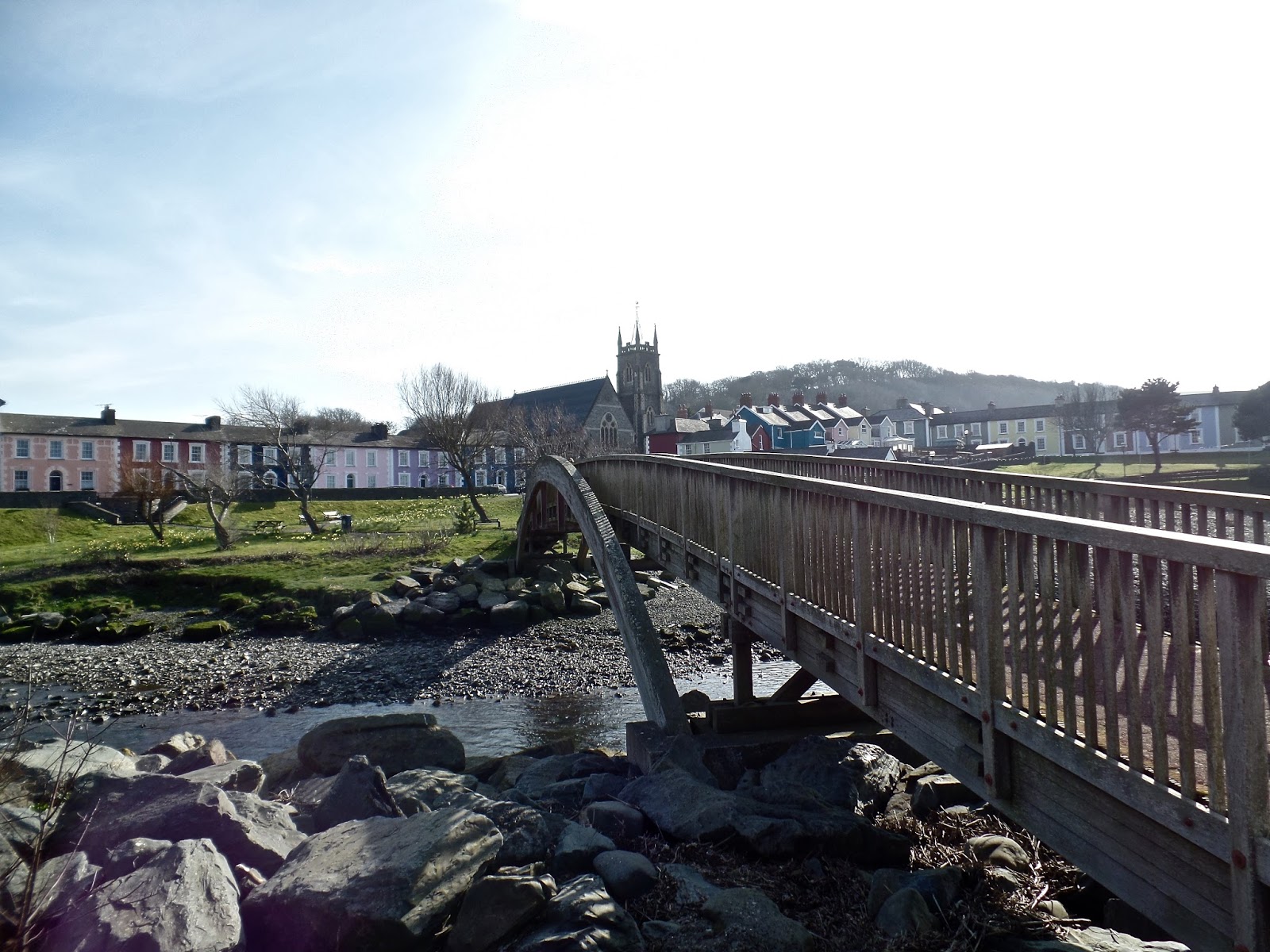
How you interpret that depends on your view of Englishness. To me it is good. Aberaeron is colorful and it has a handful of little shops, boutique restaurants and charming pubs. It is immediately likeable; it is the sort of place one might choose to take his parents were they to travel several thousand miles from another country. 


In contrast to its perceived Englishness, according to the ever-reliable Wikipedia, some 70 percent of the town's inhabitants speak Welsh. I suspect some fuzzy math there, however, because in walking around I didn't hear a single Welsh word being spoken.

Not that I cared, really. The sun was shining and it was warm enough for me to take my jacket off. I bought an ice cream and sat on a park bench overlooking the harbor and sent a text to my wife expressing my delight in having a freelancer's schedule. Far better to be doing this on a Tuesday afternoon than sitting in an office.

Aberaeron is home to the annual Cardigan Bay Seafood Festival in July, which might be worth returning for, but on a random weekday in March it was unsurprisingly quiet. Pretty, charming, but still not terribly noteworthy.

Once I had finished my ice cream I walked around town. Maybe I will come back with Jenn in the summer, I told myself. Aberaeron would be a nice place to spend the day –– eat some ice cream, go swimming in the sea. I guess it depends on how many other people have the same idea; the smallness of the town suggests it wouldn't be very enjoyable when crowded. And really, there are similar places –– in Pembrokeshire, for example –– that are easier to get to.

Either way, I suppose it was a good way to restart the GWTTA project. After walking around a little more and finding not much to pique my interest, I bundled up in my gear and sped home to Penarth. Next on the list: Aberdaron.


ADSENSE HERE

Electric motorcycles have arrived; Have we?

ADSENSE HERE

Not too long ago, I got a chance to spend a day tearing around on a Zero DSR. It was the first time I had ridden an electric motorcycle and I came away surprised at just how much fun an e-bike can be. 

When I returned home to the palatial Cope estate, I couldn't stop singing the bike's praises to my wife. My time with the DSR had convinced me that electric motorcycles are "there," I told her.

So often when motorcyclists discuss electric, we insist that the technology — specifically, the available range — hasn't arrived in terms of practical usability. But my own experience had shown that getting 120 miles from a full charge was entirely possible.In fact, that estimate may be a little conservative. Zero claims 147 miles of range, and I think that's realistic.

Either way, it really is "there" in terms of distance that the average American motorcyclist rides on any given day. Anecdotally, I'm thinking of the riders I grew up around in Texas and Minnesota. In my mother's hometown of Lake Jackson, Texas, there's a 4.5-mile stretch of road called Oyster Creek Drive that runs the width of the city. On nice evenings, dudes will get off work at the Dow plant, drive home, then hop on their Harley-Davidson Street Glides and Street Bobs. They'll rumble up and down the strip once or twice, stop for a beer downtown, and be home in time to watch the news.

At most, one of those dudes will clock up 20 miles in a night. On a Sunday afternoon, if it's not too hot, he might ride the 15 miles out to Surfside Beach, putting in roughly 50 miles that day with some back and forth. If he goes any further than that, though, he'll take his truck. The days when his mileage would truly exceed a Zero's current range are few and far between.


Within the world of motorcycling websites like The Motorcycle Obsession and RideApart, it may sound like I'm being insulting to those dudes. Because, after all, all of us are super-hardcore awesome riders, doing an Iron Butt a day in dirt while getting a knee down. That's certainly the impression people like to give in comments, at least. And people on the internet never lie.

But there's evidence to suggest that outside our interwebs fishbowl, the American motorcycling experience allies more closely to that of riders in Lake Jackson. According to the 2015 Powersports Business State of the Industry Webinar, the average American rides just 2,809 miles a year. That's 234 miles a month, or less than two full charges for a Zero DSR.

Meanwhile, over here on the other side of the Drumpf wall, the average UK rider manages roughly 7,500 miles annually. That's still not very much, and an electric motorcycle remains viable. Charge points are to be found in any number of places, including "services" (rest areas with gas stations and fast food), which are located every 20-40 miles on the motorway network. Some charge points are even free.

And, of course, all that overlooks the true purpose of most electric motorcycles: commuting. Easy to ride and almost totally maintenance-free, electrics are incredibly well-suited to urban/suburban use and equipped with a range that will meet most people's needs.

Many moons ago, when I was stuck living in Southern California, I had a daily commute of 40 miles each way from San Diego to Carlsbad. It was a painfully long drive. I listened to learning CDs in my car, and within a year had become fluent in Welsh (which is more or less how I ended up moving here). That 80 miles a day is within a Zero's ability, though –– even ignoring the possibility of plugging in the bike while at work.


"It's silly that more people aren't riding electric," I told my wife. "It just makes so much sense. A bike like that, you just get on and go. It's easy; you're more aware of your surroundings. It's such a great experience and it really is do-able in terms of range."

"You should get one," she said. "You could trade in your Suzuki."

"Ah... uh... oh... well, you know, it's not really..." I stammered. "I mean, the way I use a bike, that's different. There are times when I have to cover a lot of distance and..."

"You just said it would be possible to get up to Scotland in a day," she said, her voice now picking up the West Country lilt she uses when shooting holes in my arguments.

"I did, yes," I huffed. "It would be a long day, though, and would require some judicious planning."

"You're not capable of planning?"

"No. I mean, yes. I am. I could. But it's not a bike that fits my lifestyle. My motorcycle use, as a moto-journalist, is different. An electric bike wouldn't really work for me."

"Hmm," she said. "It sounds like you're saying everyone else should be doing something, but you don't want to give up your rumbly toy."

I still think my particular case is unique. A motorcycle is my only means of transportation and there are times when I have to travel pretty far for professional purposes. To test ride the Zero DSR, for instance, I had to ride 120 miles to Birmingham; that's a 240-mile day. Last week I had to travel to Peterborough, England, for a meeting –– some 400 miles round trip. But I do think my wife may have stumbled upon something. Perhaps the biggest obstacle for electric motorcycles isn't range or cost, but motorcyclists' unwillingness to change.


Thinking about this, I started to look at many people's arguments against electric and I was struck by their similarity to the arguments people give for not riding at all.

No doubt you've been in that situation where you mention riding to a friend or coworker, who suddenly gets a dreamy look in his or her eyes and says something like: "Yeah, I've always wanted to get a motorcycle."

To which the obvious answer is: "Well, why don't you?"

Unless you're being wheeled around a care home it's not too late to start riding.

But rather than concede to this impeccable logic the person will offer a profusion of excuses. Excuses that mask his or her true reason for not riding: he or she can't be bothered to learn how to do something different.

Essentially, that's what those who refuse to consider e-bikes are doing. They're muddying the water with a thousand excuses, trying to hide the simple fact that, golly, they just don't want to ride electric. Motorcycling is an activity that requires certain concessions of inconvenience, but they're unwilling to make these particular concessions.

I guess I shouldn't say "they." It's more appropriate to say "we." Because my wife is right – although I'm happy to take the high ground of telling people they should help save Earth by riding electric, my actions say I'm unwilling to join them.


I make my excuses about range and cost (moto-journalism isn't the most lucrative career), but quietly I know that if I didn't personally have those obstacles I still probably wouldn't be buying electric.

Probably. Maybe I would. It's a lot of fun, after all. I don't know. The fact is, although I think electric motorcycles are "there," I'm not entirely sure that I am.
ADSENSE HERE

Please let this be true: Production version of Victory's Project 156 may still happen

ADSENSE HERE

There are fresh rumors that a road version of Victory's Project 156 bike is in the works and may arrive as soon as this year. And no, I don't mean another cruiser.

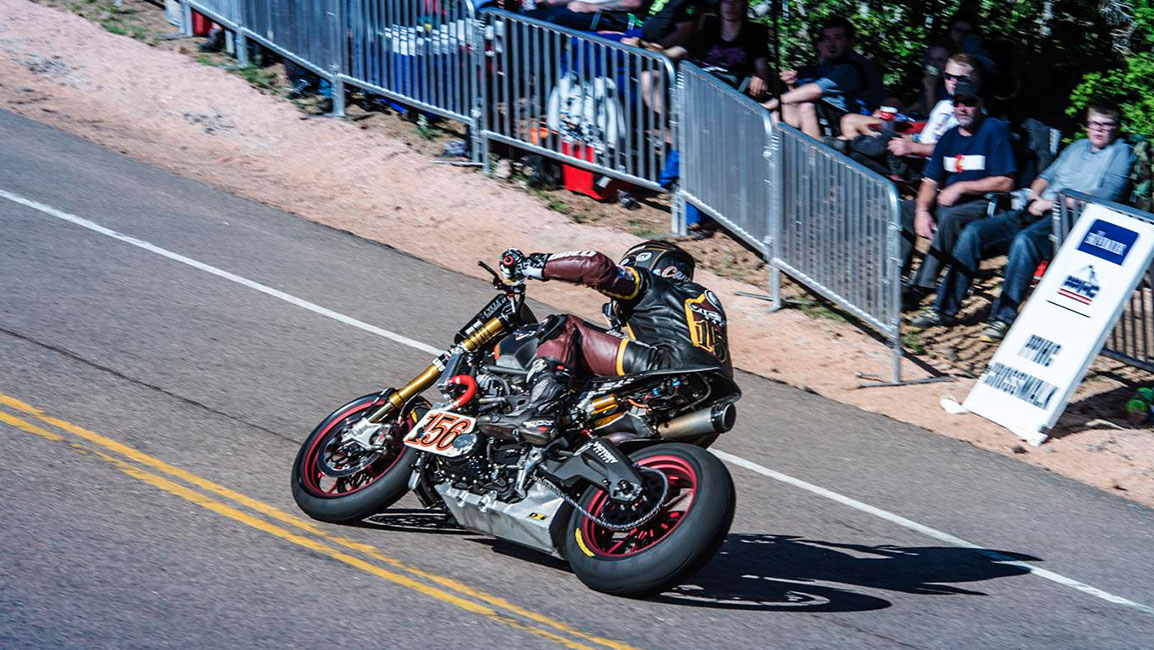
Project 156, of course, was the name for Victory's effort last year to conquer the Pike's Peak International Hill Climb. Powered by a rip-snorting prototype 1200cc liquid-cooled V-twin engine, the naked race bike was designed in part by Roland Sands and ridden by Cycle World editor Don Canet. Although the Project 156 attempt was ultimately unsuccessful, the bike Victory produced for the event drew a great deal of attention and raised many motorcyclists' hopes that a production version would soon become available.

Those hopes were raised even further in the weeks leading up to last month's unveiling of the Victory Octane, a 103 hp cruiser that some felt didn't quite live up to the Project 156 ethos. Many expressed disappointment that Victory had not delivered a model more faithful to the original Pike's Peak bike.

But now British motorcycling newspaper MCN is suggesting motorcyclists should not yet give up on the idea of a super naked from Victory. The paper claims a Polaris insider has told it: "The intention is still to create a production bike with similar levels of performance and looks for the road in the near future."

MCN says this bike "could be revealed later this year." The paper bolsters its claim by pointing out that Victory will again be racing at Pike's Peak this year. And, indeed, a quick glance at this year's competitor list shows Victory will actually be running two bikes up the notoriously difficult mountain course.


Don Canet will be back, this time astride a prototype electric motorcycle. And a 2016 version of Project 156 will be ridden by 2014 Pike's Peak Open Class winner Jeremy Toye, indicating that Victory are very serious about taking the prize this year.

Not surprisingly, Victory is saying nothing about all this. The company's standard response to any questions about what may or may not be in the works has always been: "We don't ever talk about future products."

And in this case, you can't blame Victory for keeping tight-lipped. An over-enthusiastic PR campaign for the Octane left some motorcyclists upset and may have convinced Victory that it's better to take a "less is more" approach when it comes to unveiling new models.

However, when I spoke last year to Victory/Indian external relations manager Robert Pandya about that year's Project 156 bike he did say: "Obviously we're doing this for a reason."

He also offered some hope to motorcyclists pining for an American bike that isn't a cruiser by pointing out that Victory was aware of the desire for such a thing.

"Certainly there's been interest from our existing customers" he said. "And our desire is to draw in new customers in different categories. We've got different venues we can play in, in terms of the overall opportunity on market. There are spaces where American bikes are not currently present, and maybe there's an opportunity for us."


That's an observation that feeds into a statement made earlier this month by Polaris President of Motorcycles Steve Menneto regarding the future of Victory and Indian. He told Minnesota's Star Tribune: "We project that [sales] volume will increase [and] we will double our market share over the next three years."

At present in the United States, roughly 50 percent of all street motorcycles larger than 600cc are sold by Harley-Davidson. It could be that Polaris has enough faith in the Indian brand that it thinks it can double its market share simply by cutting into Harley's piece of the pie.

Or, it may be eager to expand into other segments of the motorcycle market. Perhaps to naked motorcycles, which is the second most popular segment in the United States. And if that were the case, Victory has certainly made no secret of the fact that its aim is to focus on performance, cutting a distinct path away from the more traditional world of Indian. 

But all of these "what-ifs," "maybes" and "should-bes" are the sorts of things that led so many people to being underwhelmed by the Octane. So, personally, I'm a little skeptical of these new rumors. To build a road version of the Project 156 bike seems like too great a leap.

Victory has always been a forward-thinking company, blessed with engineers and designers capable of dreaming up ideas that are decades before their time. But it has also been pretty gun-shy when it comes to implementing those ideas.

If Victory wanted to fulfil riders' daydreams of a Project 156 bike for the masses, it obviously wouldn't be as simple as slapping an Octane engine into an upright chassis (which in itself isn't exactly "simple"). Riders would expect power north of 120 hp, as well as the bells and whistles found on many other super nakeds: ABS, traction control, rider modes, and so on. This bike would need to be at least as good as a Suzuki GSX-S1000, with many wishing it to be on par with a KTM 1290 Super Duke. That's a pretty tall order, and it's a hell of a lot to have to get right on your first try. It would, as I say, be a massive leap.


However, that doesn't mean I'm not eagerly looking forward to my first glimpse of the 2016 Project 156 bike. The look of that motorcycle may say a lot about whether production bike rumors are true. When building last year's bike, Roland Sands and his team were squeezed for time, so they used the swingarm and suspension of a Ducati 899 Panigale. Since Victory will presumably have had more time to prepare for this year's event it will be interesting to see if the chassis now has a more original "in house" look.

If it does, that may hint at production intentions. Or it may not. I guess we'll have to wait and see.

(Originally published on RideApart)
ADSENSE HERE

Ride Review: 2014 Triumph Tiger 800

ADSENSE HERE

I mentioned recently that my Suzuki V-Strom 1000 has been in the shop as a result of a recall issue. It is still in the shop. Apparently there is a backlog in getting parts out to dealerships and I won't see my bike again until the end of the month.

I would be a lot angrier about all this if it weren't for the fact Fowlers of Bristol gave me a Triumph Tiger 800 to use in the meantime. Different from the current XR/XC model, this is the Tiger 800 that served as something of an economy model from 2010-2015. That is to say, it was less expensive and a little lower spec than the Tiger 800 XC that existed during the same time period.

And certainly there are aspects of the Tiger 800 that give it the feeling of being built to a budget (e.g., suspension). But, overall, this 799cc motorcycle is a lot more fun and thrilling than I would have imagined. My experience with its successor, the Tiger 800 XRx, had been so negative it plummeted my opinion of the entire Triumph brand. This bike, and the hundreds of miles of fun I've put on it, have gone a long way to restoring the British brand's name in my eyes.

Engine

Claiming 94 hp, the Tiger 800's star feature is its springy, powerband-tastic inline triple, which impels you to exceed the speed limit with license-threatening ease. You'll need a whole lot of straight and a healthy tailwind to push the machine past 110 mph, but getting up to 80 comes with relative ease. And staying there is effortless and surprisingly smooth –– no inline four buzzing, no V-twin thrumming.

Unfortunately, 80 mph is not the legal speed limit on motorways in Her Majesty's United Kingdom of Great Britain and Northern Ireland. At legal speeds (70 mph), with the Tiger 800's hard-to-read tachometer hovering near 5,000 rpm, there is a kind of lurching/straining that makes you think you're in too low a gear.

It's not awful, nor is the sensation distracting enough to put you off tackling long stretches of super slab, but there's no doubt the Tiger 800 shines more brightly on country roads. Especially if those roads have curves. Moving up and down the gears is easy enough once the bike warms a little, though the transmission can be a little clunky at the start of a ride. Finding neutral is a challenge in either case.


Throttle response is smooth and makes you wistful for the days before ride-by-wire, while power delivery kicks in strong just below 4,000 rpm. It makes for a happy situation in corners, allowing for confidence in terms of throttle control. And shooting out of those corners gives the sensation of being propelled forward by a giant rubber band. It is a lot of fun, and revving is rewarded with a sharp bark of an exhaust note.

Ridden hard, the Tiger 800 starts to wheeze far sooner than I'd like, but within the boundaries of the law it is fine. And it's probably best to keep it there, since the bike's basic suspension setup discourages aggressive riding.

Ride quality and brakes

Equipped with road tires, the Tiger 800 is designed to never stray from pavement despite its offroad styling. A lot of moto-journalists like to complain about that sort of thing, but I have no problem with it. It makes for a bike that is comfortable and steady on real-world roads.

Though, in the British real world of roads that are repaired only once a century or so, I'd probably like the Tiger 800's suspension to be a little less stiff. Especially since that stiffness doesn't help as much as you'd think in corners. In the bumpy stuff of Wales I found the bike becoming unsettled amid spirited riding, and I was occasionally thrown off my line as a result. I never felt able to trust the bike enough to push as hard as I wanted through a bend.

I can't help but wonder if things wouldn't have been better if Triumph had not decided to equip the Tiger 800 with a 19-inch front tire. Perhaps handling would be more assured if the company had embraced the bike's road-only nature and done as Kawasaki has with its Versys, equipping it with a 17-inch front.

Again, though, the overall feeling of the bike is good. Perhaps it is simply a victim of its own success: the ride quality is so good you're convinced it is capable of being better.

Meanwhile, the dual front discs and single rear disc are a tad soft in an emergency stop, but perfectly fine when riding within the limitations set by other aspects of the bike. The Triumph's standard antilock braking system is unobtrusive enough  that I had to really work to set it off.


I can't find any weight figures for the pre-2015 Tiger 800, but it is noticeably lighter than my 'Strom, making it a hell of a lot easier to muscle around in my garden area. It is not as well-balanced, however, so feet do come down occasionally when crawling around parking lots, and U-turns sometimes run wide.

It is steady enough, though, to make filtering through traffic a simple task –– aided by the overall lightness of the bike and the fact its handlebars are relatively narrow compared to other adventure-styled motorcycles.

Electronics

ABS is the only bit of techno wizardry to be found on the Tiger 800. No riding modes or traction control. No slipper or assisted clutch. By and large, these things are not missed too badly. Though, there were a few instances where traction control would have been helpful.

As mentioned, the ABS is a pretty basic and most riders will never manage to set it off.

Comfort and features

Seat height on the Tiger 800 is a non-adjustable 810mm (31.8 in). That creates a situation that's just a little bit cramped for my long legs, but knee soreness only ever set in after more than 230 continuous miles. The seat itself is plenty comfortable, with enough room to shift around a little over long distances. The passenger seat, too, is comfortable and large enough to accommodate a normal-sized human being (something that can be rare with motorcycle passenger space).

The windscreen is far too small for my liking, both in height and width. My arms, some of my torso, and most of my helmet were left to the elements, so long hauls were a literal pain in the neck. If I owned a Tiger 800, my very first modification would be the addition of a Givi AirFlow windscreen.

I'd also add handguards and heated grips, two features that do not come standard. With these additions, the bike could serve as a decent long-distance machine for someone a little shorter than myself. Though, you may want to avoid particularly toasty locales because the engine puts out a surprising amount of heat on the right side. Even at 80 mph I could feel warmth on my shin.


The Tiger 800's dashboard is impossible to figure out without an owners manual (I didn't have one) and defaults to a display that shows only the estimated number of miles left until empty. An odometer is visible only at startup. I hated this aspect of the bike, especially because the fuel gauge wasn't terribly accurate.

Riding along the motorway one day, I spotted a sign telling me the next fuel stop was 9 miles away. According to the Tiger 800's fuel gauge at that point, I had enough dino juice to go another 50 miles. But when I reached the fuel stop, the gauge was indicating just 12 miles of range.

Another complaint is the absence of hazard lights. That's a tiny qualm, perhaps, but British traffic can sometimes come to a very immediate stop, and hazard lights allow me to communicate more effectively to the vehicles behind me. It seems an odd omission on a bike that has features like a gear indicator and fuel gauge.

The mirrors are decent, though inclined to move. Headlights deliver a decently bright, though not as brilliant as I would have expected considering there are two.

Practicality

There's no doubt the Tiger 800 is a solid all-rounder. It filters well through city traffic and is steady on the motorway. It's all-day comfortable while being delightful (within its limits) on twisty roads. I'm a big fan of do-all motorcycles because I don't have the funds to own more than one. My experience with this Tiger 800 has been generally positive enough that I would be willing to give its successor, the Tiger 800 XR, another chance.

Absence of a center stand makes cleaning and oiling the chain an utter pain, though. Which is frustrating in light of other features that show someone at Triumph was really thinking when they designed this bike. Replacing the headlight bulbs, for example, could not be easier. And angled valve stems aid in making sure it's easy to maintain correct tire pressure.

As my pictures show, there are plenty of bits to hook a bungee cord to, and a small luggage rack comes standard.

Fuel economy is decent. Exactly how decent is hard to say due to the fact the fuel gauge is unreliable and the dash doesn't show an odometer when riding. But I was able to travel 200 miles on a single tank at one point.


Build quality

Looking closely at this bike, I think it's fair to say that in the 6,000 miles that had been racked up before it came into my possession, the bike had never been washed, the chain had never been cleaned, and the oil had never been changed. It's a loaner bike and Fowlers and Fowlers customers haven't been exactly loving.

I put roughly 1,000 miles on the bike during its month in my possession, attempting to clean and oil the chain out of sympathy but otherwise putting no effort into its maintenance or care.

In light of all that abuse, I'd say the build quality of the Tiger 800 is really, really good. The header pipes were showing rust but everything else looked and functioned as you would expect. The bike started every time and ran well.

Verdict

I realize beauty is in the eye of the beholder, but I'm simply not able to get over just how ugly the Tiger 800 is. Up close, examining every little feature, things only get worse. It is, hands down, the most aesthetically unpleasant motorcycle I have ever encountered.

That's a shame because it is otherwise a very good bike. Durable, reliable and fun, it is a far better motorcycle than I had expected. With the addition of some basic aftermarket parts it could easily serve as all the motorcycle you'd ever need.

The Three Questions:

1) Does it fit my current needs/lifestyle?
Yes. The Tiger 800 fits into the exact same class as the Suzuki V-Strom 1000. It's a do-all, go-everywhere bike and it fits easily in my shed.

2) Does it put a grin on my face?
Yes. I had a lot of fun during my time with the Tiger 800 and really enjoyed the opportunity to rip it all over Wales and Southern England. The springing nature of its power delivery was particularly enjoyable.

3) Is it better than my current bike?
No. Despite my deep frustration at Suzuki for the situation that led to my having the Tiger 800, I still prefer my 'Strom. My bike doesn't wheeze at high speed, its suspension is far better, its brakes are better, the dashboard is more useful, it's more comfortable, it's better balanced, and it's better set up to tackle long distances. Additionally, it has traction control and a slipper clutch. Beyond that, though, there are certain aspects that I've simply come to prefer. I think it looks better. I like the V-twin feel and the stronger engine braking that entails. I like the snappier throttle response. And I prefer the snarl it makes under acceleration.
ADSENSE HERE

Proclaiming My Wrongness

ADSENSE HERE
A few months ago, I wrote an article in response to the acquisition of EBR by a company known as Liquid Asset Partners, which describes itself on its website as specializing in "turning your underperforming assets into cash."

In that article I stated quite assuredly that Erik Buell's eponymous sportbike company was finally, truly dead.

"Let's be honest with ourselves," I wrote. "It's over. The final chapter has been written. EBR is no more, and nevermore shall be."

I had a handful of people take issue with me on that claim, calling me a hater who something something America something something engineering genius something something. I would soon be eating my words, I was assured, and EBR would rise again.

So confident was I, however, that I chose to double down on my claim, stating for all the interwebs to see: "I will be the first to cheer if I am ever proven wrong. I will loudly and happily proclaim my wrongness. I'll write... about what a cynical dummy head I've been. But I really don't think I'll get a chance to do that."

Of course, you know what happened next. Earlier this month, EBR announced that it is, indeed, back again. Liquid Asset Partners, despite its name, has apparently chosen not to liquidate all of EBR's assets but instead develop a "multi-year plan, and a 5- to 10-year vision" to put EBR back in the game. Production restarted on March 1st and the first bikes were expected to roll off the assembly line on St. Patrick's Day.


The company even invited the general public to celebrate at its East Troy, Wisconsin, factory on 18 March. 

All of which means I appear to have been wrong. A company that is 100% dead doesn't assemble bikes and offer free hot dogs. I guess I was being a cynical dummyhead, swimming the wrong way in a pool full of wrong juice while wearing my wrong pants.

So, here I am happily proclaiming my wrongness. Buell is back, baby, and everything is great. Nothing to worry about at all.

And yet...

I do wonder what's going to happen after this initial wave of bikes is gone. In an interview with the Milwaukee Journal Sentinel in July 2015, Erik Buell said that in the wake of EBR's collapse it had bikes "just sitting there, covered in plastic, waiting to be finished."

One assumes the bikes coming off the line now are those same bikes that have been sitting on the shelf for roughly a year — bikes that are no different than when introduced in 2014.

Whereas two years is practically nothing in the pace of change adopted by most American motorcycle companies, it's a decent stretch in EBR's chosen field of sport/performance bikes. Two years ago, the 1190RX was almost as good as the Ducati Panigale 1199, according to many moto-journalists. But now the Panigale is a 1299 and the 1190RX lacks the ABS and Euro4 compliance needed for it to even be legal in the European market, where the largest concentration of sportbike riders is found.


However, even in Europe, the popularity of sportbikes has plummeted in recent years. Wherever EBR sets up shop (it's still trying to put together a dealer network) it will be selling an outdated product to an ever-shrinking crowd.

And once the current stock of bikes runs out, once those bikes from 2014 are sold off at firesale prices to sentimental patriots, what then? What happens when EBR has to make truly new motorcycles? Does it have the equipment, the resources?

Maybe it does. Maybe the promised 1190AX adventure sport model was close to being ready when EBR collapsed a year ago and can get off the ground quickly. Maybe the company didn't lose that model in the split with Hero Motor Corp. Maybe it has the supply network and wherewithal to produce that bike and seize upon the current adventure-sport craze. Maybe the 1190AX is good enough to compete. And maybe the 1190RX and 1190SX will be updated, as well, to put them more on par with their competition. Maybe dealers and consumers will get fully behind EBR despite previous stumbles. 

Maybe. Maybe. But that sure is a lot of maybes. And I just don't see it happening.

Liquid Asset Partners has said EBR has "financial stability," but in the same breath expresses an interest in "new partnerships or investment." It's entirely possible that I don't understand the business side of motorcycling well enough, but that doesn't sound like a company on solid ground.

I find it so difficult to be anything other than cynical when I consider the future of EBR. But that wasn't the deal two months ago. I can't move the goalposts. I didn't say I'd proclaim my wrongness as soon as EBR delivered new, desirable models and turned a profit. I simply said I would apologize if I was wrong about EBR being dead.

And it's not dead, so, again, I was wrong. Wrong, wrong, wrong. Wrongity Wrongman from Wrongtown. 

My apologies.

(Originally published on RideApart)
ADSENSE HERE
 

Advertisiment